 mcc
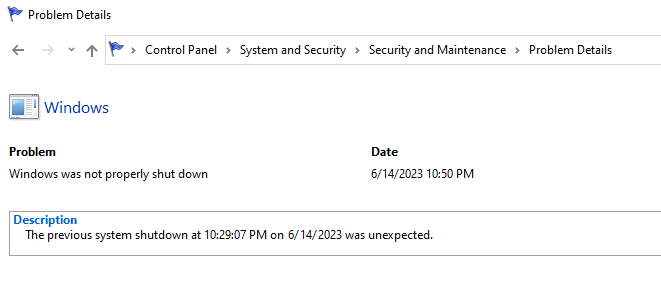
mccComputer just switched off at random, for the second time today. This time, it happened simultaneous with a power flux event (the air conditioner halting).
Maybe I need a UPS. :(
Computer just switched off at random, for the second time today. This time, it happened simultaneous with a power flux event (the air conditioner halting).
Maybe I need a UPS. :(
Ha ha heehhhh after several days of no problems my computer just shut off at random while I was sitting at it using it, and then less than five minutes later, did it again. Is there a way to get Windows to tell me, after a restart, why the hell it just restarted
Like I understand it might not know why it shuts down but surely if it restarts there's somewhere a record of why
It's happening now at times it wasn't happening before
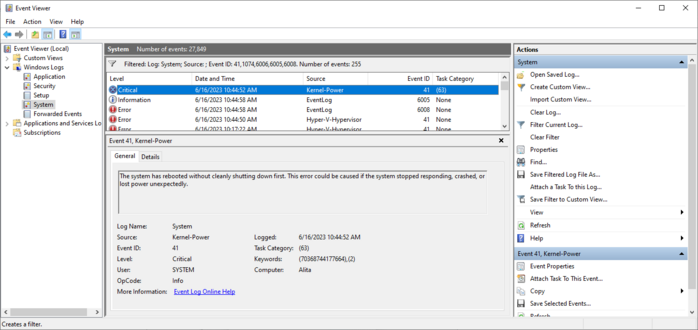
I eventually learned to get the data from the "real" event viewer instead of the fisher price baby and this is all it says.
Two references to "Power". I don't know if that means the problem is with the power, or if that's Windows' way of saying "I don't know?".
I did get a core temp log when the computer died last night. The CPU temperature was not high at all at the moment of the reset.
Every time I buy an Apple computer I eventually have to replace it even though it works and I don't want to replace it, because of planned obsolescence, and every time I buy a non-Apple computer it eventually just breaks
The scariest possible thing that could happen in the next few months is I buy a new mac because Apple forces you to buy a mac to develop for the Vision, then my Windows machine craps out totally and I'm having to use a Macintosh as my daily driver
Okay so everyone has convinced me that probably the problem is my PSU, the computer is power spiking & triggering safeties
My friends who Know Computers say it's important to check review sites like tomshardware or cultist.network & pick a high rated PSU
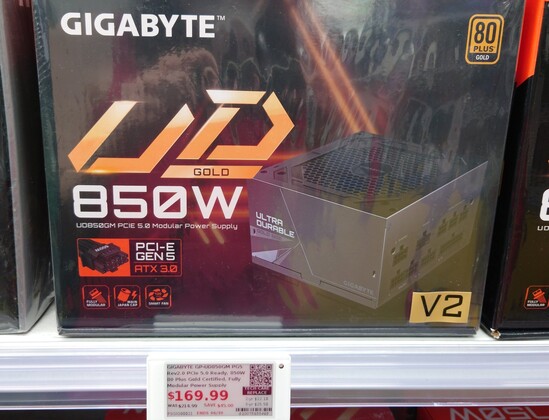
My current is a ThermalTake GF1 750W gold, the store by me only had a Gigabyte for 850W replacements
Trying to decide whether to buy that, go to Amazon & wait, or contact ThermalTake to replace the old one
In the meantime I'm stuck in Linux
Like the ThermalTake has worked fine for just under two years, nothing obviously changed before the problems started except I swapped my SATA drive for a m.2 one on the motherboard, and that was like a week or two before, then boom problems
So maybe the ThermalTake isn't overloaded, just going bad?
@mcc Oh, and as for what I had connected to RM650x:
GTX1070, 1TB SATA SSD, 4x 8TB SATA disks inside a hotplug cage, ARC-1212 RAID controller; originally I had Asus Z9PA-U8 motherboard, Xeon E5-1620 CPU, 4x8GB DDR3 registered RAM and a PCIe USB3 controller; later I changed to Asus Pro WS X570-ACE motherboard, Ryzen 5900X CPU and 2x 32GB DDR4 ECC RAM.
BTW, check the warranty for your Thermaltake – at least Corsair has either 5 or 10-year warranty (not sure which), while Seasonic claims 12-year warranty.
@jernej__s The Thermaltake (it was a GF1 not a GF3) has a 10 year warranty. I will be exploring this. But if I have to mail them the PSU I like… I have to use my computer in the meantime.
The store near me had Corsairs but none with ATX3 which I believe I need for my video card.
 Jernej Simončič �