Any day now, the Supreme Court will decide whether to strike down the Indian Child Welfare Act.

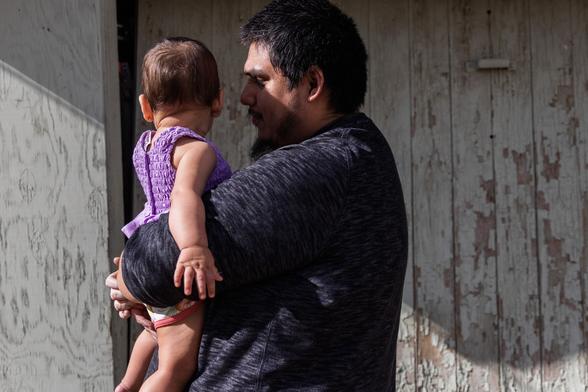
Today, we’ve got the story of a young Native American mother in #SouthDakota and how #ICWA held her family together.

But it was a long, painful fight 🧵https://www.propublica.org/article/native-american-parental-rights-termination-icwa-scotus?utm_medium=social&utm_source=mastodon&utm_campaign=mastodon-post

Native American Families Are Being Broken Up in Spite of a Law Meant to Keep Children With Their Parents

After fighting to win back her parental rights, a young Native American mother prevailed. Then the state came for her second child.

ProPublica
In 2020, a judge terminated Cheyenne Hinojosa's parental rights — the end of the line for parents with a child welfare case against them. It meant that legally she was no longer her daughter's mother. It was a "nightmare," she said.

Then something rare happened.

The South Dakota Supreme Court reversed the termination & restored Cheyenne’s parental rights. It ruled that the child welfare agency and judge violated ICWA, a powerful federal law meant to protect Native American families.

Opinion here: https://ujs.sd.gov/uploads/sc/opinions/294469946d91.pdf

The case against Cheyenne started with allegations of marijuana use and leaving her daughter unsupervised. She took parenting classes and substance abuse counseling. At her hearing, her counselors believed that she'd been sober 12 months.

The judge terminated her rights anyway.

The justices gave her credit for her progress and wrote that there were “glaring defects involving ICWA.” Under the law, child welfare needed to make “active efforts” to reunite Cheyenne and her daughter. But they cut off all services 9 mos. before the court terminated her rights.
The South Dakota Department of Social Services declined interview requests and did not respond to a detailed list of ProPublica’s questions about Cheyenne’s case.

Another federal law was at play: the Adoption and Safe Families Act, which incentivizes speedy decisions by child welfare. States must terminate parental rights 15 mos. after a child enters state custody.

My colleagues wrote this excellent piece about ASFA’s influence: https://www.propublica.org/article/six-months-or-less-parents-lose-kids-forever

The “Death Penalty” of Child Welfare: In Six Months or Less, Some Parents Lose Their Kids Forever

Twenty-five years ago, Congress passed a law aimed at speeding up adoptions of children languishing in foster care. In the process, it destroyed hundreds of thousands of families through the termination of parental rights.

ProPublica
In many ways, the goals of ASFA & ICWA are opposed. ASFA starts a ticking clock on cases, while ICWA asks states to go the extra mile for Native American families. In SD, child welfare workers are not supposed to prioritize the ASFA timeline over ICWA’s protections, but there seems to be confusion.

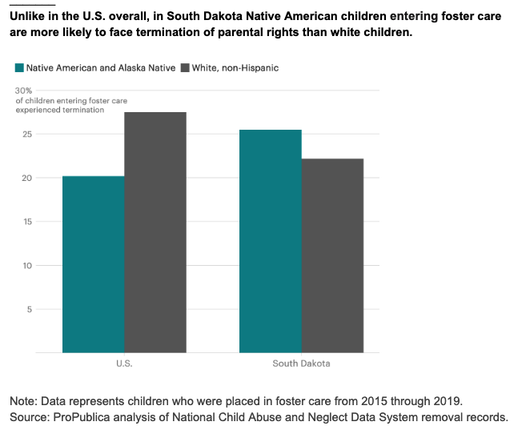
Our analysis found that, nationally, children identified as Native American were less likely to be taken permanently from their parents than white children once they have entered the system.

But in South Dakota, the reverse was true.

In Cheyenne’s case, the state agency stopped her services and requested a termination of her rights at 15 months. That decision failed to honor ICWA, the state supreme court ruled, which has no timeline. They ordered the state to give Cheyenne her rights back and resume visitation.

But then things got even weirder. A month after her rights were restored, Cheyenne found out she was pregnant.

The day after her second daughter was born, child welfare told her they were coming to take custody at the hospital.

Cheyenne said she "felt the soul leave my body."

In the case files, a child protective services worker wrote that their justification for taking the newborn was based entirely on her older sister’s case. It made no mention of the fact that Cheyenne's parental rights had been restored, instead saying she made "little progress."
I think Cheyenne’s story shows that even though #ICWA is 45 years old, the issues it was written to address are still alive and well in our system. There's a lot of concern among tribes & child welfare experts over what will happen if #SCOTUS strikes ICWA down.
The case currently before SCOTUS is about adoption, whether it is unconstitutional to give preference to placing Native American kids in Native homes. But if the court tears ICWA down, the protections that saved Cheyenne from losing her parental rights will go out the window, too.
Native American Families Are Being Broken Up in Spite of a Law Meant to Keep Children With Their Parents

After fighting to win back her parental rights, a young Native American mother prevailed. Then the state came for her second child.

ProPublica

Wow, did I say any day now? I should have said any minute. The U.S. Supreme Court has upheld the Indian Child Welfare Act by 7-2. Cheyenne's story shows how important #ICWA is, but also the ways in which it is misunderstood, unevenly applied and violated even today.

Here is the decision in Haaland v. Brackeen: https://www.supremecourt.gov/opinions/22pdf/21-376_7l48.pdf

@lussenpop That's great news, but it makes me nervous that we depend on a group of unaccountable, mostly old, mostly white, mostly men to decide what rights we have.