
In my extended social circles, people often cite Dave Sirlin's "Playing to Win" on how one should play games citing the "scrub" chapter to justify any behavior allowed by the rules.

Sirlin's argument is that by having some concept of what's ok and what's "cheap", one becomes a scrub who sucks at the game. This didn't seem right at the time, and the more I've played games the less right it seems. In many games, the top players avoid "cheapness" and people who do "cheap moves" are generally bad.
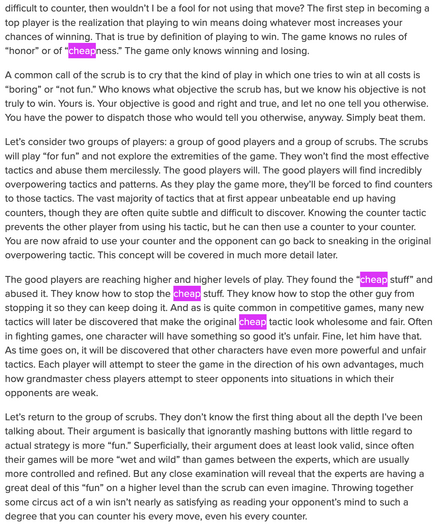

For example, in online dominion, at low levels, a lot of people will deny undos for misclicks, even if you've accepted an undo for them.

Top players basically never do that. Sirlin says only scrubs wouldn't do this "cheap" move but, in fact, only scrubs do this "cheap" move and this is true across many games.

When I played games competitively at the highest level, killing someone because they're afk or have a tech issue was analogous. Top players were much less likely to do that than scrubs.

Sirlin might argue that fighting games are different but there are still plenty of moves that aren't banned in-game that people don't do because they're "cheap" (that Sirlin himself never did), e.g., blocking your opponent's vision, nose plugs plus smearing yourself with feces or https://www.sigmaaldrich.com/CA/en/product/sial/p3929, ear plugs plus airhorn, flashbang, etc.

I suspect Sirlin would say "that doesn't count because that's different", but no such different thing can exist if you read Sirlin as written.

There's this fantasy a lot of techies and gamers have, that we can define a relatively simple set of concrete rules that demarcate all legal behaviors, removing the need for human judgment.

Every time someone's tried to do this for a non-trivial system, either the system is held together by the honor system or the system has failed, e.g., the "code is law" crypto folks using out-of-band mechanisms to roll back legal transactions that subverted the intent of the creators.

@danluu This is true in rules for communities as well.
After decades of experience, I've decided the best social rule set is "Be Nice, Or Else" with an included list of explicit bad behaviors. This also requires putting in time educating new community members about acceptable behavior.

There's always a way around explicit rules.

(Source, I started the #haskell IRC channel in ~2001 and moderated the #python IRC channel for several years)

@danluu Turns out, you need a form of SREs for policy and business matters, not just code-y code.

@danluu đź’Ż there's this great talk about how our laws have also increasingly moved in this direction, to society's detriment - https://www.ted.com/talks/philip_k_howard_four_ways_to_fix_a_broken_legal_system?language=en

And his book "the rule of nobody"

We're so afraid of people making bad judgements that we keep trying to craft laws to prevent that. Which often results in with complicated laws with outcomes that don't really serve anyone.

Philip K. Howard: Four ways to fix a broken legal system

TED
@danluu This is completely anecdotal, but I’ve come across a fair amount of libertarian-leaning individuals in tech, more so than in my other social circles. I wonder if this plays hand-in-hand with your observation here of techies preferring a “simple set of concrete rules.”
@danluu That's what I've been trying to explore with https://novehiclesinthepark.com

@danluu

Shades of “rules as code” and the automation of regulatory processes!

@danluu in case you didn’t know: there’s a whole literature around this in law, showing why it’s essentially impossible — “incomplete contracts”. Especially in the heyday of “smart” contracts it was maddening to see that body of work just… ignored.

I assume someone has done the work to explain it to programmers in computing terms (it is in some ways sort of the inverse of a halting problem) but I haven’t looked for it.

@luis_in_brief @danluu something something incompleteness theorem?