 A.R. Moxon, Verified Duck 🦆
THE DIE-ERS
Some years ago, when the White Christian President was still the President of the United States, he caught Covid, and he said a perfect thing.
THE DIE-ERS
Some years ago, when the White Christian President was still the President of the United States, he caught Covid, and he said a perfect thing.
What I mean by “a perfect thing” is that it perfectly encapsulates the supremacist worldview he represents and embodies so diligently and so well on behalf of people who deem themselves “christian” and “white,” which is what makes him the White Christian President.
The perfection makes it the thing he said that haunts me the most, even though it is by no means the most obviously disgusting or blatantly ignorant of the thousands and thousands of disgusting and/or ignorant things he has said.
The possibility of his demise was what he was considering when he said the perfect thing.
“I could be one of the diers,” he said.
One of the diers.
The diers. You know: people who die. One of *them.*
I think about this all the time.
You might be wondering what it is about this that bothers me so much.
I wonder that, too.
This is part 3 of a thing.
The previous 2 parts contemplated a dominant cultural narrative that makes sense only if you understand that it considers certain people to not be people.
Both parts discovered the assumptions behind that narrative, by tracing the currents of American fear, and examining who is licensed to feel fear, and who is only permitted to be the cause of fear.
I think the word for that dominant cultural narrative is "supremacy."
Supremacy is a belief system that rests on what I’ve called foundational lies: the lie of separation, which insists that we bear no relation to one another; the lie of scarcity, which insists that life must be earned; and the lie of redemptive violence, which insists that those who have not earned life owe a debt to those who have earned life that is best paid with violence and hard use.
When the topic is supremacy, I’ve found that it’s both easy and difficult to figure out how to start. “Easy” because it’s so prevalent, you can really start anywhere. “Difficult” for the exact same reason: where do we start?
Frequently I’ll start with a number of seemingly disconnected threads, and play each of them out before I give them all a tug, at which point hopefully a marionette that you as reader hadn’t even noticed yet starts to dance.
I think this time I’ll just cut to the dance.
It’s something you can really only believe if you’ve already convinced yourself that people who suffer and die aren’t actually people.
That’s the wrinkle I want to think about today: the idea that the people who die deserve to die *because* they died. The idea that the fact of suffering is enough all by itself to prove that suffering is deserved.
It’s something it seems to me you have to believe, if you believe that you live in the greatest nation on earth, the most perfect system ever created, exceptional among all other nations throughout history, and therefore incapable of improvement, and yet your nation also has people who suffer terribly within it.
If there is suffering in a perfect system, somebody has to be to blame.
If the system is perfect, the blame must be laid on those who suffer most.
And, because it’s something that people who suffer are doing to everyone else as an aggressive act, the act of suffering itself becomes a threat—so much so that people who suffer stop being understood as people and start being understood as threats.
And threats make people scared.
And fear of harm justifies a harmful response.
And a harmful response causes more suffering—which is also the fault of the sufferer.
This dominant cultural belief only works if the people who suffer and die are not deemed to be under any kind of threat, even as they suffer and die, and are not given social license to feel fear, even though they clearly are in the most danger—which means that it only works if people who suffer and die, as a general category, aren’t seen as people at all.
How dominant, you might ask, is this cultural belief?
It feels like this essay will be sort of like a fish trying to explain the concept of wetness.
Pretty dominant, in other words.
We could use a Public Service Announcement. A PSA.
Luckily, we have one.
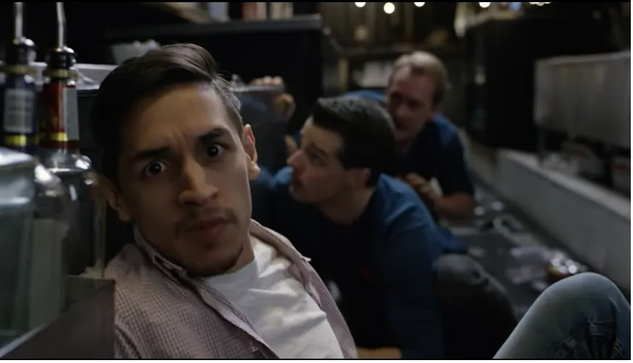
The FBI recently put out a PSA. It’s the sort of public service video that for example the fire department might put out, to give you all the behaviors and steps they’d like to see the populace take to prevent a house fire, or even to take during a house fire.
The FBIs ad is exactly like this, and it’s very well produced, which, given the topic, makes it very disturbing. Its topic is what to do during a gun massacre, which is something that happens so frequently that we need a PSA.
The fact that we need a PSA for gun massacres tells me it is a thing that has been made as inevitable as house fires, yet they are unlike house fires, because they exist not because our dominant power structures try to prevent them, but because they oppose all prevention.
And our gun violence provides very useful pretext to our law enforcement, too, to deliver the brutality and harm that they deliver on a daily basis, because after all, their jobs are frightening—look at all the gun violence!
The person playing what I’ll call “pinned down man” is behind the bar with two other men. He looks at the camera, and he says this: “I’m not a victim. I’m ready for this. I’ll go for the gun, he’ll go for the arms, the bartender will go for the head.”
I’m not sure when these three dudes worked this out.
But the thing I wanted to mention is the line “I’m not a victim.”
Well, dude, here’s the thing: you *are.*
Even if you survive, you are a victim of a traumatic event. So are we all, to a degree, living in a deliberately traumatic world, a world of fear that supremacists demand exist, a world in which only their fear matters, which is a fear that can only be assuaged by a bottomless stockpile of guns.
But I think supremacists really believe this: that, should they find themselves in a shooting, they would not be something so shameful as a *victim.*
If they were the right type of person in life, then the suffering and death of those who suffer and die will be deemed tragic, and used as a pretext for more violence in redemptive retribution, but in the end, they weren’t people, exactly. They were losers, they were victims.
They were one of the diers.
I’m reminded that White Christian President likes heroes who weren’t captured.
I am reminded that he once referred to the fallen war dead as losers and suckers.
They can’t even imagine a world in which they are pinned down by somebody armed with a massacre weapon and they don’t immediately rise up with their bare hands to save a day whose inevitability they’ve spent their lives ensuring … because they aren’t victims, no, they’re *people*—*real* people, the ones whose fears matter, no matter how untethered those fears are to reality.
You may think I’m making too much of a single line in a single PSA. I’m sure you’re right.
Hmm. What else is happening?
Well, Pew recently put out data that showed that overall, vaccines enjoyed steady levels of favorable support, except with conservatives, whose opposition to vaccines has migrated from Covid to MMR (measles, mumps, and rubella), and a desire to send their children to school unvaccinated from these communicable diseases.

About nine-in-ten (88%) Americans say, overall, the benefits of childhood vaccines for measles, mumps and rubella outweigh the risks, identical to the share who said this before the coronavirus outbreak. U.S. adults are less confident in COVID-19 vaccines: Fewer than half rate them as having high health benefits and a low risk of side effects.
@JuliusGoat obviously the "diers" didn't believe in jesus hard enough! but if they did and they still died, well then it was god taking them back to heaven. and nothing bad ever happens in *our* church, because we are doing christianity the ~right way~, whereas *those* people, etc..."
as someone who didn't grow up in religion, i didn't realize the way that an organized religion can give its members the feeling of being virtuous and above the non-believers (or the "believers but not in the ~right way~).
but yea it all comes down to separability. i liked the discussion of separability in vanessa machado de oliveira's book "hospicing modernity."

 archlentil
 kelleynnn
 mk30
mk30