 Alice Averlong🏳️⚧️
So my roommate bought that weird Hand386 portable PC that popped up on aliexpress. Let's tear it down (nondestructively for once, since I'm borrowing it).
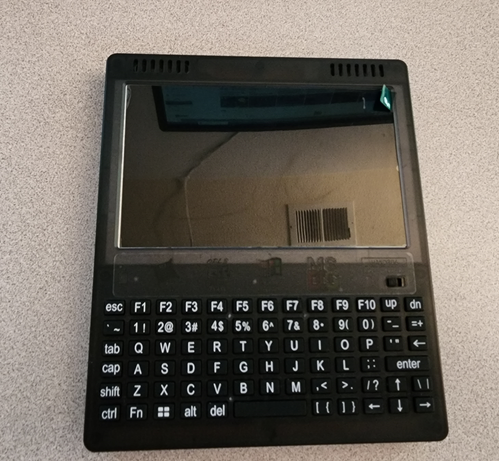
So my roommate bought that weird Hand386 portable PC that popped up on aliexpress. Let's tear it down (nondestructively for once, since I'm borrowing it).


It's easy to open (this image came out blurry, but I'm just using it for navgiation)
We've got two terminal connectors on the left, plus a 3.5mm audio jack. The right has a USB port and a barrel jack power connector.


Chip info here:
Also, I was wrong. Apparently it goes up to 64 megabytes of RAM:


There's three 74HC139s, which are dual 2-to-4 line decoders.
This maybe is used for wiring up one of the expansion ports to the ISA bus?


It's a 60 pin connector. 8-bit ISA is 62 pins, 16-bit ISA is 98 pins.
So if they just merged some grounds, 60-pins is totally doable.
@LionsPhil no, unless you bitbang some PWM out of the PC Speaker (like lots DOS of MOD-trackers, and some games - e.g. RealSound - used to do). But that will sound very bad on a piezo.
Also: this is a 386*SX* (16bit, no cache) so Doom is already stretching it.
@indigoparadox wolf3d has two different ways to play soundfx:
- stream register setting to the FM chip (VGM format style) to make an approximation of the sound (much more complex than a note, but not a sample).
- stream a digital sample, either over DMA to a Sound Blaster, or over the printer port to the FIFO of a Disney Source.
@indigoparadox
The first type (FM weird tweaks) is directly playable on a Hand386 (it has an OPL3, which is enough of a superset of AdLib's OPL2 for this to work).
The second type (digital sample) is not possible out of-the-box on Hand386. You would need the ISA bus expansion and either plug a SoundBlaster, or a parallel port ISA adapter and something compatible with Disney Source (not a mere Covox clone, you need the FIFO buffer).
@indigoparadox Sierra's EGA games(running on SCI0, starting with KQ4) definitely worked this way: each drivers (AdLib, MT-32, etc.) loads custom settings and instruments, and then the game played MIDI notes mapped to those.
In later games (eg. SQ3; or running SCI01, eg. QfG2) the music driver could intercept these MIDI notes and play samples instead, before the engine supported proper samples.
ID software games tended to be closer to VGM and streamed complex register settings
@indigoparadox For completedness yet another possibility to play (this time proper digital samples, but with shitty quality) on FM sound chips, that I haven't seen in western games (but is apparently popular for speech in Japanese games):
Composite Sine Mode synthesis.
You do a fourrier transform of your digital sample into a series of sine waves, and send the loudest sines to the number of FM operators that can do CSM.
The sound card plays sines on those operator and assembles them back.
@indigoparadox
AdLib's OPL2 (and even older OPLs and other Yamaha chips) even have hardware to help streaming those sine waves.
(But often on japanese games it sounds crap because they target cards that can only do a couple of sinewaves in parallel).
on OPL3 it's much more difficult, because the CSM is gone, one needs to setup the sinewaves manually (but if succesfully done could sound much better: after all that card could run in theory 36 operators)
@indigoparadox This hasn't stoped crazy japanese people doing Composite Sine synthesis even ON MIDI EXPANDERS.
There's a japanese video of two Roland SoundCanvas doing Bad Apple. The first SC plays the music (normal…) The second has all it voice set to a simple sine instrument... and DOES THE LYRICS. WITH ACTUAL VOICE.
(head asplode 🤯 )
@LionsPhil @foone I don't think anyone ever previously shipped a sound card with a 4-op OPL3 but no PCM sample support.
The Adlib had an 2-op OPL2.
The Sound Blaster, et al, had PCM sample support.
@foone I wonder if they have a license for that Win95.
I wonder if Microsoft still sells licenses for it.
@foone https://de.aliexpress.com/item/1005005542582463.html?gatewayAdapt=glo2deu
This shop page should shed some more light on the ISA 8 Bit extension Interface as it have the pinout
@foone appearently there is a external ISA „expansion“ with 3 card slots you can buy for $20
https://de.aliexpress.com/item/1005005543239919.html?gatewayAdapt=glo2deu


 Anatoly Shashkin💾
 Rairii
 LP🔸Light up the night
 DrYak
DrYak Gorgeous na Shock!
 Jonathan ‘theJPster’ Pallant
 Krupo
Krupo Geno
Geno Some Kind Of Anhedonia
 Peter Bindels
 Pär Björklund
 Eli the Bearded
 Runner 🏳️⚧️
 grimneko
 Ell 🏳️⚧️
 hiding from plagues ☣️♿
 Enkiusz🇺🇦
 Brent, in a jar
 Ω 🌍 Gus Posey