So my roommate bought that weird Hand386 portable PC that popped up on aliexpress. Let's tear it down (nondestructively for once, since I'm borrowing it).
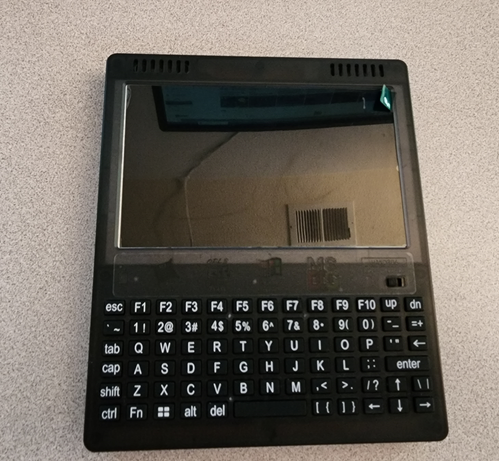
#hand386 #teardown

first off, lemme get the spoilers out of the way: It's real, it runs DOS/Windows 95, and it can run Doom (badly) and VGAPride.

It's easy to open (this image came out blurry, but I'm just using it for navgiation)

We've got two terminal connectors on the left, plus a 3.5mm audio jack. The right has a USB port and a barrel jack power connector.

First off, the CPU. This is surprising! It's an DM&P ALi M6117D.
This is a modified version of the chip made by ALi/ULi, licensed to DM&P. ALi's chip division was bought by Nvidia in 2006.
So the M6117D is a 386SX-compatible system on a chip.
It's a static 386SX Core (apparently licensed from Intel?) plus ram controller, peripheral controllers, IDE support. It runs at 25-40mhz, and up to 16 megabytes of RAM

Chip info here:
Also, I was wrong. Apparently it goes up to 64 megabytes of RAM:

https://www.dmp.com.tw/app/webcamera/pdf/m6117d.pdf

Next to the CPU, we've got four DRAM chips. AMIC A420616AS-50F, 2-megabyte chips.
So we're looking at 8 megabytes.
Then we've got our VGA chip: A Chips&Technologies 65535.
This is a fully integrated chip with built in CRT controller/flat panel support, RAMDAC, and and clocks.
It supports up to 1280x1024 resolution with enough VRAM, or 640x480 16bpp truecolor.
For VRAM, a Sharp LH6A4260K-60, which I'm pretty sure is a 512 kilobyte chip, but I can't be sure.
The really surprising chip is this, a Yamaha OPL3 YMF262-M...
Yeah, this thing has real OPL3 sound. Assuming this chip is genuine, of course.
There's two SST39SF512 half-megabyte flash chips.
The left is labeled VIDEO and the right is labeled BIOS.
The last interesting thing about the top of the PCB is that there's another speaker, labeled SP1.
There's two stereo speakers as well, so I suspect this is just used for PC Speaker, and was easier than merging the audio in with those other speakers
So here's another blurry navigation-picture for the other side of the PCB. The interesting thing here is that they've got the keyboard on a separate PCB.
So over by the USB port, we've got a CH375B.
This is an 8-bit IO chip for USB, specifically for storage.
(it's also an 8051-based core! there's always an 8051)

There's three 74HC139s, which are dual 2-to-4 line decoders.

This maybe is used for wiring up one of the expansion ports to the ISA bus?

A YAC512-M. This is a DAC used by the OPL3 to create the analog output of the audio chip.
A PAM8403 three-watt class-D stereo audio amplifier.
Assorted power regulation/charging circuitry that I'm not going to go into.
though I do want to show off this amazing bodge job.
So the keyboard PCB is also the display converter PCB. It stars a Realtek RTD2660, which is a standard video controller. It takes in analog video and drives LVDS displays with it. It's an all-in-one chip that's used on a bunch of cheap monitors, and it's also an 8051!
Next to it we've got a P25Q40H half-megabyte serial flash chip. This is presumably used to store configuration info for the RTD2660.
The other chip on the keyboard/video board is an HM82C42. I can't find any info on this specific version, but it's almost certainly an Intel MCS-48 acting as a PS/2 keyboard controller.
@foone what microscope do you use?
@foone Also that crab is dope as hell.
@foone that's... the official layout?
@foone Wow, wild! Someone miscalculated the diode drop, or didn't have the right drop on hand, I guess? Very impressive bodging for what I looks to be a production unit in some capacity, at least!
@foone The soldering equivalent of a couple of cars rear ending each other and then the airbags inflated.
@foone Delighted by the mirrored silkscreen. Wonder what happened there...maybe they were originally placed on the other side, and we ended up flipping the footprints but only changed layers for the label?
@foone Looking at how most of the traces immediately bury themselves, seems possible! And comparing with the backside, it looks like they go to internal layers (is this a 4-layer board?), and there aren't any components on the opposite side of the board "underneath" these. The board isn't terribly dense, but the rest of that half of the backside is fairly populated other than that area.
@foone … did they mirror the silkscreen?
@foone you mean OƎꓷIV and ƧOIꓭ right?
@foone I mean, if they stole a BIOS...
@kevin @foone You wouldn't steal a BIOS… #itcrowd
@forelioned @kevin @foone I can't enjoy his work any more.
@thejpster @kevin @foone ah yes, Graham Linehan, well, he goes in the file with Morrissey as someone who did great work but then turned into a dick. It doesn't make their previous work suddenly worse or make you into a hypocrite for enjoying the pre-dick work, but I would avoid their post-dick work. Same goes for Hugo Boss, but they went to another level.
@foone Windows only has drivers installed for the OPL3; no mixer or PCM... but I did notice some DOS games had sound effects... does this thing really not have PCM support and those games retroactively stole my idea for using MIDI sound effects? 🤔

@indigoparadox @foone I remember that Dune II (1992) used MIDI for sfx. In particular, if PCM was already in use when an explosion noise was needed, it would sometimes play a hihat or cymbal crash from the Adlib midi path.

Damn, now I've got that music stuck in my head. Off to see if I can find any covers on YouTube...

@mikemol @foone Apparently, it seems some games can load their sound effects as custom MIDI instrument data? https://moddingwiki.shikadi.net/wiki/Adlib_sound_effect
Adlib sound effect - ModdingWiki

@indigoparadox @foone ah, here we go, that's the stuff... https://youtu.be/3VF_LmYE7io?t=142
Dune 2 The Battle for Arrakis Soundtrack Metal Covers Mix

YouTube
@foone That OPL3 is almost certainly genuine cause they're relatively cheap as far as Yamaha stuff goes. On ebay they're about a dollar or two a piece so they're probably about a third the cost in China
@ic7 my understanding was that you could get them for very cheap because they were mostly fakes
@foone their next chip, the F0, was a lot less popular

@foone

It has flat panel support?!?

I lived in a dishwasher box on the middle of I-4. With a family of twelve.

Every car that ran over us had crush panel capability only. I'd have 8 more siblings if we had flat panel support.

Kids, these days, are so spoiled.

@foone but but the 386 didn’t have USB?!
@jpm @foone I don't think there was anything specifically preventing the 386 from having USB aside from USB showing up well past the 386's prime. I don't think my 486 or even PII had USB, but 486 PC-104 dev boards a few years later that I worked with did.
@emag @jpm @foone USB showed up around the Pentium Pro/AMD K6 era. I had it on my board at the time (header only) and my current PII machine has two ports on the back.
@jpm yes, back in the days you would have had a CD-ROM as your D: drive.
But since then, the industrial sector and the retrocomputing seen have came up with ways to plug USB sticks as D: drivers instead, on a 8bit ISA bus nonetheless.
@jpm @foone The gimmick is the CH375 chip-- it does all the "USB" heavy lifting and just exposes a pretty simple sector-oriented interface. From there, it's all drivers on the host-PC side to shim up something that handles normal BIOS INT 13 commands. With a little effort, you can even make a bootable device out of one.
@foone
running doom badly is in line with a 386 tho, isn't it?
@instereo256 ...unless you were a lucky kid whose parents blew money on a 386DX server, with 32bits memory, and cache maxed out.
Then it runs Doom... less badly?
@foone Oooh! That looks like the machine of my dreams.
@foone Wow, it's cool actually seeing it in action.