Come on - does no one care about SFN? 👀

From: @elduvelle
https://neuromatch.social/@elduvelle/110468701179097408

El Duvelle (@[email protected])

#SfN2023 abstract submissions are officially open! More info: https://www.sfn.org/meetings/neuroscience-2023/call-for-abstracts Deadline: Wednesday, June 14, 5 p.m. EDT. Fee: $155 🤔 🤔 + cost of being a member 🤔🙄 (Despite my complaints I’ll probably be there - who else will be?!) Where: Washington DC + poster session online When: November 11-15, 2023. #SfN #Neuroscience

Neuromatch Social
@elduvelle never been. Doesn't sound like my cup of tea. Don't plan to go.
@neuralreckoning what conferences do you like / go to?
@elduvelle smaller ones! Can't cope with that many people. Also these days, ones I can get to by train, trying to avoid flying. Going to CCN in Oxford in August.
@neuralreckoning @elduvelle I would love to go to CCN. I live in Oxford, so my carbon footprint would be low.
@neuralreckoning @elduvelle I am interested in computational theories of vision and of brain function as a whole. I have been looking through the #ccn2023 abstracts for examples but not found any yet. Lots of computational modelling, of course, but that is different. Marr’s computational theory has not survived well, but he made a compelling case for one. What are our best attempts today? https://www.cell.com/current-biology/pdf/S0960-9822(02)01204-6.pdf
@elduvelle_neuro i have been reading @Neurograce’s chapter on grand unified theories of the brain. A GUT is not quite the same as a computational theory since a CT should be a principled approach derived from the constraints on the inputs and outputs to a system. At least in physics, where the term GUT is most often used, the CT approach is not possible. But it is for neuroscience. The ideas in the chapter were quite disparate (a bad sign) and unconvincing.
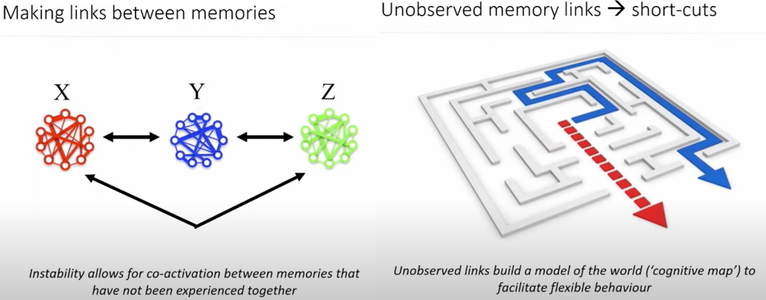
@elduvelle_neuro @Neurograce Helen Barron just gave a fascinating talk at CCN2023 describing elegant, compelling and herculean work But it is a good example of the discussion above. The slides in the introduction shown here did not came close to what Marr would describe as a computational theory (in this case of of taking shortcuts).
@ag3dvr @Neurograce hmm I guess I don’t know enough about Marr to know if the cognitive map would qualify as a theory according to his ideas…
Edit: typo that I just noticed
@elduvelle_neuro @Neurograce Not on its own, no. "Sets out the goal of a process and an outline of how it can be achieved in principle. This includes defining the input, the output and establishing the constraints that will be used in computing one from the other." https://doi.org/10.1016/S0960-9822(02)01204-6 . Here is an example of an implementation that succeeds on navigational tasks and uses grid cells but not a cognitive map: https://doi.org/10.1038/s41586-018-0102-6. The computational theory is quite different.
@elduvelle_neuro @Neurograce The TEM representation is a graph of states (nodes) joined by actions (edges) with loop closure rewarded/enforced giving it a more metric structure. This makes it a type of policy network (more than a map) https://doi.org/10.1098/rstb.2021.0448 which is good. Experimentally, we find failures of loop closure/consistency in human navigation, so that bit may not be necessary: https://doi.org/10.1371/journal.pone.0033782 https://doi.org/10.1371/journal.pone.0247818. But, yes, TEM is closer to having a computational theory.

@elduvelle
I will likely send my students but not sure I'll go myself... Undecided 🤔

Pros:

  • I get to catch up with all my friends
  • lots of interesting science

Cons:

  • traveling
  • I usually don't get very much out of SfN professionally
  • I'm usually disappointed by most sessions
  • I'm still Covid-cautious but no one cares anymore... So no socializing in bars / restaurants while everyone else does. That takes one of the biggest perks out of the equation 😭
@GunnarBlohm @elduvelle
Ditto - I don’t go, but I’m always happy for the rest of the team to attend.
@GunnarBlohm I’m still very weary of Covid and think I might go to some events but with a good mask on?
Also the poster session is online as well it seems, this year…

@elduvelle #SfN2023 #sfn #conference #neuroscience

SFN is my favorite meeting. The key is to see SFN as a deconstructed meeting, where everyone gets to create their own experience.

Because every neuroscience question is at SFN, we can all find our own paths through it. I can spend a morning talking addiction, go to lunch with a striatal colleague, and then spend an afternoon talking hippocampus. And then spend the evening talking neuroeconomics. Someone else might spend the morning in drosophila head direction systems and the afternoon talking rat navigation with me. Everyone finds their own path through SFN.

The problem I see people having with SFN is that they treat it like a normal conference. It's not. It's more like a chance to swim in a great science ocean and to see lots of friends from many different communities. If you go into SFN trying to see specific things, you'll likely fail and hate it. But if you go with the zen attitude of "I'm going to see some great science for a few days", then it's a wonderful meeting.
@adredish That’s a great approach! I’ll try to do that next time I go - hopefully this year.
@elduvelle I am on the fence! #SfN is great for the social aspect i.e. end up in a random tiki bar with all your scientific heroes. I’d be tempted to do #cosyne instead - I find myself more challenged there so it feels more valuable. @elduvelle are you going for a poster or symposium?
@mrspaghetti Cosyne definitely seems great and I want to try it out one day!
The last (and only) time I went to SFN, I did a mini-symposium presentation and there was almost no time for questions, which was a bit frustrating. So for this SfN I will go for a poster! But I’m not sure my vocal chords will be up for it 👀
@elduvelle i am still just in complete denial that its time for abstract submission again. I feel like i just submitted the last one yesterday
@BlakeP_Neuro
Time flies like an arrow
Fruit flies like a banana