
Our sun is big. It’s 864,000 miles or 1,392,000 km in diameter. Or 109x wider than Earth. But it’s also an average sized star.

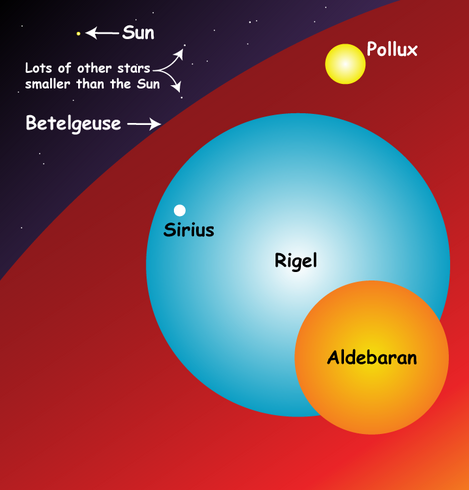
Some stars are much bigger.

Betelgeuse, in the constellation Orion, is a red supergiant star ~700x the size of the sun.

If we replaced our sun with Betelgeuse, it would stretch past Jupiter's orbit. https://universe.nasa.gov/news/237/what-is-betelgeuse-inside-the-strange-volatile-star/ #space #science
What is Betelgeuse? Inside the Strange, Volatile Star

A blazing red supergiant shining brilliantly in the night sky, Betelgeuse is a star that has captured attention for centuries.

NASA Universe Exploration

@Sheril I stopped calling our Sun an “average” star when I learned that something like 75% of stars are red dwarfs. It’s in the middle, size-wise, but it’s big compared to a large majority of stars.

It also bothered me that red dwarfs got the shaft in texts (early high school) that I taught out of - they barely rated a mention in descriptions of properties and life cycles of stars.

@MichaelPorter @Sheril A median star?
@level98 @Sheril The median star would still be a red dwarf 😊

@MichaelPorter @Sheril Good point, well made.

A red dwarf would also be the most fashionable (a la "mode"). 😀

@level98 @Sheril You’re a dad, aren’t you? 😄
@MichaelPorter @Sheril it’s basically a mid-range star. Certainly not the most common type or size. Using “average,” while technically valid because there are 4 kinds of average, is inviting all kinds of trouble with this kind of distribution.

@Sheril For those that have dug into this thread… There’s a very nice chart that gives abundances, sizes, masses, you name it, of different types of stars. Our Sun is a “G” type star.

http://www.atlasoftheuniverse.com/startype.html

The Classification of Stars