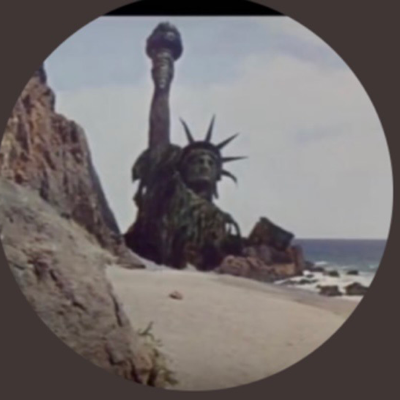
The enforcement of copyright law is really simple.

If you were a kid who used Napster in the early 2000s to download the latest album by The Offspring or Destiny's Child, because you couldn't afford the CD, then you need to go to court! And potentially face criminal sanctions or punitive damages to the RIAA for each song you download, because you're an evil pirate! You wouldn't steal a car! Creators must be paid!

If you created educational videos on YouTube in the 2010s, and featured a video or audio clip, then even if it's fair use, and even if it's used to make a legitimate point, you're getting demonetised. That's assuming your videos don't disappear or get shadow banned or your account isn't shut entirely. Oh, and good luck finding your way through YouTube's convoluted DMCA process! All creators are equal in deserving pay, but some are more equal than others!

And if you're a corporation with a market capitalisation of US$1.5 trillion (Google/Alphabet) or US$2.3 billion (Microsoft), then you can freely use everyone's intellectual property to train your generative AI bots. Suddenly creators don't deserve to be paid a cent.

Apparently, an individual downloading a single file is like stealing a car. But a trillion-dollar corporation stealing every car is just good business.

@[email protected] @technology #technology #tech #economics #copyright #ArtificialIntelligence #capitalism #IntellectualProperty @[email protected] #law #legal #economics

@ajsadauskas
First, copying some work 1:1 (download the music and listen to it) is exactly what copyright is there to protect creators from.

Second, copyright doesn't mean you are entitled to monetization from YouTube. That's based on the agreement (contract) between you and the video platform you put your stuff on.

Third, training AI is not 1:1 copying of works, but highly transformative, and as such is fair use /fair dealing in many jurisdictions.

#AI #Copyright #AiArt

@nicemicro @ajsadauskas "highly transformative": is that enough? (morally or practically)

Because, many of the source works took effort and money to produce, and were taken / stolen / used without permission / whatever. That's an industry not just under threat of extinction, but necessary for the new works to be created.

We might have a battle of generative vs human-intensive works, but not have a result where both can exist. Does one have to kill the other?

@ckent @ajsadauskas well, that is going to be somewhat subjective, but I think that getting an image and making it into a bunch of gradients to train a neural network is much more transformative than anything a human artist does when "remixing" previous works, and we know of many cases when courts ruled that even re-cutting a video into a different story can be transformative enough to be "fair use".

Copyright law also does not care about how much did it cost to produce a work.

@nicemicro @ajsadauskas well this is why I asked “morally and practically” (sustainable long term) rather than legally. Sure, if we gotta update the law then we gotta update the law. It’s an area that gets regular updates.
@ckent @ajsadauskas sure, the law (or rather the laws of many jurisdictions) might be updated, but my sense is that the current change is "just" quantitative (the AI tools enable quicker, more efficient remixing than whatever humans were doing), and not qualitative, so the legal frameworks should work. When napster and then bittorrent made illegal copying of stuff easier and more efficient, we didn't need to change the law, we needed some precedents, so the courts can work faster.
@nicemicro @ckent @ajsadauskas Copyright law has been overcome by technology. When AI generates new works from a compilation of millions of old works, things get muddy very quickly. And when those new works are recycled back into the database, even worse.
Perhaps the lawsuits will have AI generated defense briefs?
Where does this end?
Or is it the start of an informational age like we have never imagined in 1960?
What hath the semiconductor wrought?

@bouriquet I agree that it is quantitatively different, but because I don't think the change is really qualitative, the law can't just overcome it with a few additional guidelines so the courts interpret the same thing occurring again and again the same way.

Where does it end? Well, it ends where everyone will be able to remix the stuff themselves, without having to take years learning how to paint.

Like, how electronic music totally killed live music.