 uri
uri Scot Hacker
Best explanation I've seen of why the Paradox of Tolerance is no paradox at all.

Best explanation I've seen of why the Paradox of Tolerance is no paradox at all.
@shacker I'm not sure how deep this goes in other countries, but in The Netherlands there's this annoying tendency to try and engage with intolerance, as if they had a rational debate when they stormed the beaches of Normandy.
Some people just should not be engaged. Some people are just too far gone and it's totally okay to treat them for what they are - nazis - and ignore them so we can focus our energy on the rest of us.
@shacker @thomholwerda Engaging in bad faith is a risk that sometimes bears reward. Look up the viral “do you know how much a slave cost” video for my favorite example.
It pays off when a larger audience gets to see them remove their masks.
@shacker source for the cited inspiration: Tolerance is not a moral precept
(see also Issuepedia)

Attached: 1 image Best explanation I've seen of why the Paradox of Tolerance is no paradox at all. #philosophy
@shacker #Alt4You to copy/paste edit
The Paradox of tolerance disappears if you look at tolerance, not as a moral standard, but as a social contract.
If someone does not abide by the terms of the contract, then they are not covered by it.
In other words: The intolerant are not following the rules of the social contract of mutual tolerance.
Since they have broken the terms of the contract, they are no longer covered by the contract, and their intolerance should NOT be tolerated.
@shacker @forschungstorte Wow, it doesn’t? That’s unconscionable. What’s the deal, @ivory?
(I just downloaded the app to test but I’m not going to subscribe just to see whether or not it allows accessible toots or not as posting is a premium feature.)
PS. Thanks for adding the alt text in. Will boost now.
@graygoogirl @shacker Yes, and what exactly is the social contract? In a fascist society, the contract is that you must maintain loyalty to the state and constantly prove it with service and sacrifice. By the standard set forth in this thread, fascism would be "tolerant".
Tolerance is by definition unconditional, and a society that faces no paradox of tolerance is probably neither free nor just.
@ostrich @graygoogirl @shacker
you are pedantically changing the definition. The "social contract" of tolerance is ONLY the agreement to tolerate EACH OTHER. Your definition of "acceptance" is an example of NOT tolerating, and is thus completely irrelevant.
The point is that the ideal of tolerance is NOT a suicide pact.
I understand precisely what you're talking about, and you are changing the subject to force discussion of it. Lack of acceptance IS NOT TOLERANCE which is the POINT of the OP.
I'm sure you WANT to discuss a different, broader social evil. Respectable. But that is NOT this discussion.
Please. Read something beyond philosophy 101.
Answer is blatantly "no"; you know it, and you want to derail for your pedantic games. Go away.
@ostrich @video_manager @graygoogirl @shacker You're jumping to a lot of conclusions.
1. "Not tolerating intolerance" doesn't mean "ignoring prison abuse."
2. "'Tolerance' has an expectation of behavior, fascism has an expectation of behavior, therefore you're the same" sounds good, but makes no practical sense. By this logic, cyanide gas and birthday cakes are morally equivalent because they both require a recipe.
This isn't an issue that can be solved with abstractions. The outcomes matter.
@ostrich @video_manager @graygoogirl @shacker I'll add: you cannot define it to simply mean the rules of *any* social contract - it is specifically about the agreement to peacefully co-exist.
When that's broken, then people are no longer required to peacefully coexist with you.
It can't be applied to queer people just for existing - that's still within the agreement. Saying "queer people can't exist as they are" is the "first shot" fired in this exchange.
@ostrich @video_manager @graygoogirl @shacker I'm not sure why you're assuming the social contract is between the government and the governed, or that breaching it means "all bets are off!"
That's something you're bringing to the table, it's not the default.
@ostrich You're still assuming breaching the social contract means the person has voided all claim to basic human rights. I don't think it does. Breaking the social contract doesn't mean "now we can torture and murder you."
I'm really not tracking your point here. It seems like you're disagreeing for the sake of disagreement, and I am sure it's just my misunderstanding.
@ostrich I understand a "social contract" to be an implied or explicit agreement between people living within a given space: an apartment, a region, a nation, the planet - specifically for the purposes of allowing harmony between as many parties as possible (with the assumption that no party has privileged status over another).
Is your definition different from mine?
@edwardnewton The question is what the scope of the agreement is, what the conditions of it being considered broken are, and what the recourse is when it is broken.
Hobbes's social contract, for example, considers every aspect of society outside of Hobbesian Anarchy (i.e.: constant interpersonal war) to be part of the social contract. It also essentially defines a totalitarian state.
@ostrich Tolerance is not a privilege, it's a mutually agreed upon pact.
Under the social contract of mutual tolerance, the first person to withdraw from the contract is the one who has voided the tolerance extended to them. That's the idea.
Can that be twisted to fascist ends? Of course. There is nothing that can't be. That doesn't make it intrinsically bad.
 Thom Holwerda
 Seirdy
 Daniël Franke 🏳️🌈
 Woozle Hypertwin
 ted byfield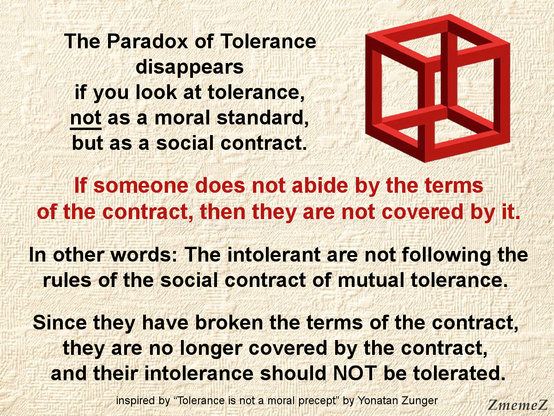
 Elle Nerdinger M.A.
 Aral Balkan
 Ivory by Tapbots
 Uckermark MacGyver
 Martin Kelly
 Baessito
  ☭🇧🇷🇺🇳🇵🇸
 GrayGooGirl 🏳️🌈
 Ostrich
 Tracy Hall
 Edward Newton
 Natanael ⚠️
 ⁂ Fish Id Wardrobe