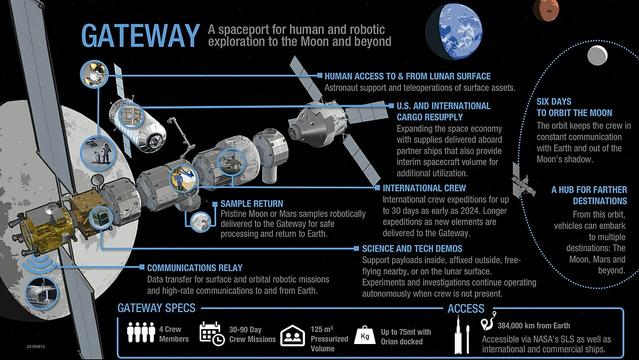
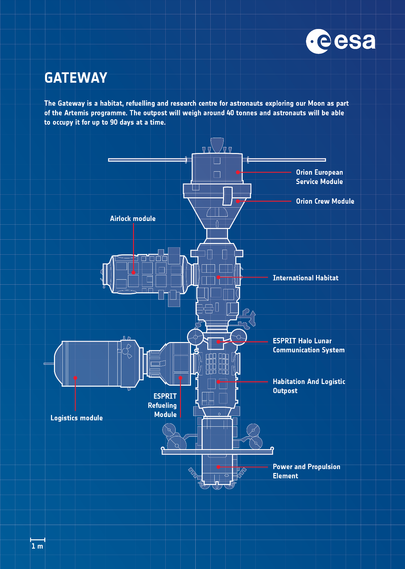
There is no #radiation #shelter at the #LunarGateway but only instruments #measuring it.

"During a future #Artemis mission, if a solar β˜€οΈ radiation squall were to occur while #astronauts are beyond #Earth’s magnetic bubble, they might tell the crew to #build a temporary shelter" https://www.nasa.gov/feature/goddard/2019/how-nasa-protects-astronauts-from-space-radiation-at-moon-mars-solar-cosmic-rays

#ESA’s IDA, instruments provided by #JAXA, will fly inside #HALO* to #study potential radiation inside #Gateway https://www.nasa.gov/feature/gateway-a-deep-space-home-and-so-much-more

*Habitation and Logistics Outpost https://en.wikipedia.org/wiki/Habitation_and_Logistics_Outpost

#HumanSpaceflightHealth #RadiationProtection #SpaceStation #SpaceAgency

How NASA Will Protect Astronauts From Space Radiation at the Moon

Space radiation is a critical factor for astronaut safety as they venture to the Moon. NASA is exploring a variety of techniques and technology to mitigate different types of radiation during space travel.

NASA

#LunarGateway : no #radiation shelter planned.

#ESA : Radiation poses a major #health #risk to people in #space. Astronauts on the #ISS receive doses roughly 120 times higher than on Earth. Away from Earth’s protective magnetic field, #astronauts πŸ‘¨β€πŸš€ receive roughly 250 times πŸ“ˆ more radiation than a person on #Earth 🌍" https://blogs.esa.int/exploration/internal-radiation-payload-approved-for-the-gateway

#NASA : "During a future #Artemis mission, if a solar β˜€οΈ radiation squall were to occur while #astronauts are beyond #Earth’s magnetic bubble, they might tell the crew to #build a temporary shelter πŸ“¦" https://www.nasa.gov/feature/goddard/2019/how-nasa-protects-astronauts-from-space-radiation-at-moon-mars-solar-cosmic-rays

#HumanSpaceflightHealth #RadiationProtection

Picture : https://www.esa.int/ESA_Multimedia/Images/2023/03/Gateway_blueprint

Internal radiation payload approved for the Gateway – ESA – Exploration

#Nature πŸ“† 19 October 2021 ☒️ #RadiationProtection : The three-layer shield πŸ›‘οΈ showed advantages due to the diversity and lower number of layers, and lower construction #cost πŸ’Ά. The ultimate optimal case is a combination of three layers of Bronze- Aluminum and Molybdenum. https://www.nature.com/articles/s41598-021-99739-2

#HumanSpaceflightHealth #LunarGateway

Picture :  Penetrating Powers of Ionizing Radiation https://commons.wikimedia.org/wiki/File:EPA_image_-_Penetrating_Powers_of_Ionizing_Radiation_Image.svg

Multilayer radiation shield for satellite electronic components protection - Scientific Reports

In this paper, various multi-layer shields are designed, optimized, and analyzed for electron and proton space environments. The design process is performed for various suitable materials for the local protection of sensitive electronic devices using MCNPX code and the Genetic optimization Algorithm. In the optimizations process, the total ionizing dose is 53.3% and 72% greater than the aluminum shield for proton and electron environments, respectively. Considering the importance of the protons in the LEO orbits, the construction of the shield was based on designing a proton source. A sample shield is built using a combination of Aluminum Bronze and molybdenum layers with a copper carrier to demonstrate the idea. Comparisons of radiation attenuation coefficient results indicate a good agreement between the experimental, simulation, and analytical calculations results. The good specifications of the proposed multi-layer shield prove their capability and ability to use in satellite missions for electronic device protection.
Nature