
#FunFactFriday: Experts say that the next decade is decisive for PV Solar - what do you think is the most important renewable energy source going forward? News Source: https://www.sciencedaily.com/releases/2023/04/230418142516.htm
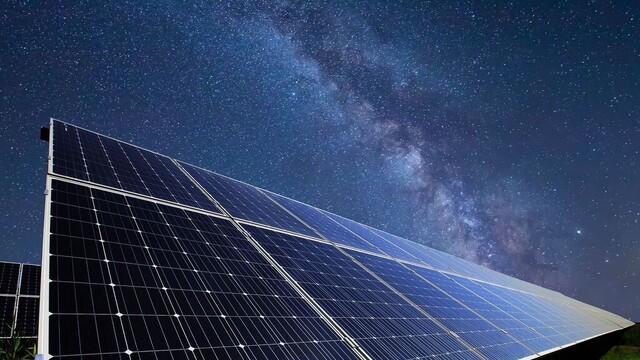
Next decade decisive for PV growth on the path to 2050: Experts warn waiting no longer an option for commitment to multi-terawatt photovoltaic production worldwide

Global experts on solar power strongly urge a commitment to the continued growth of photovoltaic (PV) manufacturing and deployment to power the planet, arguing that lowballing projections for PV growth while waiting for a consensus on other energy pathways or the emergence of technological last-minute miracles 'is no longer an option.'

ScienceDaily

@mattferrell
To be honest the source that I think needs more attention, research and implementation is biogas (RNG). But people don't like to think or talk about using poop and rotten food to produce fuel that could replace fossil fuels in part.

I doubt it will ever completely replace fossil fuels- but it is something that deserves more attention and funding for research and implementation.

@mattferrell
I am a layman in this debate, but I have thought for a long time now, that #nuclear is (and will continue to be) the most important renewable source of energy for a clean future. It is not truly renewable, but with the right fuel it is probably renewable enough.

The power density (W/m²) of nuclear is just so much higher than wind and solar. You can combine it with hydro/dam power to create 'batteries' of potential energy. It is always on, no dependence on sunshine or wind.

1/2

@mattferrell
I think we are kidding ourselves, if we expect to go green and continue (or more likely increase) our current global energy usage, without nuclear. Recent events in Germany is a good example of this.

Dont get me wrong, I think we need a combination of energy sources for a green future. But I dont think it will work without nuclear power as a backbone.

2/2

@Primetime nuclear is and will be part of the mix for sure. Unfortunately it’s crazy expensive compared to other options, but that may be changing with companies like Last Energy.

@mattferrell
I read up on this a bit, and OMG nuclear is expensive. Also construction is way longer than a solar farm. I guess I should have known.

However I must confess that I dislike the idea of acres upon acres covered in solar panels, when these could be reforested. Hence my argument for power density.

Last Energy type solutions help solve both issues though, pretty cool.

Solar cells on top of my roof though, that is just logical. Unfortunately this is disincentivized where I live :(

@Primetime solar on top of existing infrastructure is a no-brainer. It’s why I’m a big advocate of “all of the above” solutions and not just one type to rule them all.
@mattferrell I coulden't agree more
@Primetime @mattferrell Plus reducing our energy consumption maybe? I wouldn't go for nuclear but that's another debate. My point here is that we accept that energy consumption will go up, and maybe it should not. What are your opinions?

@rafa_font @mattferrell
It would be good if global energy consumption could be decreased.

But we have to consider that the developed world uses the most energy per capita in the world.

As the rest of the world catches up in terms of development and standard of living, the power consumption per capita here will increase. And these are large populations we are considering: India, China, south America, Africa.

No way to avoid increased global power consumption, in my opinion

@mattferrell
I'm sorry for hijacking your post by the way. I wasn't really aware that nuclear is so controversial. It's just another power source to me.
@Primetime no worries. It’s a good conversation.

@Primetime @mattferrell please do the math on how much wind or solar could be built for one nuke plant. Or the math on how much storage could be built, given the way storage prices are falling.

And the math you're doing won't even properly be accounting for security for the facility or the transportation and storage of the fuel and waste.

Nukes are a boondoggle.

@qkslvrwolf @mattferrell
I'm not disputing that wind and solar are cheaper, not at all.
I was pointing out, that nuclear has a higher power density.

Solar has the higest power density of any renewable.
A good estimate for the mean power generation of solar is 5 W/m². A country like Germany expends a little over 1 W/m². To cover Germanys consumption with solar alone, you would need to cover 20% of the country in solar panels.

I'm saying there is not enough land for only the cheap options.

@Primetime @mattferrell that's not even a little true.

You could power my whole town by covering 1/3 of our parking lots with solar, and we're not even a sprawling town.

We could power everyone in the world easily with solar over buildings and pavement. And that's not even including the new building wind + solar options coming soon.

This is FUD

@qkslvrwolf
As I said, I am a layman. Therefore I am ready to rectify my own opinions if presented with good convincing arguments, based in hard facts (numbers). Anecdotal evidence is not convincing.

All figures I use for my back of the napkin calculations are from these publications:
https://royalsocietypublishing.org/doi/10.1098/rsta.2011.0431
https://www.sciencedirect.com/science/article/abs/pii/S1364032117304720?via%3Dihub

I am not out to create fear, uncertainty or doubt. I am here to have a discussion based in facts.
You could further the discussion by providing some.

@Primetime Well, for starters, "Assessing the implications in terms of land availability (i.e., land not already used for human activities), the list of vulnerable countries enlarges substantially (the EU-27 requiring around 50% of its available land),"

Why would they only consider land not already in use? The vast majority of solar can and should go on already used land. There's literally nothing about it that requires unused land.

@Primetime And maybe that's addressed in the paper, but I'm not going to pay Elsevier or write the authors asking for a copy.

@qkslvrwolf
Not sure why they only consider unused land. Maybe because not all technologies can be mounted on buildings (wind)? Completely agree that solar can, and should, be placed anywhere.

Anyhow, I used the power density figures for wind and solar from this publication, because they were the most recent I could find summing up in W/m². Also, the numbers feature uncertainties, counting future power density improvements.

If you are interested in the paper you can look it up on Sci Hub ;)

@Primetime And the royal society one is 10 years old, and when trying to figure out origins of some of MacKay's numbers, I found people noting that he was using numbers that were both outdated and worst case scenario, while also buying "clean coal" claims without much skepticism.

That old MacKay report doesn't even dream of modern wind, modern wind capacity factors, or the explosion of storage potential. So not sure it's worth much time.

@Primetime Oh, and renewable costs are literally DECADES AHEAD (lower) than what they were estimating circa when he wrote that. Lots of that cost is because capacity ramped much faster than he expected.

https://ieefa.org/resources/ieefa-iea-playing-catch-falling-renewables-costs-halving-solar-estimates

IEEFA: IEA playing ‘catch-up’ with falling renewables costs, halving solar estimates

IEA playing ‘catch-up’ with falling renewables costs, halving solar estimates

@qkslvrwolf
Price is of course really important for adoption of e.g. solar, and it is good to see it go down.
Hopefully their cost goes down further (I want panels on my house).

Price is a good topic for discussion as well, but what I was trying to understand is the land area required for 100% renewable - price is less of a factor here.

In the ieefa figure nuclear costs also predict to go down a fair bit though ;)
I'm just pulling your leg.

@qkslvrwolf
It is a bit old, yes. I did not realise that there may be problems with their published numbers. Also their numbers for energy consumption?

What I used from this publication was their figure displaying 'energy consumption per person (kWh/d/p)' vs 'population density (p/km²)' for countries. It was easy to calculate each countrys energy consumption per m² (W/m²) from this data.

I boldly assumed here, that western energy consumption would have stagnated at best.
Has it gone down?

@mattferrell all of the above, there is no single solution.
@mattferrell the energy sources will be a mix of fully renewables. Solar, wind, geo.
The only remaining question is which storage options will primary the mix.

@mattferrell In regards to solar, improving efficiency & solving idustrial scale storage are the keys. Scarcity & extraction of raw materials pose both short-term & and long-term environmental, political, & manufacturing supply complications. We'll get there. Smart people are working on it (also greedy people see a payout and environments have a passion).

Free fuel from the sun is way better than buying carbon from fossils.

@mattferrell
Not sure, but I do think that solving the energy storage problem remains the most important issue.