
#ELI5 Why is water see through?

I'd never thought about it like this. Wow.
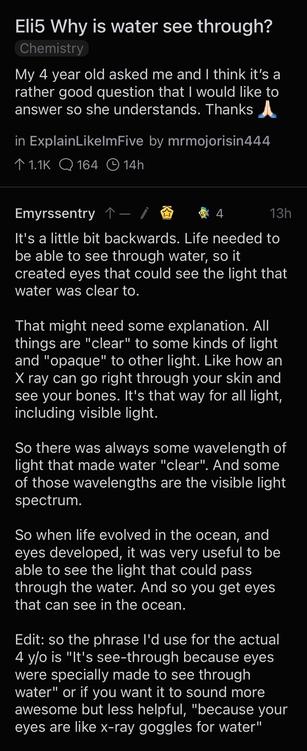
@Jdreben hm... Why then vision evolved for this particular (narrow) range, while water is transparent to a lot more? I can guess why big wavelength were less advantageous, as you want to see small things with good resolution, not blurry blobs saying "your speck of food is vaguely in this cubic meter of space". But why we don't see in UV or X-ray ranges?
@isagalaev @Jdreben it’s not just that, but the wavelengths of visible light are also the only ones that are capable of causing the kind of changes in pigment molecules that we use in our eyes—it would not really be possible for life as we know it to use other wavelengths (besides a tiny bit of ultraviolet and infrared for insects) — microwave or x-ray eyes are out of evolutionary reach.
@pmcarlton @Jdreben now that feels backwards. If reacting to microwave gave us advantage, we would evolve vision based on different biology rather than existing eye chemistry. Like, say, sensitivity to temperature increase created by microwave radiation. It's much harder to show that such a thing *could not* theoretically evolve.
@isagalaev @Jdreben no, what I'm saying is that a biological discriminator of slightly different wavelengths of >700 or <400 nanometer EM radiation does not exist, but for >400,<700 it uniquely does exist in the form of rhodopsins, gfp, etc.
@isagalaev @Jdreben although one should never say something is biologically impossible since evolution is so much smarter than we are …
@pmcarlton @Jdreben yeah, I was thinking about bats just now :-) Their hearing is actually more like vision, but built on a completely different principle using ultrasonic air waves which should allow them to "see" with sub-centimeter precision. So there.

@pmcarlton @Jdreben in fact, if I'm reading Wikipedia correctly[1], and 20 KHz correspond to 1.9 cm wavelength, then bats hearing up to 200KHz can discern down to 1.9 mm objects!

[1]: https://en.wikipedia.org/wiki/Ultrasound

Ultrasound - Wikipedia