
This is the graph everyone needs to see for International Workers' Day.

@rbreich "It seems to me to be equally plain that no business which depends for existence on paying less than living wages to its workers has any right to continue in this country."

FDR understood this a hundred years ago.

@rbreich Union membership aligns with Boomers’ blue collar working age?
@rbreich I'd boost with alt text?
@rbreich Yet another graph in which Ronald Reagan sits right at the inflection point.
@tito_swineflu @rbreich He was another GQP Domestic Terrorist!
@rbreich Two parameters missing from the chart:
1) Product quality, or at least perceived product quality.
2) Skilled Manufacturing jobs exported to countries with lower labor costs.

@rbreich

If one took a worker salary.

Is doing (Salary/100)*250 the right way to calculate what it would be if salary had continued to track with productivity?

Sleepy work brain isn't doing math right.

@rbreich there are no "workers" anymore. Just "employees". They feel no longer as working class. 🤔

They all play the same game of neo-liberalism (exploiting others) until they got bitten themselves. Then they are replaced by someone you can exploit more.

@rbreich
How do you isolate the workers' improvements in productivity from other factors (e.g., automation, improved inputs, process improvements)?
@BlueGrits @rbreich you don't, we are the same humans we were thousands of years ago, the only difference is "technology", which is all the things you described and more. Worker improvement is technology improvement (not in a derogatory way, and workers still deserve everything they produce).
@rbreich Missing annotation: UAW selling out younger workers at Lordstown in 1972. I grew up in a world where I couldn't have faith that unions were on the side of workers

@rbreich

alt text:
Graph titled 1948-2017: Worker productivity, compensation & union membership.

Union membership hit a high of around 30% around 1960 with a steady decline starting at 1970 down to around 5%.

Productivity linearly increasing the entire time ending at 250% increase.

Hourly compensation increased in lock step w/ productivity till the early 1970 and then mostly flattened off at around 100%.

Source: https://www.epi.org/publication/top-charts-2019/ and https://www.epi.org/productivity-pay-gap/

Top charts of 2019: Thirteen charts that clarify what our economic priorities need to be in 2020

Black unemployment and underemployment is still too high, black college graduates have seen their wages fall, inaction from federal policymakers on the minimum wage has dropped the wage floor from under workers at the low end of the wage ladder, and workers are still thwarted in their efforts to bargain collectively for better wages from…

Economic Policy Institute
@rbreich I want to share it but unfortunately it lacks a sufficient image description, therefore a big part of my followers couldn't see it :/

@rbreich
Union Membership was nonlinear compared to compensation and productivity.

However, productivity has gone unrewarded with diminished union membership and compensation.

This is ultimately going to damage our economy.

@rbreich
these are all rates of change
all positive values

productivity is increasing exponentially
hourly rates are increasing linearly
And union membership has reached a market saturation?

What is your takeaway

@atreys @rbreich Union membership is on a different scale, axis on the right, showing percentage of workers in a union.
@atreys @rbreich not quite. The Y axis is confusing — but the left side (% change, positive values) applies to wages and productivity. The right side is “% of workers in a union”, and is in the range of 0 to 100%. Line going down==negative change (in percentage).
@atreys @rbreich Yeah, the graph isn't worded particularly well. I'm pretty sure it's supposed to be "percent change since 1950" rather than yearly percent change. We aren't seeing a doubling of average wages year on year after all.
@rbreich Solid decade of substantial decline in union membership prior to wages flattening, so to 1st order wage flattening has zip to do with union membership. Seems odd to share on May Day, but you do you!
@tjradcliffe
Surprised you don’t know about lagging indicators with all those qualifications in your bio, but you do you!
@tjradcliffe @rbreich
“We needn’t worry about teenagers smoking, the people with lung cancer are all in their 40s and 50s.”
- TJ Radcliffe, probably
@rbreich Thing is this graph makes it look like union membership had no impact.
@rbreich huh. What happened in 1980?
@rbreich When I was in business school we were told that rising productivity was good because it meant that employers could increase wages without causing inflation. I guess I read into that a bit too much. Sure, employers *could* so so. Doesn’t mean they will. ☹️
@rbreich does anyone have an equivalent graph for UK and australia?
@rbreich Capitalism enthusiasts be like: “We told you! Unions are bad for productivity. Proof!”

@rbreich
What I see: compensation did at some point no longer raise with productivity, so people stopped unionizing.

I can relate with that.

@rbreich unions & the power of collective bargaining literally saved my life. I owe the IBEW more thanks than I can give.
@rbreich It looks significant to me that pay stopped rising with productivity in the 70s, *before* the significant drops in unionisation began. Maybe to do with energy prices & inflation.
@rbreich this country was founded on the spirit of unions--democracy. We need it!
@rbreich The less unionized people, the more productivity. Nothing to wonder here.
@rbreich waiting for the obligatory "so this means productivity rises if there's less unions" misinterpretation 
@Polychrome @rbreich the sad thing is that you're right. Someone will unironically say that.

@rbreich

Now do the c suite salary right next to the worker salary
@rbreich
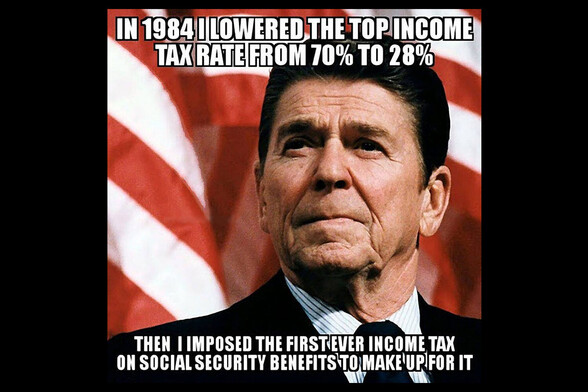
Productivity and wages went along until mit 70ies. Then wages stagnated.
That is the turning point from Fordism to Post-Fordism.
Politically represented by politicians like Reagan and Thatcher. In Germany, the political turn was in 1982, with election of Chancellor Dr. Kohl.
Where Has All the Income Gone? | Federal Reserve Bank of Minneapolis

Middle American incomes rise substantially even while inequality increases

@rbreich
This is pretty clearly USA data.
For the UK, output has been much flatter but it remains the case that output has grown but workers' share has not.
@rbreich less people in a union >> more productivity
@rbreich Thank St. Ronnie, and the govt busting PATCO. THAT sent the batsignal that anything went.
@rbreich
this old meme makes Reagan-idolitrists blow their tops; the truth hurts, even if brutally oversimplified..
@rbreich Geez, it’s certainly a strong correlation. Unions make a lot of sense and they work to raise wages and protect the interests of the worker. One proof is how bat-shit agressive corporations are at fighting them being created. Corporations know organised workers get a better deal, and they can’t have that hurting executive bonus cheques and share holder buybacks. Pie only goes so far!