 John Carlos Baez
I'm fascinated by the Inuit-Yupik-Unangan languages in Alaska, Canada and Greenland. There are many of these languages: they ring much of the Arctic Ocean. I just learned that they use a base 20 system for numbers, with a 'sub-base' of 5. That is, quantities are counted in scores (twenties) with intermediate numerals for 5, 10, and 15. This makes a lot of sense if you look at your fingers and toes.
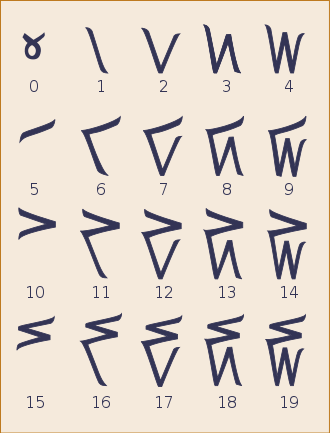
But the Inuit didn't have a written form of their number system - until the early 1990s, when high school students in the town of Kaktovik, Alaska invented one! There were just 9 students at this small school, and they all joined in.
They used 5 principles:
• Visual simplicity: The symbols should be easy to remember.
• Iconicity: There should be a clear relationship between the symbols and their meanings.
• Efficiency: It should be easy to write the symbols without lifting the pencil from the paper.
• Distinctiveness: There should be no confusion between this system and Arabic numerals.
• Aesthetics: They should be pleasing to look at.
They decided that the symbol for zero should look like crossed arms, meaning that nothing was being counted.
This was the start of quite a tale!
(1/n)
 Simon Brooke
 HighlandLawyer
 Iain MacGilleBhràith