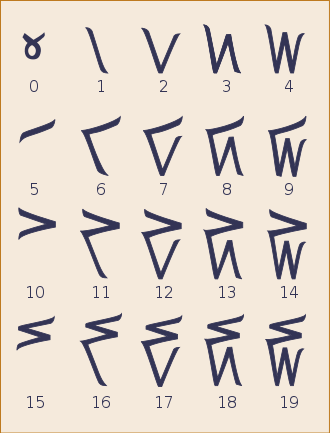
I'm fascinated by the Inuit-Yupik-Unangan languages in Alaska, Canada and Greenland. There are many of these languages: they ring much of the Arctic Ocean. I just learned that they use a base 20 system for numbers, with a 'sub-base' of 5. That is, quantities are counted in scores (twenties) with intermediate numerals for 5, 10, and 15. This makes a lot of sense if you look at your fingers and toes.

But the Inuit didn't have a written form of their number system - until the early 1990s, when high school students in the town of Kaktovik, Alaska invented one! There were just 9 students at this small school, and they all joined in.

They used 5 principles:

• Visual simplicity: The symbols should be easy to remember.

• Iconicity: There should be a clear relationship between the symbols and their meanings.

• Efficiency: It should be easy to write the symbols without lifting the pencil from the paper.

• Distinctiveness: There should be no confusion between this system and Arabic numerals.

• Aesthetics: They should be pleasing to look at.

They decided that the symbol for zero should look like crossed arms, meaning that nothing was being counted.

This was the start of quite a tale!

(1/n)
@johncarlosbaez What I find interesting about this is that both English ('the years of a man's life are three score and ten') and French ('quatre vingt huit") traditionally used base twenty counting.
@simon_brooke @johncarlosbaez Gàidhlig was commonly using a vigesimal system until late C20th too; it's only since the 1980s that decimal has really been taught as the standard eg ceathrad instead of dà fhichead

@HighlandLawyer @simon_brooke @johncarlosbaez
Yup and to be clear (“Gàidhlig was commonly using a vigesimal system until late C20th too…”): most older speakers who didn’t learn that system are STILL using ‘àireamhan tradaiseanta’ (traditional numbers, ie vigesimal system) rather than ‘àireamhan ùr’ (new numbers)!
(Suspect you know that!)

Literally speaking to a bodach last night and we have to translate: he teaches me old and I teach him new…

@HighlandLawyer @simon_brooke @johncarlosbaez
So Simon eighty in Gàighlig in traditional system is almost exactly the same as French: ‘ceithir fichead’ (lit. four twenty)…

…but ‘ochdad’ in new system (as per some French dialects such as Swiss Romande and Belgian French: ‘octante’!)

I always like 50 = leth-cheud (half-hundred … or half a century!)

@HighlandLawyer @simon_brooke @johncarlosbaez

PS to clear up one common misconception that plagues this: people often think this is hard & ‘silly’ & needs maths…
4 x 20 = 80… ??
No!!!
Native speakers just *think* of ‘ceithir fichead’ - or ‘quatre-vingt-dix’ - as numbers. 80, 90.

Just as no EN speaker thinks of nineteen as 9 + 10 = 19!
Or fifty as 5 x 10 = 50!
Sure the spelling in EN disguises it a bit but it’s also bc one takes it for granted as a number…!

@AeonMach @HighlandLawyer @simon_brooke @johncarlosbaez Overall I think the scores system looks easier for learners (or me as a learner anyway) because there's a strong repetitive pattern and actually fewer new words to learn! I found this wiki page with all the numbers helpfully listed out https://gaelicgrammar.org/~gaelic/mediawiki/index.php/Numerals
Numerals - Scottish Gaelic Grammar Wiki

@stephaniejne Ha I like your glass half full and practical approach of realising there are less words in base 20 👌

PS from what I know the ‘air’ approach (eg. ceithir air fhichead) might be a mistaken corruption of ‘(th)ar’ - since as I note there ‘thar’ (over) is normally contracted to ‘ar’ (ceithir ar fhichead).

@AeonMach I hadn't yet seen the air/thar approach anywhere else but on that page. Is it in common usage?

@stephaniejne Sorry, not sure I understand?
You (can) use one of air or (th)ar in the vigesimal approach in the numbers between 20 and 40 rather than using fichead ‘s…
…so 24 is 4 and/over 20 rather than 20 and 4.

Yes this is common! Was just talking to an old boy yesterday who used it!

Does than answer?

@AeonMach Yes it does, thank you!

I'm in the early stages of Gaelic learning so Duolingo, Gaelic With Jason and SpeakGaelic are my sources so far. I'm yet to encounter real Gaelic 'in the wild'.
However, I remember from French A levels how different a real language can be from its classroom equivalent!

@AeonMach @HighlandLawyer @johncarlosbaez I didn't know this - but I'm certainly fascinated to learn it!
@simon_brooke
Basically if you learn Gaelic for practical use (given prevalence of old system among many older speakers - who are a source of much wisdom and good craic) you have to learn both systems!
Which is fun… ;-)
@AeonMach I will admit to having to actively think to use the new numbers...