I'm just learning about this issue of the warming effects of leaked #hydrogen. What do my #EnergyMastodon friends think? Is this overhyped, or a real danger? Can we control hydrogen leaks so that this isn't a big problem, or is this a deal-breaker for many applications of H2, such as in electricity generation? @chrisnelder I would particularly appreciate your perspective here.

#climatecrisis #energytransition

https://www.edf.org/blog/2022/03/07/hydrogen-climate-solution-leaks-must-be-tackled

For hydrogen to be a climate solution, leaks must be tackled

With the continued increase in the demand for hydrogen, here's a look at how the gas can contribute to climate change — including its warming potential.

Environmental Defense Fund

@croselund @chrisnelder First of all, do take a few minutes of time and read the reviewer comments ("Interactive discussion") on the paper of the authors: https://acp.copernicus.org/articles/22/9349/2022/acp-22-9349-2022-discussion.html

The whole topic and the specific accounting is a bit disputed.

Where they are right: H2 leaking into the atmosphere will have some climate impact. It is best to prevent that.

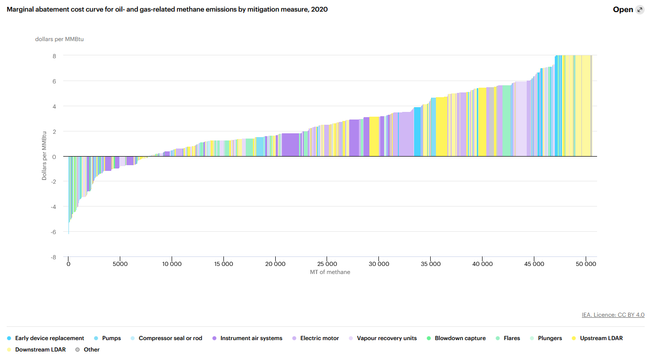
@croselund @chrisnelder But there is a big difference between natural gas and H2 leaks: While NG is usually cheaply available and companies have not cared much about leakage (economic argument: If you get it basically for free, why spent money on detecting and fixing small leaks)? The IEA had a nice figure on abatement costs for CH4 leakages.

Abatement costs are estimated to be negative in some cases (sic!).

From here:
https://www.iea.org/reports/methane-tracker-2021/methane-abatement-and-regulation

Methane abatement and regulation – Methane Tracker 2021 – Analysis - IEA

Methane Tracker 2021 - Analysis and key findings. A report by the International Energy Agency.

IEA

@croselund @chrisnelder Coming back to H2: The economics are a bit different. A lot of investment and costs go into producing every single molecule of H2. It's much more precious than your average natural gas.
So there is an economic incentive to detect and reduce leakage.

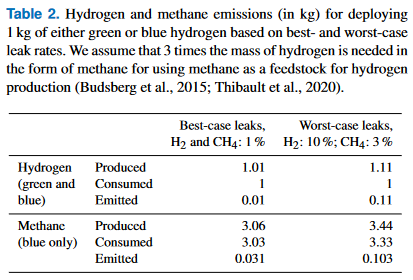
In the paper by Ocko and Hamburg (2022) between 1-10% leakage of H2 is assumed. That. Is. A. Lot.

It also directly translates to H2 costs being 1-10% higher.

I doubt we'll see two digit leakage rates in the future.

@croselund @chrisnelder So my bottom line is:

* Improve monitoring and detection: Certainly
* More policy attention: Certainly (e.g. H2 emissions are not monitored like other Kyoto protocol gases)
* Stricter limits on H2 leakage: Yes

The more we electrify, push energy efficiency and reduce transport distance for H2, the less H2 leakage will become an issue.

Using derivatives of H2 instead of molecular H2 will also help.

@euronion @chrisnelder Thank you for those insights! Your bottom line sounds highly reasonable; I also wonder if this makes some applications of H2 (like blending H2 in residential gas networks) more problematic from a climate perspective.

@croselund @chrisnelder Agreed. This could be the case, but I've never seen it considered anywhere in an evaluation.

Blending with NG in distribution grids (notwithstanding other reasons against it) could be a prime example: You'll not retrofit appliances for 10-20%-vol. blend, so probably also see increased leakage of H2 there.