 Tom Moffatt
 Sheril Kirshenbaum
How a country’s healthcare expenditure correlates with its citizens average life expectancy.
With one notable anomaly.
Source: Latinometrics using World Bank data
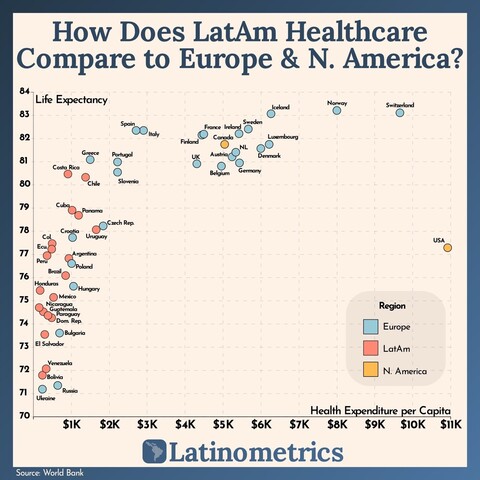
How a country’s healthcare expenditure correlates with its citizens average life expectancy.
With one notable anomaly.
Source: Latinometrics using World Bank data
@akaBeth10 @Sheril Thank you. It makes a change to meet someone genuinely interested. So one of the problems in nutrition research, as you might know, is industry funding or comparing nuts, legumes, seeds, oils and meat to terrible ultra-processed foods making them look healthy.
This study compares nuts to pretzels! This puts nuts in a favourable light (full of fat) and focuses on weight. Endothelial function?
https://www.tandfonline.com/doi/abs/10.1080/07315724.2010.10719834

Objective: There is a widely held view that, due to high fat content, snacking on nuts will lead to weight gain, ultimately causing unhealthy changes in lipid profiles. This study is designed to st...
@akaBeth10 @Sheril it's not always the intention of the researchers, but this goes off into the media as 'eat loads on pistachios'.
Approx 28g of nuts is the recommendation (and only because people eat such junk and it displaces junk - not really healthy - the protein, vits, minerals are available in foods with a lower fat burden.
They add up over a day in cereals, baking, butters/spreads, cereal bars, and sitting munching in front of the TV.

Objective To examine the traditional diet-heart hypothesis through recovery and analysis of previously unpublished data from the Minnesota Coronary Experiment (MCE) and to put findings in the context of existing diet-heart randomized controlled trials through a systematic review and meta-analysis. Design The MCE (1968-73) is a double blind randomized controlled trial designed to test whether replacement of saturated fat with vegetable oil rich in linoleic acid reduces coronary heart disease and death by lowering serum cholesterol. Recovered MCE unpublished documents and raw data were analyzed according to hypotheses prespecified by original investigators. Further, a systematic review and meta-analyses of randomized controlled trials that lowered serum cholesterol by providing vegetable oil rich in linoleic acid in place of saturated fat without confounding by concomitant interventions was conducted. Setting One nursing home and six state mental hospitals in Minnesota, United States. Participants Unpublished documents with completed analyses for the randomized cohort of 9423 women and men aged 20-97; longitudinal data on serum cholesterol for the 2355 participants exposed to the study diets for a year or more; 149 completed autopsy files. Interventions Serum cholesterol lowering diet that replaced saturated fat with linoleic acid (from corn oil and corn oil polyunsaturated margarine). Control diet was high in saturated fat from animal fats, common margarines, and shortenings. Main outcome measures Death from all causes; association between changes in serum cholesterol and death; and coronary atherosclerosis and myocardial infarcts detected at autopsy. Results The intervention group had significant reduction in serum cholesterol compared with controls (mean change from baseline −13.8% v −1.0%; P<0.001). Kaplan Meier graphs showed no mortality benefit for the intervention group in the full randomized cohort or for any prespecified subgroup. There was a 22% higher risk of death for each 30 mg/dL (0.78 mmol/L) reduction in serum cholesterol in covariate adjusted Cox regression models (hazard ratio 1.22, 95% confidence interval 1.14 to 1.32; P<0.001). There was no evidence of benefit in the intervention group for coronary atherosclerosis or myocardial infarcts. Systematic review identified five randomized controlled trials for inclusion (n=10 808). In meta-analyses, these cholesterol lowering interventions showed no evidence of benefit on mortality from coronary heart disease (1.13, 0.83 to 1.54) or all cause mortality (1.07, 0.90 to 1.27). Conclusions Available evidence from randomized controlled trials shows that replacement of saturated fat in the diet with linoleic acid effectively lowers serum cholesterol but does not support the hypothesis that this translates to a lower risk of death from coronary heart disease or all causes. Findings from the Minnesota Coronary Experiment add to growing evidence that incomplete publication has contributed to overestimation of the benefits of replacing saturated fat with vegetable oils rich in linoleic acid.
@akaBeth10 @Sheril fat is damaging. Meat contains fat, and inflammatory and/or cancer-carusing agents - N-nitrosos, MelQX, heterocyclic amines, polycyclic aromatic hydrocarbons, Neu5Gc, etc.
Along with these molecules, fats/oils in larger or sudden amounts (from plants or animals), damage our endothelial linings. Cholesterol is part of a wider mix. Here's an intro, then we could get into the specific scientific studies on endothelial. https://www.wholefoodsplantbasedhealth.com.au/heart-health/endothelium/
@paulpeace @Sheril Going back to the 1st link, it states, for example: "Despite studies on animal models supporting the cancer-promoting effect induced by high fat intake [26], epidemiological studies reported opposite results [27]" And here's the link to the actual study for [27]: https://pubmed.ncbi.nlm.nih.gov/20697723/?dopt=Abstract
If you go through every link listed you can go to the actual studies on PubMed and read them.

This meta-analysis suggests that dietary fat may not be associated with the increased risk of CRC. More well-designed studies with larger population performed among Asians are needed to further evaluate the associations. In addition, probable bias caused by measurement error should be noticed in thi …
@akaBeth10 @Sheril You agreed to make fewer points and we'd discuss via dialogue, taking our time, rather than talking at one another in bursts of monologue.
I shared an overview with you to ease in before the science papers, which are heavier for us, not as a definitive scientific guide to endothelial function. You're not a scientist. It's an easier read.
@paulpeace @Sheril Ok, what I want to send you is not available for the general public. I don't know why. But it's this study, https://academic.oup.com/eurjpc/article-abstract/29/18/2312/6691821
I subscribe to the work of a researcher in the UK, so I have her extensive review of this study, so I know what's in it, but can't share it since it's behind a paywall. But this article from her PhD work is free. https://bjsm.bmj.com/content/53/22/1393

Introduction: For half a century, a high level of total cholesterol (TC) or low-density lipoprotein cholesterol (LDL-C) has been considered to be the major cause of atherosclerosis and cardiovascul...
I suspect the difference in suicides are are result of the insane lack of gun regulations in the US.
@akaBeth10 @Sheril Guns kill roughly the same number of people as cars, but ~2/3 of those gun deaths are suicides until the last two years of available data.
It's still the case that gun homicides are one of the leading causes of death in children, though.
@Sheril
...but universal healthcare is communism!!11!!11111
Shocking.
Yes, the #US wastes a lot of $$$ when it comes to #HealthSpending. #DrugPrices and very unequal distribution of the benefits are likely culprits.
However, #LifeExpectancy also heavily depends on your eating habits (and others).
The #MediterraneanDiet seems much more effective than assumed:
we all remember the pictures from #Bergamo in the #Pandemic of 2020. #Italy's healthcare is not great, nor is #Greece's, or the ones in the #LatinAmerica.
@Sheril Looking at health expenditure: Switzerland and U.S. at far right—greatest expense per capita—with Switzerland having the higher life-expectancy. If I’m reading the chart correctly.
Does a large proportion of poor, of immigrants, influence the results? The expense? Switzerland having fewer than U.S.—accounting for the more life years—at same high expense per capita?
@Sheril It isn't "waste" responsible for the US being far out in right field.
No, tt is the moral equivalent of theft, again the rich stealing from the poor.
The obsession with the free market means that some businessvermin has to have the right to cheat you at each and every step of the war, and you as an individual have no leverage.
 s1m0n4
 Travis Briggs
 BigD
BigD aardvark
 Paul Peace
 Sophie
 Elizabeth

 TomGregory
 Anti-Fatalist
 dr2chase
 Badwolf303
 Menno
Menno infinite_loopy
 chef 😎
 Jakob Thoböll - R.I.P. Natenom
 HistoPol (#HP) 🏴 🇺🇸 🏴
 Mrinappropriate
 Reboot Robotnik
 Mark Mason
 AskYourLocalGerman
 gavinisdie
 PJT North
 Terri Henry
 Tom Ritchford