 itatiVCS
today is the DAY we talk about elephants and carbon gains in savannas for #FlashbackFriday !
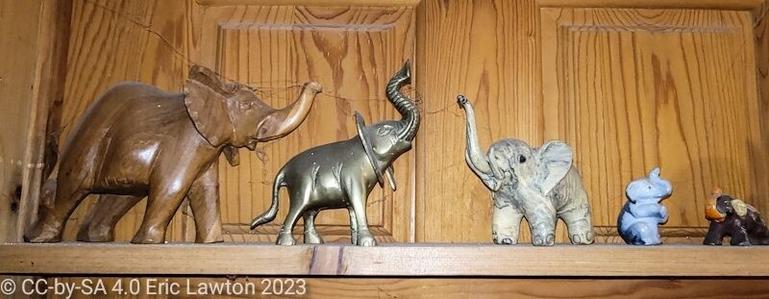
#Elephants are truly great creatures. They’re highly intelligent, charismatic megafauna who hold a special place in the hearts of many people. They’re :the: charismatic megafauna of the savanna. Also, they make for the cutest plush animals.

but, dear reader, do you know the real reason I love elephants?
.
.
.
Because at local to regional scales their foraging behavior keeps the trees out of my savannas!
.
.
.
Because at local to regional scales their foraging behavior keeps the trees out of my savannas!
"But itati, how do we know that?"
worry not, frienderinos. We know that from this really cool study by AB Davies.
Davies, AB, Asner, GP. Elephants limit aboveground carbon gains in African savannas. Glob Change Biol. 2019; 25: 1368– 138
Its actually a very rad study that combines 1) the best mammals and 2) liDAR data. But let's get back to basics first. Why did we need to investigate if elephants were important to savannal C cycles?
First, there's a general *vibe* in the #carbon cycling literature: that animals are not as important to carbon #biogeochemistry as plants or soil microbes. This is wild, because we have a few concrete examples of how large animals like moose can contribute to C cycling.
Their selective #grazing and foraging changes the canopy height of the plants around them, leading to warmer and drier soils. These dry soils lead to decreaed carbon dioxide uptake by the plants.
Additionally,in the Serengeti, wildebeest eat so much grass that fire spreads less;so much so that this leads to an increase in stored carbon. every 100K wildebeest leads to 10% less burned area. So, knowing that manimals can have such an impact, we should really get to figuring out impacts that megafauna like elephants have!
We know in the past that megafauna in particular were REALLY important for plant life cycles--we think that the amazonian rain forest today actually has less carbon due to the absence or decline of giant herbivores that used to disperse the seeds of tropical trees!
What might this mean for elephants in my beautiful savannas? Well, first its important to note that elephants use their trunks to both browse on trees and munch on grasses-this choice between greenery has to do with availability!
Elephants eat trees not just by gently using their extendanose, but if you're a bull elephant, you FLEX on these savannal haters by literally TOPPLING the trees so you can eat all the delicious soft leafery you want. goals, tbh.
In this specific savanna, the elephant population has exploded following a ban (moratorium) on culling. In the same timespan, other researchers have noticed that woody biomass has decreased.
Is the decrease because elephants-either male elephants or mixed-sex herds-are hungry af?
As you can probably imagine, its hard to get really high quality measurements of both landscape variaton via sampling on the ground and do manipulative field experiments in the savanna. its the *literal* wild. So what's an elephant lover to do?
As you can probably imagine, its hard to get really high quality measurements of both landscape variaton via sampling on the ground and do manipulative field experiments in the savanna. its the *literal* wild. So what's an elephant lover to do?
In this study, the authors combined #LiDAR data with field measurements and exclosures to see if elephants played a significant role in landscape level changes to carbon stocks (so, stored woody mass) in the savanna.
So, a drone flew over the savanna and collected relevant data over the wet season that allowed the authors to make maps of Aboveground Carbon Density (how widespread is treecover, in all dimensions) for 2008 and 2014. The difference b/w those two maps is the difference in ACD.
So, a drone flew over the savanna and collected relevant data over the wet season that allowed the authors to make maps of Aboveground Carbon Density (how widespread is treecover, in all dimensions) for 2008 and 2014. The difference b/w those two maps is the difference in ACD.
But, just because we have the map of the carbon doesn't mean we know its because of the elefantes or because of something else. So, we need to make spatial datasets for what could explain the difference in ACD. Using more LiDAR data,the authors made maps of slope, elevation, aspect, and relative elevation as well as accounting for fire scars and distance to streams (elephants love to eat by streams). they also made maps of elephant density, seperate for each herd type.
to isolate the effects of ~just elephants~, the authors also incorporated data from two sets of experimental herbivore exclosures to see how the exclusion of elephants affected ACD in those areas.
Overall, from 2008 to 2014, ACD increased in 4/6 of the study savanna landscapes observed. Landscape topography and elephant density were the most influential factors in changing ACD values. HOWEVER!
Overall, from 2008 to 2014, ACD increased in 4/6 of the study savanna landscapes observed. Landscape topography and elephant density were the most influential factors in changing ACD values. HOWEVER!
Decreases in ACD-so, losses in woody mass and cover-only happened with bull elephants, not with mixed herd elephants. Imagine being such a bro that you literally change regional carbon dynamics as a flex. thats what bull elephants are.
other important factors in ACD loss were distance to river and elevation--elephants of all kinds love to chow down near rivers and on gentle slopes. The interaction of low rainfall, high fire frequency, and recent time since fire interacted with bull elephant density to lower ACD.
So, at the landscape scale, the explosion of elephants doesnt lead to substantial carbon losses (in terms of aboveground biomass).
So, at the landscape scale, the explosion of elephants doesnt lead to substantial carbon losses (in terms of aboveground biomass).
But, at finer scales, bull elephants (especially in high densities) can lead to decreases in ACD. Are elephants all-around the savanna causing incredible losses in aboveground carbon? not really. But, in certain zones, are they toppling enough trees to make a marked difference in carbon gains? yes! We shouldn't discredit their contribution to ecosystem function.
Thanks for following along with me talking about #elephants and #carboncycling for this #flashbackfriday
 Eric Lawton