JWST Sees the Same Supernova Three Times in an Epic Gravitational Lens

Thanks to a powerful gravitational lens, astronomers were fortunate enough to see the same supernova three times in a distant galaxy. The lens is the galaxy cluster RX J2129, located about 3.2 billion light-years from Earth. When examining the region, researchers noticed that one of the lensed galaxies is duplicated three times - and they all contain the same supernova. Because the light took different paths, the same supernova is seen hundreds of days apart, showing its evolution in a single image.

https://www.esa.int/ESA_Multimedia/Images/2023/02/Seeing_triple
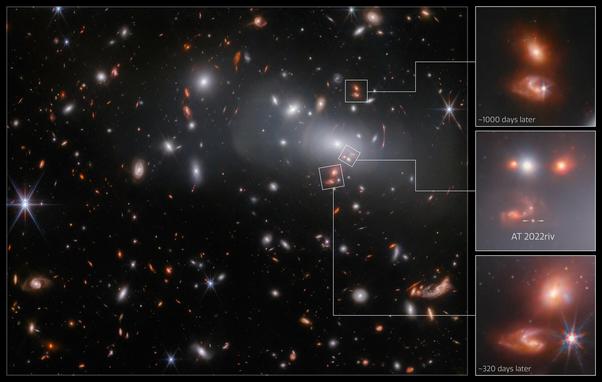
Seeing triple

@fraser This is unlimitedly cool.
@tomlevenson they've actually seen this kind of thing before. In one case the supernova hasn't gone off in one of the images.

@AstroKatie @tomlevenson

This one:
A Gravitationally Lensed Supernova with an Observable Two-Decade Time Delayhttps://arxiv.org/pdf/2106.08935.pdf

@fraser General Relativity is the gift that keeps on giving.
@fraser @tomlevenson This was going to be my very next question - thankyou!
@fraser
With three data points providing a definitely known time difference and therefore distance difference the light travelled via each route, does that give a precise measurement of anything about the supernova, I wonder? Actual brightness or distance or something?
@petealexharris I'm not sure. The valuable ones are where the supernova hasn't appeared yet. So they can observe it the moment it explodes.
@antygon czyli zagadka "trzech galaktyk z roznych okresow w dziejach na jednym zdjeciu" wyjasniona :D pytanie czy to nie jest jakas wada #JWST, ktora w tym konkretnym przypadku okazala sie niesc wiecej korzysci jak problemow?
@fraser ok, that is just cool
@fraser Snazzy bit of astronomical time travel there...Taking me back to the first #SciFi I read when I was seven years old - Tunnel Through Time, Lester del Rey
@dendroica @fraser Lester del RayTakes, me back ...

@dendroica @fraser

I remember that novel. I got it from Scholastic Book Services at school. I re-read it occasionally

@fraser if there’s any random ish signal from those, we could get absurdly accurate (and continuously analysed) distance deltas between fhe three light paths. Down to fractions of a meter potentially. Would that be useful?!
@fraser this is easily the coolest thing I've ever seen
@pyro OH MY GOSH MY HEART! This is brilliant on so many levels!
@fraser Since #photons have no mass and unaffected by gravity - it is space and time that are “bent” by massive gravitational forces - hmm - might have to think about that a little more.