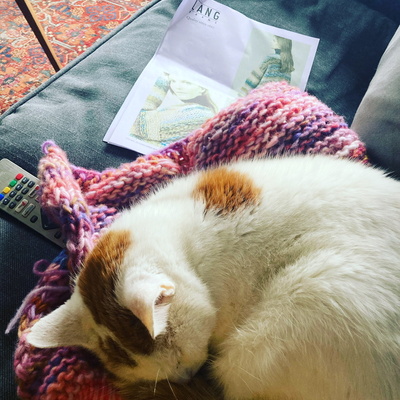
I am reading The Golden Thread: How Fabric Changed History, by Kassia St. Clair. I'm on page 21. I am already incensed at the perception of history I was taught for 35 years of my life.

Stone Age. Bronze Age. Iron Age.

Those are the tools that survived, yes. But what those tools were for was the Twisted Fiber Age. The Linen Age. The Wool Age.

We then entered the Cotton Age, riding the backs of global colonization and industry. Now we are in the Petrochemical Age.
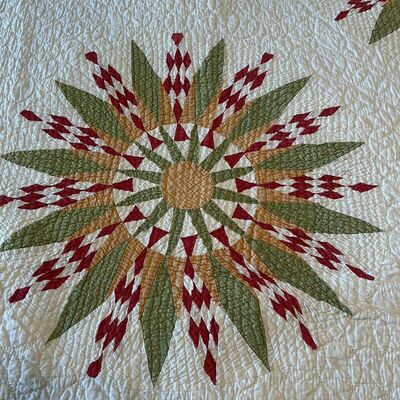
#FiberArts #History

Why we have the former names, Industrial Age, Atomic Age, Information Age, and not the Fast Fashion Age, is just, is, it's so rooted in the devaluation of the work of women that I just sputter with rage.

The way we talk about time is fundamentally misogynist, and if I don't prevent myself from contemplating it I grind chips off of my teeth.

#History #FiberArts #Misogyny

@sigridellis

From an ecological standpoint, the fashion industry is terribly polluting and wasteful.

We don't need closets full of clothes/shoes that we wear a few times a year, or worse, just once.

We are in drastic times, and drastic changes need to be made all across our lifestyles board - especially in something as inconsequential as what we wear.
If it were up to me, we'd all be wearing a uniform type of clothing, 5 outfits each with replacements once a year for everyone.

Oc, changes to our monetary system need to be made as well - some type of ubi that pays ppl to not work. Equal distributions to everyone.
Coupled with slashing our energy use everywhere.

For the sake of the planet, humans need to get over themselves and their obsession with fashion and looking good.
There will be no prize for the best dressed when we are drowning, frying or dying from the pollution we dump on the planet daily.

Just saying. 🤷

@sigridellis Exactly so! I feel like I've been saying this for the past 30 years!

Have you read "Women's Work: The First 20000 Years" by Elizabeth Wayland Barber? I read it when it came out in 1994, and I just wished it had come out a year earlier - I could have summed up my college capstone project by pointing to it and saying "SEE?!!? Like THAT!"

@megueyb I have read it and I own it, yep.
@megueyb @sigridellis that book is one I give people like samizdat only it doesn't require any labour on my part
@sigridellis wishlisting that book asap
@sigridellis Kindergarten should begin with a lesson on survivor bias.

@sigridellis: Well, it is possible to grow potatoes, use the starch as a feedstock for organic chemical synthesis, and thus make all sorts of formerly petrochemical fibres out of the potatoes.

The best part of it is, if you burn the synthetic plastic when you're done with it, it'll be carbon neutral, and if you bury it in a landfill, you will have removed that much carbon from the atmosphere, and sent it back to the chthonic depths whence it came. (Well, slightly lower depths, but the idea is the same.)

@sigridellis that’s a fascinating book.
@sigridellis that’s going on the reading list
@sigridellis I mean it strikes me that those early ‘ages’ are largely named after items that will stay well preserved in archeology sites. Did we have good evidence of advances in fabric tech back in the 1800s?
@chris We absolutely did. The (largely male) archaeologists frequently mis-identified objects used in fiber arts as ceremonial, or currency, or decorative. Loom weights are a great example of this! Also, the metal remnants of wool-carding devices were misidentified as grooming products for humans.

@sigridellis
Computer programming is weaving with ones and zeros instead of warp and weft, or knit and perl.

Knitting instructions are a bona fide machine language with sequencing, branching and looping.

The product is something substantial made from the skillful arrangement of tiny insubstantial things. No brute force is required, only monumental patience and rapt attention to detail.

Cloth instead of pelts,
Pottery instead of stone,
Bread instead of meat,
Baskets instead of buckets,
Nets instead of spears,
All from the same "something out of nothing" synthesis that drove so much of civilization.

Thanks for recommending The Golden Thread.

@sigridellis Yeh, like who do they think invented the needle and sewing, needles and knitting or crochet or lace-making, or embroidery, or tapestry? Who made all those clothes everyone wore? Hint; it almost certainly wasn't men, they were out, doing other stuff.
@sigridellis thank you, I'm listening to the audiobook now
@sigridellis this looks like a great book, thanks for sharing. My library has it! Borrowing it today!
@sigridellis I feel the same as I read Worn by Sofi Thanhauser. Just raging about how we are not taught about the importance of textiles to everything because it is made by women- most of whom have been exploited in one way or another.