
We have a new study out!

The short version is this: "Car Brain" - the cultural blind spot that makes people apply double standards when they think about driving - is real, measurable and pervasive.

Read on for more details... 1/14 @[email protected] @[email protected] @[email protected]

This work was carried out with top-class humans @[email protected] and @[email protected]. We did something deliberately very simple: we had an independent polling agency contact a representative sample of 2157 people across the UK and ask them five questions 2/14
Randomly, people either got questions about driving or they got the same set of questions with a couple of words changed so that they asked exactly the same things, but not about driving 3/14

For example, half were asked if they agreed:

"People shouldn't drive in highly populated areas where other people have to breathe the car fumes"

and half got:

"People shouldn't smoke in highly populated areas where other people have to breathe the cigarette fumes"

4/14

(We originally considered specific v general questions, e.g.,

"People driving cars in public places should be liable for any harm..."

"People operating machinery in public places should be liable..."

but decided that changing the context was neater and less subjective) 5/14

Here's the full set of answers. As you can see, responses could change dramatically when driving was mentioned. All except Question 2 were hugely statistically different.

This doesn't make sense! The principle is the same in both forms of each question; only context changes 6/14

What we demonstrated is an example of the "Special Pleading Fallacy" https://en.m.wikipedia.org/wiki/Special_pleading where certain specific cases get a free ride in thought and discourse. People selectively fail to apply the moral and ethical standards they would use in other contexts 7/14
Special pleading - Wikipedia

Is this self-interest? Cognitive dissonance? Most people drive, so it might make sense they'd make excuses.

But no. We separated out the subset of people who didn't themselves drive and they basically responded the same as the drivers, also making special pleading for cars 8/

This all required a deeper explanation. We interpreted the findings within a socio-ecological framework: each of us is surrounded by a series of social, physical and cultural environments that shape how we think and act. And how do these look when it comes to motoring...? 9/14
We routinely see people driving short distances, speeding, parking badly, all while given priority over pedestrians; free parking; urban and residential streets designed for fast driving; subsidies; lax enforcement of traffic laws; clearly deadly vehicles made legal... 10/14
Growing up surrounded by that environment, people internalise the idea that fast, untrammelled, near-consequence-free motoring is normal and, moreover, people conclude that *this must surely be the proper way of things*. In our paper we call this mindset "Motonormativity" 11/14
We chose this term to draw parallels with other areas such as heteronormativity, where similarly a certain perspective unthinkingly gets accepted as both normal and proper, with other groups obliged to accommodate this https://www.simplypsychology.org/what-is-heteronormativity.html 12/14
What Is Heteronormativity?

We suggest this mindset isn't just present in the public, it's also endemic in policymakers and people who look after public health. This explains a lot of planning and policy decisions: they make sense if you assume everyone drives and that this can't, or shouldn't, change 13/14

We end with a call for policymakers to recognise their unconscious and institutional biases and to implement mechanisms to overcome them in planning and health decisions.

You can read the full paper here for free https://psyarxiv.com/egnmj

Thanks for reading! 14/14

‘Motonormativity’: Britons more accepting of driving-related risk

Allowance made for dangers that would not be accepted in other parts of life, finds study with potentially major policy implications

The Guardian
@ianwalker fantastic. I'd long suspected something like this must exist. It seems to me even those who want to reduce driving often give in to the social norm that it's a special case.
Will you be doing follow-ups?
@transport #TransportPlanning
@tgent_fens @transport Oh I do hope so. There's definitely more to be done with this now we've created somd sort of framework for thinking about it
@ianwalker great. I imagine underlying assumptions need to be probed? Eg, a car is assumed to be locked without keys, whereas something left in the street is unguarded. Also car use is *assumed* to have non-user benefits, whereas smoking doesn't!
I've a feeling that perception that driving is necessary and socially useful (arguably true to some extent) is key? So utility theory comes into this?
Apologies - I'm sure youre ahead of me on this. Interested to see where you go next!

@tgent_fens Thanks, Tim. Yes, I'd be interested to probe those things further - but, critically, as mechanisms through which the special pleading happens. I would not want to get into the realm of "Well, yes, I guess a certain number of deaths IS okay if it means people can move around..." which is the danger of this sort of thinking.

What we're calling for here is a shift in how we ask these questions: "How can we achieve the goal of moving around IN A WAY THAT FITS OUR VALUES?"

@ianwalker

Hi. Thanks for sharing, interesting!

Having only read the summary and looked at your thread I do wonder how you took in account people not only perceiving different risks but risks actually being on a different level or coming from a different source. Ci and Cii for example appear very different to me as the deciding agent (private choice for various reasons vs work where there's always dependency) is not always the same.

@Pepijn The goal was really to show biases when driving is compared across a range of more neutral topics. If we ONLY did driving v working we'd need to worry about objective data more, but that wasn't really the aim here which was primarily to provide an illustration of a phenomenon that we suspected existed
@ianwalker Ah ok, that works :-)
@ianwalker @Pepijn I think this bias is something we've all come across before. Certainly, interactions I've had with people in the past where I've asked similar questions have resulted in similar reactions to those which you found in your research.
Anyway, I just want to thank you for doing this research as we now have something other than anecdote to point at.

@hembrow @ianwalker

As a Dutch person who lived in the UK (Wales) I suspect most people are aware of their own anti-cycling/walking bias but not their own pro-car bias.

I wonder how this is in the Netherlands though: my theory is that a much lower percentage has a anti-cycling/walking bias but a similar portion has the pro-car bias.*

Is either of you aware of research on this?

*leading to things where at stations there's free car parking and (good) paid bike parking and no-one bats an eye

@Pepijn @ianwalker That's pretty much how I see it as well. Dutch people are rarely anti-cycle (though many are anti-cycling subset - e.g. don't like racers or cargo bikes or recumbents or any other group of cyclists who they perceive as an out-group) but they're also very pro-car and unfortunately that spills over into areas which damage cycling. Not only with paid parking, but also in the increasing trend to ban cycling in shopping streets. This maximises convenience for those who drove to the centre of town and who don't want to see any bicycles once they're there, but it makes cycling for everyday purposes far less convenient and provides a push towards car ownership and use.

@hembrow @ianwalker Solid point on the shopping streets trend. And more and more not even walking with a bicycle is permitted as it's seen as a dirty vehicle that needs to be parked on centralized dedicated infrastructure outside of the shopping zone.

Anecdotal: As I travel a lot with a small foldable bicycle (with a bag around it if it's actually dirty) the Netherlands has been the only country where I got shit for having it with me in shops.

@hembrow @ianwalker To be fair: In old cramped and busy pedestrian areas I kinda get the "step of the bicycle and walk with it until you can leave it in front of the shop". This is for example how it has been since the 80s in some streets in my small hometown.

@Pepijn @hembrow @ianwalker To be honest, parking (either car or bike) policies are very much depending on the station you are at. Most stations have at least some free bike parking of reasonable quality, some have also paid (guarded) bike parking. Many have paid car parking and some have also free car parking.

This applies to The Netherlands.

@ianwalker I don’t drive (I don’t even know how to) and all my life (I’m over 60) one thing has always stuck out:
People comparing other serious risks in life to the danger levels of road traffic accidents – oh, it’s no more dangerous than crossing the road, and you do that every day

And I reply with “that’s my point” but that inevitably goes over their heads


[obligatory] cars kill people slowly and sometimes quickly
@u0421793 Lovely way of putting it!
@ianwalker that sounds like great research and aligns well with my personal experience as a person trying to change traffic policies. Do you plan on releasing some king of campaigners handbook like "how to make people care about traffic deaths and start changing"? For me that's the big open question. Lately I had the though to mentally treat car users like addicts.

@jnbhlr If only I had enough answers to write the book on this!

Actually, we do know a lot of things that would work, but a key barrier to enacting them is cultural resistance to change. That was a big motivator for this study: we wanted to challenge the cultural biases that make it so hard to enact the fixes that we know would help (make driving harder and slower, basically...)

@ianwalker Well I don't need a book, just a toot or two might help :-) Now that you pinpointed cultural resistance to be a key barrier, I hoped you might have an idea or two. It contributes to the tripping point concept: Once our car-centric environment gets fixed, people will want car-centric rules less and less.

@ianwalker @jnbhlr

A book would good. A bike would be better.

My (unscientific) observation of many years is that the simple act of cycling in cities is the only consistently effective treatment for motonormativity (fun phrase). Within weeks, new cyclists start talking about motorist behavior.

It would have been interesting to track “daily urban cyclists” as a subgroup of your participants. My thesis would be daily cyclists would rank lowest on a motonormativity scale.

@ianwalker relevant for cybersecurity too. Harm being normalised. Interesting work !

@ianwalker Great work! Thanks for sharing it. It'll help a lot of researchers in the field.

A question: Could some results be partially affected by linguistic confusion?
for example: the question about leaving belongings unattended in the street, most people would think of the word "belongings" as a small thing you could have in proximity at all times, very dissimilar to a car.

@ianwalker Incredible research. As a multi-modal driver / cyclist / public transport-er (that last one doesn't work as a descriptor), this has made me think about how we view the position a car takes in society. Especially that 1st Q about your car or belongings getting stolen. Expands well beyond into drivers believing they are being considerate (to other drivers) by parking on pavements & leaving more space for cars to drive past. How do we tackle this? It's taken 40-odd yrs to get this stage.
@natzdb Thank you! I think the first stage is for people to admit there's a problem. I hope on some way this work makes people start to notice that. The dream is they put systems in place to counter the problem, and to stop ourselves actinf in a way that's actually counter to our values
@ianwalker just finished reading your superb paper. Fascinated by the final Q smoking v driving & how much that will have changed since intro of smoking ban 15y ago. I remember the backlash at the time, now it's totally normal that you don't smoke around others indoors. Can only hope we make equally rapid progress with urban design & public health messages re: driving. Keep up the great work.

@ianwalker I don’t think there’s any doubt that you’re right about us making unconscious excuses for cars.  But I wonder if it is a lot more deep-seated than we realise.

It could be environmental of course, but I suspect it goes back thousands of generations.  A huge amount of information perceived by the eye does not get as far as our brain because it is filtered out, otherwise we would go mad with Information overload. I think our brain separates images by relevance.

@peterbrown You're right, and I can bang on about attention and driving very happily! But, critically, what we attend to when we try to avoid information overload is predictable, and the relevance we use to decide where we will attend is based on our expectations. And these, in turn, are shaped by personal experience and cultural norms

@ianwalker food is the most important determinant.

Is it going to eat us or can we eat it?

 The body language of a man, and gives a good indication whether you’re about to become dinner; the wider the stance the higher the probability you are in his sights. 

So somewhere deep in our subconscious, our brain sees what appears to be a large mammal with its headlights looking straight at us, and our instinct is to respect it and avoid it. Many car makers deliberately tap into this e.g. Jaguar

@ianwalker I would further suggest that the “sorry I didn’t see you mate” syndrome for bicycles and motorcycles, where the driver looks straight at the oncoming two-wheeled vehicle and then pulls out in front of it, is due to the brain filtering out the bicycle or motorcycle, because it must be a large bird, and cannot be of any danger.
@ianwalker I think this taps in to the much publicised study where subjects watch a video of a football match, but very few see the bear walking across the screen on the football pitch. The brain is focused on the football game and screens out “less relevant” images.
A PhD for somebody ?

@ianwalker

Love that you referenced 'heteronomative'. I've done a non-scientific experiment w/this very concept. It involves asking people to close their eyes and picture what the first Homo sapiens looked like...9 out of 10 times they reply; white male.

That 1 out of 10? The epiphany.

I'm hoping your research will result in the same epiphanies on a grand scale.

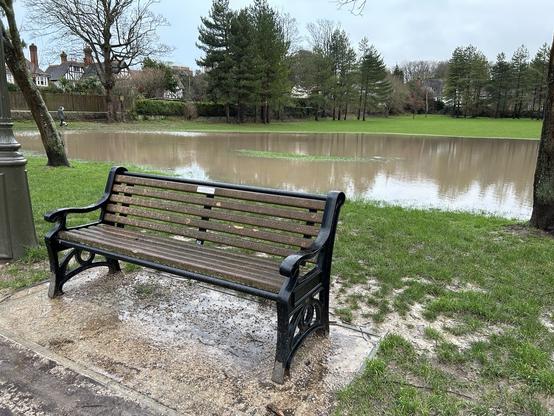
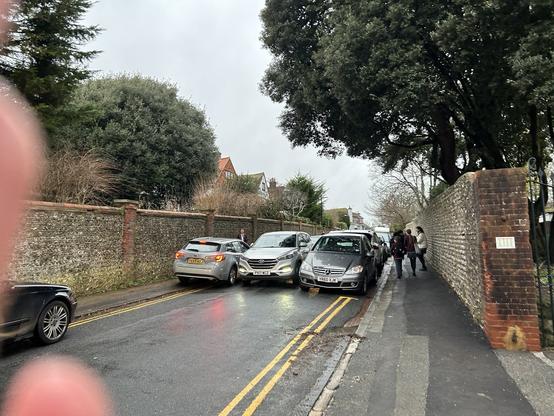
@ianwalker just a little illustration from outside our school two days ago (can’t be bothered to hide number plates). Meanwhile our local park 200m away is completely flooded by unprecedented amounts of rain. I know the links are tangential but they are there and i wish people would see them but they just don’t

@ianwalker great paper snd great term. I just replied elsewhere: will use of for teaching intersection of personhood infrastructure - car culture so deeply intertwined with how we think about what it means to be a person

https://mastodon.green/@pvonhellermannn/109703314518108356

Pauline von Hellermann (@[email protected])

@[email protected] what a good word, motonormativity. I am teaching a new module this term, on #Personhood, with one week on Infrastructure, where i am very much looking forward to letting rip on how car dependency shapes our sense of self (entitlement, individualism etc). Really designed the whole module just for that!

Mastodon.green
@ianwalker oh I like this!
@wlukewindsor It's such a useful framework for understanding how we're influenced from outside
@ianwalker I’ve used a similar approach to explain complex improvised musical behaviours!
@ianwalker This is the one that surprises me and breaks my preconceived idea that it was all tied to self-interest and/or being protective because of the money people ‘invested’ in their cars.

@ianwalker Woah 🤯 this is my introduction to the concept of the “special pleading fallacy” and it is totally congruent with my life experience.

For me, in concept and in the abstract, I am far more principled than most of my peers. In social settings these double standards come up in conversation often. — I’m just as guilty as the next person in holding and living out double standards — But with that said, having a term to describe the phenomenon is so helpful.

@ianwalker Those are striking differences. Did the research also had some population/control questions like "do you have a drivers license" or own a car, are a cyclists, age, gender etc?

Glad to see that at least "bending the safety rules" is even for car drivers not seen as acceptable (Q2)

@ianwalker Forget my earlier question, it is in the following toots. Good work! I am now reading the full paper, which I also will share with (a.o.) my daughter, who is a designer by training and will appreciate the complexity behind whatever-normativity (be it motonomativity, heteronomativity, malenomativity, etcnomativity).
@ianwalker I'd like to know if you really feel that a delivery driver and a chef have the same kind of relationship with health and safety rules, There's no explanation in your paper regarding to the methodology you used to establish this kind of comparisons, but your study is based on this statement: the questions on the left/right are equivalent. Can you please prove it? Because I don't know if you have thought about the difference between leaving a bag or an elephant in the street.
@ianwalker The smoking one is very interesting - an example of how the Overton Window has comprehensively shifted! 20 or even 10 years ago it would've been the same as the driving example.
As for the delivery driver example, I'm *very* surprised so few people agreed that it's fine for delivery drivers to park on pavements etc - but maybe "bend a few health & safety rules" isn't understood as parking on pavements & in bike lanes
@ianwalker: I don't think all of the question pairs are good matches, so I'd approach the results with some reservations, but it's a neat idea, and future studies like that have a great potential.
@ianwalker das ist hart. Ohne diese Abnormität gäbe es eine 75% Mehrheit gegen stinker in Städten und nur 10% Gegner. Wäre für Politik also ein No-brainer das zu tun.
@ianwalker I suspect the reason Question 2 got the response it did, is because it’s about other (working class, i.e. poor) people driving. The thing about carbrain is that it mutes people’s empathy, so I actually think the answer is totally inline with the rest of the results.
@lbSterling Or perhaps, as somebody else just suggested on here, it could be because those questions explicitly mention rules being broken?