
In pop culture, computing & programming are often depicted with “tech bros.” But the first computer programmer was a brilliant woman.

Augusta “Ada” Lovelace was born in 1815. Her notes include an algorithm designed to be carried out by a machine & she envisioned that computers could go beyond calculations. Lovelace described “how individuals & society relate to technology as a collaborative tool.”

Lovelace passed away in 1852 at just 36. https://www.newyorker.com/tech/annals-of-technology/ada-lovelace-the-first-tech-visionary #HistoryRemix #history #science
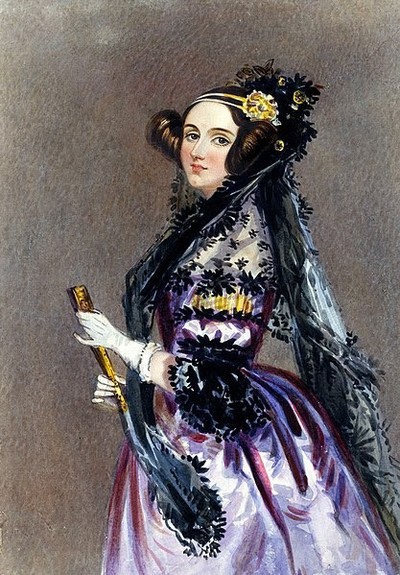
Ada Lovelace, the First Tech Visionary

Lovelace, known as the first computer programmer, has been recognized annually to highlight the often overlooked contributions of women to math and science.

The New Yorker

@Sheril

Here's a video I recorded at the #ComputerHistoryMuseum back in 2014 on #GoogleGlass.

The "Babbage Analytical Engine" demonstrated. This is one of two in existence, on loan at the time to the CPH in #MountainView The other's in London.

Beautiful piece of machinery, should be named for Lovelace. 💜

@NerdGirlInVR @Sheril Nathan Myrhvold kindly lent his Babbage Engine to #ComputerHistoryMuseum for ~half-dozen years. When he wanted it back, we replaced it with a big Ada Lovelace exhibit in cooperation with Oxford & Prof Ursula Martin, who was curating big batch if Ada’s letters. Here’s link to event on resulting book, which also links to page when we earlier opened the exhibit, which ran for several years.
https://computerhistory.org/events/ada-lovelace-making-computer-scientist/
Ada Lovelace: The Making of a Computer Scientist - CHM

Join two of the co-authors of Ada Lovelace: The Making of a Computer Scientist, Ursula Martin and Adrian Rice for a discussion of Ada Lovelace’s life in mathematics and its meaning for us today.

CHM

@JohnMashey @Sheril thank you!!! I could not remember the gentleman's name but I do remember the story of how the Computer History Museum got it on loan.

Per the docents, two of these built. One for the Science Museum in London and one for Mr. Nathan Myhrvold to display in his private home. His wife was not keen on the idea of having this machine dripping oil on her floors. 🤣

An incredible thing to see, good to hear Ada Lovelace is finally recognized for it.

@NerdGirlInVR @Sheril
Agreed, more. Nathan had been Microsoft CTO, visited Science Museum in London, saw Babbage Engine, told them he'd pay to complete its printer & to build a 2nd one. CHM heard & persuaded Nathan to lend it to us for a year ... and we asked each year. Indeed, wife didn't want it in living room & original Inllectual Ventures building may not have had good space, but moved to a spiffy new building & eventually Nathan wanted Engine back, so here it is:
https://commons.wikimedia.org/wiki/File:Difference_Engine_at_Intellectual_Ventures_30.JPG
File:Difference Engine at Intellectual Ventures 30.JPG - Wikimedia Commons

@JohnMashey @Sheril also, I consider the Computer History Museum in Mountain View to be the best museum in the Bay Area. 💜
@NerdGirlInVR @Sheril
Many thanks! I've been a #ComputerHistoryMuseum Trustee for 20+ years ... and the Ada exhibit happened because Prof Martin is old firend,kl was staying with us, and we invited Museum CEO to dinner with her ... in (successful) hopes of stirring interest.

@JohnMashey @Sheril truly a huge inspiration to all the little girl's out there who just love math and think that makes them different. Different is good!

I wish there had been more about Ada Lovelace (or any!) taught when I was a kid. I have always loved math too. 💜

Thanks to you and others for giving young ladies a chance to dream BIG.

@NerdGirlInVR @Sheril
CMPSC is a field where talent varies hugely and success of organizations depends on hiring and developing smart people, of whom half are female. When I was teaching CMPSC in early 1970s at Penn State, ~1/3 of the CMPSC undergrads were women. That % rose for a while and then sadly diminished, for various reasons. Follow Mar Hicks, @histoftech for insights in this turf.

@JohnMashey @Sheril

Followed @histoftech ... Thanks for the recommendation. 😁

@NerdGirlInVR @Sheril @histoftech
You might watch the video of @histoftech's fine discussion at #ComputerHistoryMuseum in 2017:
https://computerhistory.org/blog/women-gender-sexuality-and-computing-history/
My British wife's PhD dissertation was in mathematical programming, and she resonated to Mar Hicks' discussion.
Women, Gender, Sexuality, and Computing History

The experience of women, and the issues of gender and sexuality, are vitally important to our understanding of the story of computing, and hence our contemporary world, for many reasons. Perhaps most straightforwardly, women have been ubiquitous throughout the history of computing as makers and users of it. As Eileen Clancy, the archivist and City University of New York graduate student, so aptly put it in her recent talk “Sekiko Yoshida: Abacus ‘Software’ in the Early US Space Program” at the Society for the History of Technology’s 2017 meeting: “The women are always there, if you look for them.”

CHM