@lbruno @nazgul @MudMan

I can't stop thinking about this.

@LadyA @lbruno @nazgul

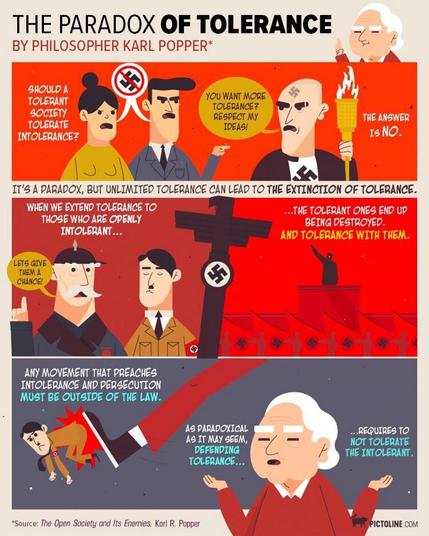
The Paradox of Tolerance disappears if you look at tolerance, not as a moral standard, but as a social contract.

If someone does not abide by the contract, then they are not covered by it.

In other words: The intolerant are not following the rules of the social contract of mutual tolerance.

Since they have broken the terms of the contract, they are no longer covered by the contract, and their intolerance should NOT be tolerated.

#Tolerance #Intolerance #Meme #Memes

@ZhiZhu @lbruno @nazgul I like it. The other thing gives me a headache.
@ZhiZhu @LadyA @lbruno @nazgul Yes. The “unclean hands doctrine” applies more broadly than laws.

@jpanzer @LadyA @lbruno @nazgul

I had to look up the "unclean hands doctrine:"
--
An equitable defense that bars relief to a party who has engaged in inequitable behavior (including fraud, deceit, unconscionability or bad faith) related to the subject matter of that party's claim.
--
But yes, that makes sense. Thanks for the new concept!

@ZhiZhu @LadyA @lbruno @nazgul So, what does such a breach of contract give rational, fair-minded people leave to do?

I gotta say, we seem to be on a continuum that begins with this perfectly acceptable keyboard-warrior debate, but escalates to eventual overt combat using guns, knives, and fists instead of words.

American blood spilled in fear and hatred. This is a terrifying prospect which I'm not prepared for, but seems to be an increasingly realistic destination.

@randywaterhouse @LadyA @nazgul @ZhiZhu @lbruno "What does such a breach of contract give people leave to do?"

Fairly obviously: it's a mandate for the [minimum necessary] use of whatever force is required to defend the social contract. Be proportionate and measured, but don't be a doormat.

Note that this isn't an American problem, it's a global one this decade.

@cstross @randywaterhouse @LadyA @nazgul @ZhiZhu @lbruno

Essentially, enforcement of the broken social contract is where morality comes into play. It's an echo of the shift in justice systems from the "bloody code" era of execution as the only punishment to modern systems.

Nothing can eliminate morality, and I reckon the contract model has to be built around consent, which is part of the morality. And can be argued about.

@cstross @randywaterhouse @LadyA @nazgul @ZhiZhu @lbruno

An example question: can we consent to permanent harm?

This bear looks at the stump of his trans-tibial amputation, and notes it was his own leg. He consented. It wasn't somebody else's leg.

There are people who, through age or mental deficiencies, we don't trust to make a choice. But that is a power issue and "Power tends to corrupt". Lord Acton's warning has to be part of of it.

@cstross @randywaterhouse @LadyA @nazgul @ZhiZhu @lbruno

So we have reached Lord Acton, and the tendency of power to corrupt. That brings us into issues of harm and necessity and sometimes blatant abuses of power to invent excuses.

Stockholm Syndrome is an example of such lies. We can see similar instances attached to transsexualism, and the object is P-O-W-E-R!

The Myth of “Stockholm Syndrome” and other labels which are used to discredit and pathologize victims of abuse

A Cry For Justice

@Wolf_Baginski @cstross @randywaterhouse @LadyA @nazgul @ZhiZhu @lbruno Eliminating morality is an appropriate first step.

Morals are personal and do not scale. Policy cannot be moral, and becomes nigh-infinitely more difficult when you try to make it moral. (Also, pyramids of skulls; they were sinners.)

Define, strictly materially, without reference to even implicit abstract feels, the desired end state. Least sufficient means to get there.

This can produce effective policy.

@Wolf_Baginski @cstross @randywaterhouse @LadyA @nazgul @ZhiZhu @lbruno The right talks about morals incessantly BECAUSE they can't work.

They know that they're really after a simple material objective -- owning everything and everyone not in the in-group -- and how they get there is immaterial. "Don't engage with rationalizations" is a helpful principle.

Personal codes of conduct and morals are fine; it's thinking you can get general agreement that fails. Not failing is better.

@cstross @randywaterhouse @LadyA @nazgul @ZhiZhu @lbruno They don't begin by breaking the contract right away. They start by demanding it/evangelizing it. Actual breaking of contract happens when they're sure to have enough people on their side that they can get away with it.
@ZhiZhu @LadyA @lbruno @nazgul This makes a lot of sense. Covers also not being expected to (verbally) debate the deal-breakers. Debate is a democratic-only instrument.

@ZhiZhu This! I've been linking this article, every time someone's brought of the so called "tolerance paradox".

https://extranewsfeed.com/tolerance-is-not-a-moral-precept-1af7007d6376

Tolerance is not a moral precept - Extra Newsfeed

The title of this essay should disturb you. We have been brought up to believe that tolerating other people is one of the things you do if you’re a nice person — whether we learned this in…

Extra Newsfeed
@ZhiZhu @LadyA @lbruno @nazgul I've always thought of, an eye for an eye and the golden rule as two sides of the same coin.
@ZhiZhu @LadyA @lbruno @nazgul it looks fine in the first look, but I think it is a slippery slope to move away from morals. How do we counter a repressive regime treating dissenters ('intolerant in their eyes') inhumanly? They could argue it is just breaking the contract. I think we cannot give up basic moral rights that is applicable to every human being even when people we don't like is on the other side.
@ZhiZhu @LadyA @lbruno @nazgul I think this is a good way of looking at it

@ZhiZhu @LadyA @lbruno @nazgul

thats something that so much more people should understand

@ZhiZhu @LadyA @lbruno @nazgul This reminds me very much of the tit-for-tat from game theory. It's a good way to look at things imo.

The idea there is basically that you can be cooperative or non-cooperative with people. Tit-for-tat is the strategy that says "I start with being cooperative, then I use the strategy you used the last time". In this case that would mean that you show tolerance (i.e. be cooperative) to people, until they show non-tolerance (i.e. their last strategy was non-cooperative, so you're non cooperative to them.)
@ZhiZhu @LadyA @lbruno @nazgul @digifox all you've done here is reframing the situation into an unnecessarily legalistic framework. The paradox is already resolved if you actually understand it; you don't need to come up with a distinct mental framework for it to arrive at the same conclusion. It's not a logic puzzle, it's not science, it's not law.
@ZhiZhu @LadyA @lbruno @nazgul a fancy way of saying punching Nazis is cool 😎
Does Democracy Demand the Tolerance of the Intolerant? Karl Popper’s Paradox

Photo via Wikimedia Commons In the past few years, when far-right nationalists are banned from social media, violent extremists face boycotts, or institutions refuse to give a platform to racists, a faux-outraged moan has gone up: “So much for the tolerant left!” “So much for liberal tolerance!” The complaint became so hackneyed it turned into an already-hackneyed meme.

Open Culture
@ZhiZhu @lbruno @nazgul @LadyA
There is no social contract.
Nor is there any paradox.

@ZhiZhu @LadyA @lbruno @nazgul
It almost just seems like a very elaborate way of describing the word "respect"

... But that's not quite the same thing.