@penguin42 @victorgijsbers Could be. Let’s see ...
‘Tube computers primarily used triodes and pentodes as switching and amplifying elements. At least one specially designed gating tube had two control grids with similar characteristics, which allowed it to directly implement a two-input AND gate.’
https://en.wikipedia.org/wiki/Vacuum-tube_computer
So, good catch!
@srtcd424 @penguin42 @victorgijsbers
The puppy tore up my paper tape of a BASIC program, so let’s not think about that. :D
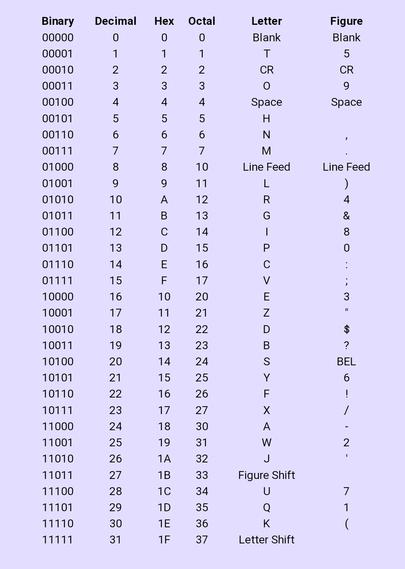
If he used the original ITA1 encoding, it says "G22 44.4"
@penguin42 @victorgijsbers I think that it is a Baudot/Murray representation, too. But why it is alternating in to diagrams.
Another interpratation is that it is the configuration of a crossbar switch. But again: Why is it alternating?
BTW: 5 lines can be musical notation (staff). Unlikely …
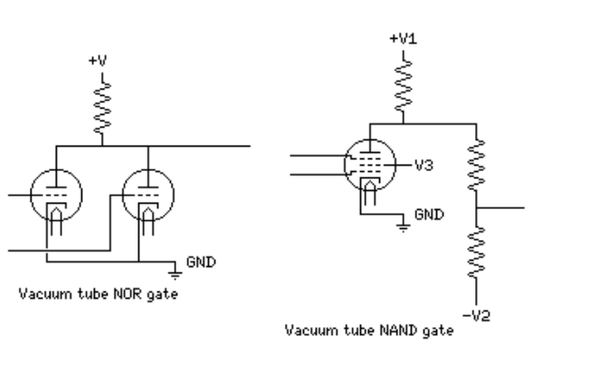
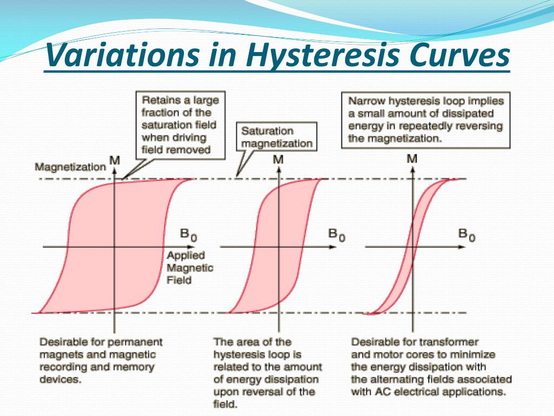
graph on the right looks like a magnetization hysteresis curve, which make me think that the dotted grids in the center represent core memory arrays. the drawing on the left is the schematic symbol for an indirectly-heated pentode
The code for the middle section reads:
(Top dots)
0-1-0-1-0
0-0-0-1-0
0-1-0-0-0
0-1-0-0-0
0-0-0-0-0
(Bottom dots)
1-0-1-0-0
1-0-1-0-0
0-0-1-0-1
0-0-0-0-1
1-0-1-0-0
At that point in history, this is NOT likely to be ASCII. Can anyone decipher that binary?
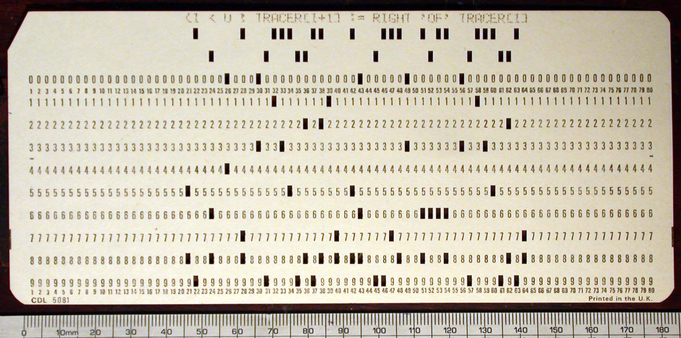
https://itenterpriser.com/knowledge-base/what-is-punched-paper-tape-how-to-read-it/
@wtremmel @victorgijsbers
I looked up Baudot. The possible interpretations are too many for my available time this afternoon, I'm afraid. Perhaps someone else can have more success?
@wtremmel @victorgijsbers
Another Baudot chart. This one seems different? Using Baudot, the message makes no sense in any language-- too many constants. (Or maybe I'm doing it wrong.)
https://cs.stanford.edu/people/eroberts/courses/soco/projects/2008-09/colossus/baudot.html
@ai6yr @victorgijsbers
Assuming the middle section is punch ribbon, then this would be the code...
@[email protected] @[email protected] The code for the middle section reads: (Top dots) 0-1-0-1-0 0-0-0-1-0 0-1-0-0-0 0-1-0-0-0 0-0-0-0-0 (Bottom dots) 1-0-1-0-0 1-0-1-0-0 0-0-1-0-1 0-0-0-0-1 1-0-1-0-0 At that point in history, this is NOT likely to be ASCII. Can anyone decipher that binary? https://itenterpriser.com/knowledge-base/what-is-punched-paper-tape-how-to-read-it/
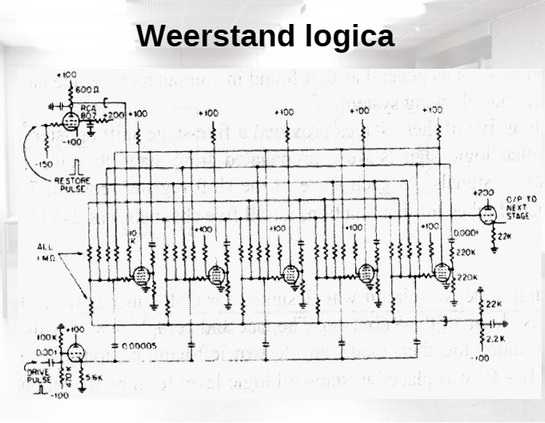
Weerstand is Dutch for resistance, so "resistance logic" is likely an early name for resistor-transistor logic (RTL), which this would predate as a structural and functional equivalent.
@victorgijsbers the symbol on the left seems to be some vacuum tube, with filament, anode, cathode and several grilles.
On the right, it represents an hysteresis trace, like that of Schmitt Trigger logic gates.
At the top I believe it could be some core memory…
And I wonder wonder.
@victorgijsbers
I've been trying to find some information to decode the memory maps, but all I can seem to find is that the ARMAC had 34-bit words plus 2 parity bits, which doesn't seem to match up with the 25-bit groups on the plate.
I would normally try looking at the instruction set and text encodings for the computer and see if I could find any way to match it up, but it's tricky if the number of bits doesn't even match up.
@victorgijsbers Do you know if there are any computing history museums, or any museums that have anything from the ARMAC computer? It looks like you've got tons of info on what the symbols and text are already, but places like that might maybe be able to tell you more about the background of the plate.
Usually they'll have things like staff photos, sometimes event photos too, and sometimes they'll have photos or even examples of commemorative merch, memorabilia, or other small items that were made for/given to team members or staff. If you can reach out to them they might be able to tell you a bit more, assuming it's definitely something official and not something your grandfather commissioned or made himself. (Even if it's the latter they might still be interested in photos.)
@stshank
The drawing on the right is the magnetic hysteresis loop, that is what allows the ferrite cores to "remember" information.