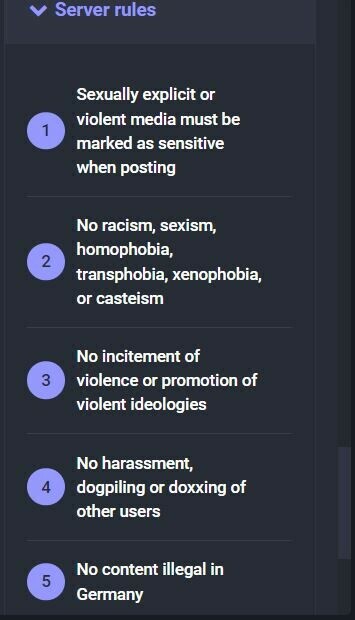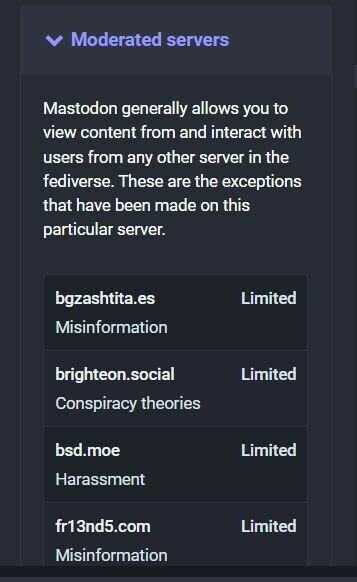
@JMMaok @pensato @futurebird

@jeffjarvis @jayrosen_nyu

J, really good start, needs politics re known, well understood, provable unreliable sources, disinformation spreaders; need help from the Trust Project and the Journalism Trust Initiative from Reporters Without Borders

@craignewmark @JMMaok @pensato @futurebird @jeffjarvis @jayrosen_nyu

New, so learning, & have a question to clarify . I understand you are hoping to formalize an overall minimal standard for all instances & that would mean enforcement at some point . Which I assume would be universally having the same moderating body & list, or something similiar ? Also, want to note whatever happens the fact moderation with a fair ,open face is what happens here is an achievement & makes a difference .Ty

@PBruce @craignewmark @JMMaok @futurebird @jeffjarvis @jayrosen_nyu this is part of why I'm suggesting a model similar to Creative Commons. It would allow instances to self-select from a menu and post the appropriate moderation label/badge somewhere public-facing. People could follow the link to where the detailed moderation paper exists (universally), which saves time and creates consistency. If there are exceptions or specifics on implementation, the moderator can post that.
@pensato @PBruce @craignewmark @JMMaok @futurebird @jeffjarvis @jayrosen_nyu there's no reason to tie this to the instance. Moderation is just a way of labeling content---just like boosting. Anyone should be able to offer "moderation" and everyone should be able to choose their own moderators.
@karger @pensato @PBruce @craignewmark @JMMaok @futurebird @jayrosen_nyu
Exactly the structure I've been dying for: pick your own moderation. @Zittrain tried to convince Facebook to offer this years ago; they didn't listen, sadly.
@jeffjarvis @pensato @PBruce @craignewmark @JMMaok @futurebird @jayrosen_nyu @Zittrain this would be platform-killing for Facebook; I can understand why they wouldn't pick it up.
@karger @jeffjarvis @pensato @PBruce @craignewmark @JMMaok @futurebird @jayrosen_nyu @Zittrain the trust network for fact checkers as an aspect of moderation would require FB to navigate AOL Community Manager & Mavrix v LiveJournal precedents for volunteer vs labour & the “publisher” implications of “at the direction of the service” created by paid fact checkers suppressing user-created misinfo.
Social media corps see that as a liability landmine.
@karger @jeffjarvis @pensato @PBruce @craignewmark @JMMaok @futurebird @jayrosen_nyu @Zittrain None of the social media corporations want to be the test case for “your AUP enforcement is biased against free speech / Republicans \ isn’t covered by Section 230’s language \ breaches your DMCA Safe Harbour \ makes you a publisher” litigation / legislation. Every aspect of moderation they can push off, outsource, or sidestep, they do.
@PennyOaken @jeffjarvis @pensato @PBruce @craignewmark @JMMaok @futurebird @jayrosen_nyu @Zittrain from that perspective empowering individuals as moderators could help platforms shed some of the moderation burden they are currently shouldering (badly), and get *out* of the crosshairs of those complaining about moderation choices.

@karger

To talk about Mastodon in particular the moderation system is OK. I would like to see a ticket system where user reports would create a ticket that could be shared across servers (including notes and links to posts) I'd like to see an *option* to inform users who make reports about what happened.

I'd also like a true shadow-ban option-- limiting is close, but a way to mute a user over a whole server. (been dealing with people who keep making new accounts)

@futurebird yeah there are lots of opportunities for improvement in the moderation system.

@karger moderation's more than just labeling content. It's also about de-escalating situations before they turn into trashfires, protecting people and communities from bad actors, and reinforcing positive norms. People on an instance that prohibits hate speech shouldn't be able to choose "freeze peach" absolutists as their moderators. @jeffjarvis I assume @Zittrain's pitch to FB addressed this?

@jdp23 @futurebird @jeffjarvis @Zittrain I agree all these things are important, but they should be enforced at the community level rather than the instance level. Take gmail for example---is that a "community"? should google be making enforcement decisions about what kinds of email to deliver? They don't; instead many different communities with different norms share the same gmail infrastructure for communication. Social media should be similar; many communities on common infrastructure.

@karger @futurebird @jeffjarvis @Zittrain Instances are currently the primary mechanism for community in the fediverse so I'm not sure about the distinction you're making.

And Google actually does make decisions about what email to deliver and what to moderate by labeling it as social or spam.

@jdp23 @futurebird @jeffjarvis @Zittrain as for the distinction i'm drawing, it's basically the usual one that computer scientists draw between the physical and logical architecture. consider email again: a particular email server might host many mailing lists, but moderation is generally considered a job for each mailing list to tackle itself, not something the email server does uniformly to all of them.

@karger @futurebird

This is analogous to how Twitch moderation works. There are service level expectations (no slurs, organized harassment, etc.) and then on a per channel basis (think instances) there are varying behavior expectations enforced by moderators for that channel (swearing? gameplay suggestions? talking about current events? sharing links?)

Service level expectations are enforced automatically when possible, but channel moderators are also responsible for enforcement.

@drewww @futurebird yes, reddit also does this, with light moderation done at the platform level and individual subreddits empowered to choose their own communal moderation standards. It's close to what I think we should have, but I think that further layers of delegation should be possible.

@karger @drewww to @futurebird’s comment about channels vs instances… as far as I can tell, an instance is not a very meaningful center of community.

I have conversations about music, design, television programs, politics, etc., with different groups of people, and I don’t imagine centering those conversations around any particular instance.

Is there an equivalent of a subreddit (a place to have a conversation around a particular topic) in the fediverse?

@skuwamoto @karger @drewww @futurebird That’s because you are on a giant, general purpose instance. Most instances are smaller and have vibrant communities of interest with conversations in the Local timeline. Before making judgements about what is and isn’t working on Mastodon, you may want to try creating a second account on an instance that is community-based and explore that.
@bhawthorne @karger @drewww @futurebird fair enough. And to be clear, I’m not trying to judge. I’m trying to understand. Sorry if it came across the wrong way.

@skuwamoto @bhawthorne

I do think it's fair to say the median experience at this point IS those big generic instances, and the way people tend to show up is like on Twitter -- a bundle of interests, posts on a variety of topics. And I rarely see the moderation discourse here being about posts inappropriate to the theme of the instance. More about anti-social behavior generally.

Maybe norms will evolve in that direction, with topic-focused alts being more common.

@drewww @skuwamoto @bhawthorne but right now since moderation is instance-based there's no way for thos alts to evolve with their own moderation, unless they have resources to deploy and instnace.

@karger my understanding of your concept of moderation is to decouple moderation from instances and allow users to subscribe to moderation services.

Do you think of moderation mostly as filtering what I, as a subscriber, see?

@drewww @bhawthorne

@skuwamoto @drewww @bhawthorne I think moderation rather fuzzily spans a range of actions---from deletion (making inaccessible) to downranking (making it less visibible) for a range of entities from individuals to communities to society at large. From blocking child porn (deletion for society) to moving car ads to a spam folder (downranking for an individual). All of these can and should coexist.
@skuwamoto @drewww @bhawthorne But I think we need to give more weight to autonomy in moderation decisions. We should be skeptical of (but not absolutely opposed to) society imposing its moderation norms on communities, and of communities imposing their moderation norms on individuals. Conversely, we should be giving individuals better tools to individually reject content their society or community considers acceptable.

@karger @drewww @bhawthorne my viewpoint is that the most harm comes from conversations around me, which blocking can’t help with.

To take an example that somewhat in the gray area… The Libs of TikTok account claims it is just spreading information. Others feel it is stoking a kind of mob mentality that could endanger people through brigading, etc

@drewww @karger @skuwamoto I agree with you there, but I think we are discussing different needs here: moderation and curation. Moderation is a term commonly used to describe limiting what can be posted by a writer. Curation refers to limiting what an individual sees. I don’t see it as productive to to try to combine these concepts.
@drewww @karger @skuwamoto Moderation is inherently community-norms-based, primarily focused on safety, and individuals can choose what norms are implemented by choosing their instance.
Curation is inherently values-based, primarily focused on interests, and individuals can choose what they see by deciding who to follow, who to mute/block, what hashtags to follow, and what filters to put in place.