Fun fact: Windows includes an HDD overwrite functionality. (Note: This won't hardware-level wipe SSDs)
(Also, don't do this you'll probably do it wrong and delete all your data.)

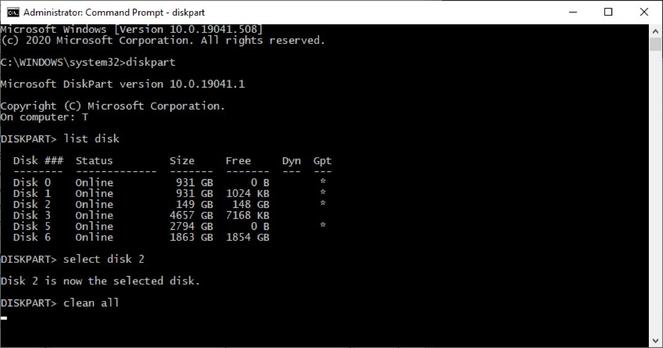
diskpart.exe
list disk
select disk #
clean all

It writes 0's to all logical sectors on the disk. But this isn't the same as all physical sectors on an HDD, and nothing much guaranteed on an SSD. You need to (also) use ATA SECURE ERASE to do that.

But if you have drives you want to dispose and aren't paranoid it's what I did to go through 15 old disks in my closet before smashing them up with a hammer. (Just the hammer works fine too)

The thing about data storage is that they are so incredibly intricate and low-level complicated, just giving a HDD or SSD some really solid whacks with a hammer that messes up the internals a bit makes it functionally impossible to recover.

And Google and Microsoft and Amazon and NSA don't software-wipe hard drives they physically destroy them.

@SwiftOnSecurity good thread but re the Big 3 cloud providers, for AWS anyway that does vary slightly by region and kit age (e.g., for the Nitro servers, NVMe is integrated into the entire board), so hardware rekeying is sometimes used. For nerds who want to dig deeper, see Appendix A of 800-88-rev1-final:

https://nvlpubs.nist.gov/nistpubs/SpecialPublications/NIST.SP.800-88r1.pdf

https://aws.amazon.com/compliance/data-center/controls/#Device_Management

@kennwhite @SwiftOnSecurity Is this similar to running „nvme-cli sanitize -a 0x04“ (https://manpages.debian.org/testing/nvme-cli/nvme-sanitize.1.en.html )?
nvme-sanitize(1) — nvme-cli — Debian testing — Debian Manpages