 PAC2
PAC2I'll try to post each day a dataviz related to #Wikidata or #Wikipedia until Christmas.
The film director Jean-Luc Godard has passed away last September.
Discover his filmography with this dataviz based on #Wikidata 👉 https://observablehq.com/@pac02/tribute-to-jlg

Tribute to JLG
A beeswarm plot of Godard's filmography Jean-Luc Godard has passed away on September 13, 2022. He was one of the greatest film director of all times. This dataviz explore his whole filmography using Wikidata. The data are retrieved from Wikidata using a <a href="https://query.wikidata.org/# ">SPARQL query</a>. We find movies directed by Jean-Luc Godard in Wikidata. It shows all movies by year of release with the number of wikimedia sitelinks. The number of sitelinks measure the number of pages or articles
Annie Ernaux got the Nobel prize in literature. Have a look at her career in one chart :
https://observablehq.com/@pac02/tribute-to-annie-ernaux

Tribute to Annie Ernaux
French writer Annie Ernaux is Nobel laureate in 2022. This dataviz explore Annie Ernaux's work using Wikidata. The data are retrieved from Wikidata using a <a href="https://query.wikidata.org/# ">SPARQL query</a>. I find works written by Annie Ernaux in Wikidata. It shows all novels by year of release with the number of wikimedia sitelinks. The number of sitelinks measure the number of pages or articles dedicated to a topic on various Wikimedia projects such as Wikipedia in different languages. Beeswarm p
Annie Ernaux got the Nobel prize. But how many women got the Nobel?
Look at all Nobel prize laureates by gender and by year :
https://observablehq.com/@pac02/all-nobel-laureates-by-gender-and-by-year


All Nobel laureates by gender and by year
In this notebook, I look at all Nobel laureates from the beginnings to today by gender, number of sitelinks and year. The data are retrieved from Wikidata using a <a href="https://query.wikidata.org/# ">SPARQL query</a>. I find Nobel laureates in the database. The number of sitelinks measure the number of pages or articles dedicated to a topic on various Wikimedia projects such as Wikipedia in different languages. All Nobel together Each dot is a Nobel laureate. The size is proportional to number of sitel
Look at the career of Nobel laureates in literature? when they got the Nobel? did they publish most of their work before the Nobel? did they still publish after the Nobel?
Explore 3,396 works published by 120 laureates in one dot chart !
https://observablehq.com/@pac02/career-of-nobel-laureates-in-literature


Career of Nobel laureates in literature
In this notebook, I look at the career of all Nobel laureates in literature. The data are retrieved from Wikidata using a <a href="https://query.wikidata.org/# ">SPARQL query</a>. I find works written by Nobel laureates in the database. All works published by all Nobel prize in literature (according to Wikidata) The chart shows all works published by Nobel laureates by age of the author and the age in their career when they got the Nobel prize. The visualization is still a bit messy with some overlap. I
Last wikiviz about the Nobel prize.
Browse the career of every Nobel prize in economics :
https://observablehq.com/@pac02/career-of-nobel-laureates-in-economics
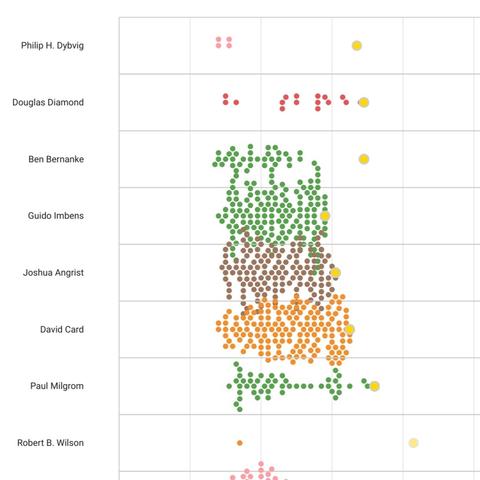

Career of Nobel laureates in economics
In this notebook, I look at the career of all Nobel laureates in economics. The data are retrieved from Wikidata using a <a href="https://query.wikidata.org/# ">SPARQL query</a>. I find works written by Nobel laureates in the database. All works published by all Nobel prize in economics (according to Wikidata) The chart shows all works published by Nobel laureates by age of the author and the age in their career when they got the Nobel prize. The visualization is still a bit messy with some overlap. I h
The whole history of the #TourdeFrance in one chart :
https://observablehq.com/@pac02/tour-de-frances-history-at-a-glance?collection=@pac02/wikidata


Tour de France's history at a glance
This dataviz shows all stage winners of the Tour de France by country of citizenship. It tells a story of the Tour de France since the first occurrence in 1903. The data comes from Wikidata. They are collected using a SPARQL query and imported directly into Observable. There may be some problems in the data if there are several stages on the same day. If you meet a `Runtime error`, just try reloading the page (CTRL + R) and be patient. All stages from 1903 to today I use a cell plot to show all stages from
Now the same #Dataviz but for the Tour de France Femmes :
https://observablehq.com/@pac02/tour-de-france-femmes
#wikiviz #Wikidata #Observablehq #ObservablePlot #TourdeFranceFemmes #TourdeFrance


Tour de France Femmes
This dataviz shows all stage winners of the Tour de France Femmes by country of citizenship. It is a simple fork from @pac02/tour-de-frances-history-at-a-glance?collection=@pac02/wikidata. The data comes from Wikidata. They are collected using a SPARQL query and imported directly into Observable. There may be some problems in the data if there are several stages on the same day. If you meet a `Runtime error`, just try reloading the page (CTRL + R) and be patient. All stages I use a cell plot to show all sta
Now we can look at the history of the Vuelta (Spain's tour) in one chart.
Colors have been replaced by flags.
https://observablehq.com/@pac02/all-vueltas-stage-winners-by-country-of-citizenship

All Vuelta's stage winners by country of citizenship
The data comes from Wikidata. They are collected using a SPARQL query and imported directly into Observable. There may be some problems in the data if there are several stages on the same day. If you meet a `Runtime error`, just try reloading the page (CTRL + R) and be patient. I focus on vueltas after 2011 since the data before 2011 are really incomplete. Number of stage wins by country Details Under the hood Libraries
What is your probability of having an article in #frwiki ?
It depends on your birthplace.
Evidence from France => https://observablehq.com/@pac02/births-department-wikipedia?collection=@pac02/wikipedia
#wikipedia #wikidata #spatialinequalities #Observablehq #observablePlot
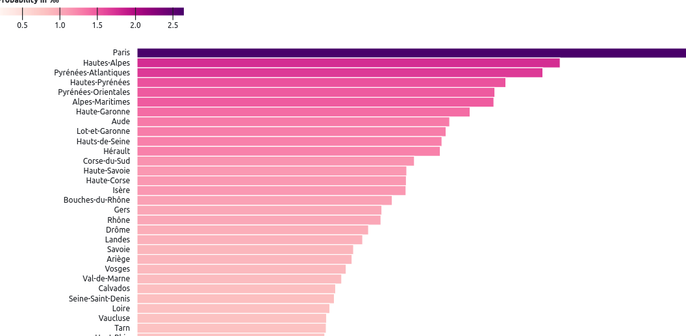

Does your birthplace affect your probability to have your Wikipedia biography ? some evidence from people born in France.
How does your birthplace affect your probability of being on Wikipedia ? Having a Wikipedia page is a sign of notoriety. We know that the probability of being successful depends on your birthplace. So in this notebook I look at the probability of having a Wikipedia page depending on your birthplace. While browsing Wikipedia in French, I was surprised by the number of people born in Neuilly-sur-Seine (Hauts-de-Seine) or in Paris. So I wanted to know if there was an overrepresentation of people born in these
The probability of having a Wikipedia page, displayed on a map.
https://observablehq.com/@pac02/visualizing-the-probability-of-having-a-wikipedia-page-usi

Visualizing the probability of having a Wikipedia page using a Dorling cartogram.
This is a complementary visualization to the Does your birthplace affect your probability to have your Wikipedia biography ? notebook. We use Bertin.js to draw a Dorling cartogram. Bubble size is proportional to the number of births in each department while the filling color of bubbles is proportional to the probability of having a Wikipedia page. We focus on people born in metropolitan France between 1975 and 1990. Unfortunately, data for the overseas departments are not available. Appendix
Do actresses become singers and singers become actors? Evidence from France using #Wikidata
https://observablehq.com/@pac02/actress-singers-and-actor-singers-do-actresses-become-sing

Actress-singers and actor-singers: do actresses become singers and singers become actors?
Jeanne Moreau and Anna Karina were first known as actresses and then became singers. We have also many examples of singers becoming actors. For instance Eddy Mitchell, Johnny Hallyday, Orelsan or Philippe Katerine were at first singers and then became actors. So my intuition is that the actress-singers tend to be actresses at first and then become singers whereas male singers tend to have opportunities to become actors later in their career. Now, I need to find data to test my assumption. I collect data fro
Wikipedia in French has now more than 2,000 featured articles!
Today's notebook explores those 2,000 articles using #Wikidata.
https://observablehq.com/@pac02/celebrating-the-2-000-featured-articles-milestone-in-wikip

Celebrating the 2,000 featured articles milestone in Wikipedia in French
Wikipedia in French has now 2,000 featured articles ("Articles de qualité"). It's time to celebrate this milestone and to look at those 2,000 articles using Wikidata. I use the Wikipedia Categorymembers API through a SPARQL query to get all articles featured in category "Article de qualité". Let's have a look at the data ! Instance of (P31) : a majority of humans I only show the top 20 occurrences. Country (P17) : a majority of articles about France Note : I use the fantastic Bertin.js library to draw a Dor
The same analysis as yesterday but for good articles in #frwiki
Good articles are similar to featured articles but criteria are just a bit easier to achieve.
Distribution of articles by instance of (#P31), country (P17) , gender (P21) , country of citizenship (P27) and occupation (P106)
https://observablehq.com/@pac02/good-articles-in-wikipedia-in-french

Good articles in Wikipedia in French.
I explore the list of good articles in Wikipedia in French. See https://fr.wikipedia.org/wiki/Wikip%C3%A9dia:Bons_articles if you want to know more about the selection process of good articles. Instance of (P31) : a majority of humans I only show the top 20 occurrences. Country (P17) : a majority of articles about France Note : I use the fantastic Bertin.js library to draw a Dorling cartogram. Focus on humans Gender : only 16% of women Occupation (P106) : Writers, politicians and actors come first ! Country
Today's wikiviz is a short introduction to #Observablehq for #Wikidata users.
https://observablehq.com/@pac02/an-introduction-to-observable-for-wikidata-users
It shows how to go from a #SPARQL query to a dataviz in Observable.

An introduction to Observable for Wikidata users
Wikidata is an open and contributive knowledge base. Query.wikidata.org is a tool to query Wikidata using SPARQL queries. Query.wikidata.org is a great tool. However it has its own limitations. For instance, it is not possible to combine several queries to write a story with the data. It is limited to computations allowed by SPARQL and it is not possible to customize the visualisation. Observable is a platform allowing to write notebooks in Javascript. Like the Jupyter or Rmarkdown notebooks often used in d
 Kingsley Uyi Idehen
Do you have variants of your #Observablehq notebook demos where the #Wikidata ID is surfaced?
Why is this useful?
It enables one lookup additional information about what an ID denotes.
Here's an example from the not too distant past using #DBpedia ID.
