 Parker Molloy
May 2021, December 2022
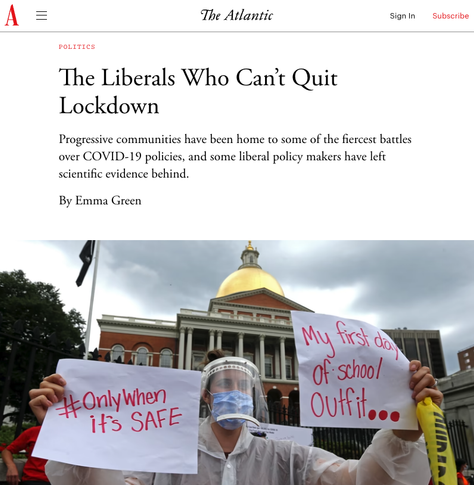
Emma Green must be cursed to keep writing the same exact story where she sneers at people who wear masks
May 2021, December 2022
Emma Green must be cursed to keep writing the same exact story where she sneers at people who wear masks
Hundreds of thousands of people in the U.S. have died from COVID between the publication of those two pieces, but she seems as unfazed as ever and convinced that people who took COVID seriously were somehow overreacting.
It's just such a frustrating type of journalism, with the writer's pre-formed opinion driving the direction.
And, I think it's worth keeping in mind, that these types of articles (there was another just the other day in NYT about "the last holdouts" i.e. people who still wear masks) are taking issue with people *choosing* to wear masks places. For the most part, mask mandates (which were always pretty limited) just aren't happening anywhere anymore. This is all very "your personal behavior irritates me and I don't like to be reminded that COVID happened."
It's bizarre. It's controlling.
So since late 2020-ish, there have been these writers who put out pieces where they try to create an argument against masks.
Those pieces inevitably boil down to a few implicit and explicit points:
Aesthetics:
So much of those pieces come down to "I don't like seeing things that remind me of the pandemic" or something similar. The point of these pieces is to create a social stigma around masks so that people who wear them might feel social pressure to ditch it.
And someone might point to the stigmatization of people who wouldn't wear masks/get vaccinated/adhere to recommendations, etc., as a "gotcha."
And, again, this is all built on the premise that being disallowed from wearing masks and being required to wear masks in a particular venue have similar levels of negative effects on others in that group. And that's just simply not even close to the case.
 Klaas Bals
 Sarah T. Roberts, Ph.D.
 Gospel X
 Tom Bellin
 Gothmomma666