 Parker Molloy
May 2021, December 2022
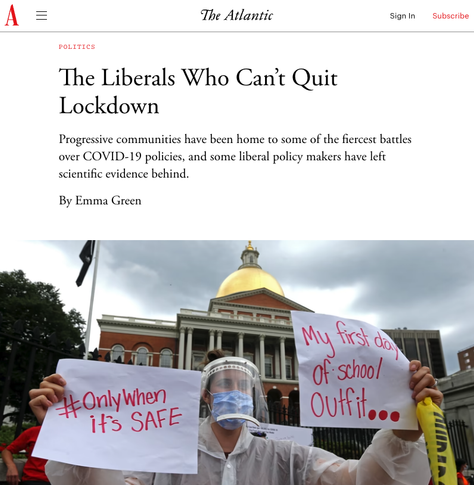
Emma Green must be cursed to keep writing the same exact story where she sneers at people who wear masks
May 2021, December 2022
Emma Green must be cursed to keep writing the same exact story where she sneers at people who wear masks
Hundreds of thousands of people in the U.S. have died from COVID between the publication of those two pieces, but she seems as unfazed as ever and convinced that people who took COVID seriously were somehow overreacting.
It's just such a frustrating type of journalism, with the writer's pre-formed opinion driving the direction.
And, I think it's worth keeping in mind, that these types of articles (there was another just the other day in NYT about "the last holdouts" i.e. people who still wear masks) are taking issue with people *choosing* to wear masks places. For the most part, mask mandates (which were always pretty limited) just aren't happening anywhere anymore. This is all very "your personal behavior irritates me and I don't like to be reminded that COVID happened."
It's bizarre. It's controlling.
So since late 2020-ish, there have been these writers who put out pieces where they try to create an argument against masks.
Those pieces inevitably boil down to a few implicit and explicit points:
Aesthetics:
So much of those pieces come down to "I don't like seeing things that remind me of the pandemic" or something similar. The point of these pieces is to create a social stigma around masks so that people who wear them might feel social pressure to ditch it.
And someone might point to the stigmatization of people who wouldn't wear masks/get vaccinated/adhere to recommendations, etc., as a "gotcha."
And, again, this is all built on the premise that being disallowed from wearing masks and being required to wear masks in a particular venue have similar levels of negative effects on others in that group. And that's just simply not even close to the case.
And this happens on a number of topics. Anything that's been propped up as being related to a "culture war" or "cultural issue" gets argued in this same exact way in media: largely aesthetically-based, dependent on people ignoring that the negative consequences of Action A are not identical to the negative consequences of Action B.
This is why "contrarianism," while hugely rewarded in the media industry, is usually so damaging when it comes to sharing actual news.
@parkermolloy the culture war framing of it is so bizarre to me, in that the premise is the author/ed board are the perfect rational centrists gawping at these inexplicable weirdos. It would be the simplest thing imaginable to just explain: these guys look at people who won't mask in crowds the way you guys look at the people who won't wash their hands or get a vaccine - the pointlessly stubborn dupes crushing our hospitals and hurting themselves because they can't possibly bear the slightest personal inconvenience.
That's a really huge threat to their self image as the enlightened, scientific, rational centrists though, and makes it sound a lot like those guys might have a fair point. So every one of these pieces devolves into "hmm so what, other than completely sensible stuff that makes my position look bad, can we attribute this phenomenon"
@parkermolloy @mtsw the most surreal part of the article for me was right here. First, Tom Frieden makes the totally baseless pop-sci speculative claim, presented as fact, that making recommendations that (some? Many? Most?) people don't follow is counterproductive.
Then she presents these arguments from the people's CDC alongside claims that we are meant to take as slam-dunk rebuttals, when in each instance they're just beside the point!
"The 5-day quarantine rule is bogus [and was acknowledged as a compromise with business interests at the time!]"
"A majority of transmission happens in that window."
So? No one has agreed that cutting transmission from known infectious people by 51% is the right threshold!
"One-way masking is insufficient."
"One-way masking is protective."
Again, that just does not rise to a rebuttal! These are like LSAT examples of logical fallacies!
Nicely put.
Prof. Charles Blattberg theorises that all the obviously-false conspiracy theories are primarily aesthetic, and are enjoyed for aesthetic reasons. And concludes that discourse helps them, and mockery is perhaps the most useful countermeasure. https://www.abc.net.au/radionational/programs/philosopherszone/conspiracy-theories-anti-semitism-and-fun/14101862

You don’t have to be stupid to be a conspiracy theorist. Many people who buy into paranoid fantasies about stolen Presidential elections and global Satanic cabals are perfectly sane, well-educated individuals. So why do they fall for these myths? This week we consider the possibility that the attraction is primarily aesthetic, and that the experience is fun. But why the perennial focus on Jews?
@parkermolloy It is not alarmist to point out that viruses (not just covid) can have subtle, long-term effects on our bodies and brains that can leave us debilitated.
Humans are notoriously bad at managing risk from illnesses bc of our tendency to ignore risks when things seem normal and overreact when things seem out of control.
Any analysis of mask-wearing that doesn't center these basic facts is dabbling in quackery.

 🌊Ann Morris🐕🍀🌎🌊🌊
 nshrubs
 I AM BANKSY ☕ / 🗑🔥
 John Yonchuk
 AutisticMumTo3 She/her
 word saladin
 Jeff Tucker
 Craig Danz
 Viveka
 Klaas Bals
 Sarah T. Roberts, Ph.D.
 Gospel X
 Tom Bellin
 Gothmomma666