
New publication in Urban Studies journal.
In #urban #research, there is most often the assumption: the longer somebody lives somewhere, the more this person feels some kind of #belonging to this place.
But is this really the case?

Open Access here:
https://journals.sagepub.com/doi/10.1177/00420980221136960

/1
We investigated with data from our #SFB1265 project.
To explain our research design: we conducted representative surveys in four very different neighbourhoods in Berlin (described in more detail in the article).

Their real names do not matter for the sake of the argument, let us call them A (Apolda Springs), B (Borkum Rock), C (Coswig Gardens) and D (Dorsten Heights).

/2

In line with most assumptions, we find that (overall, on average) neighbourhood belonging increases by length of residence in a neighbourhood.

In all neighbourhood contexts, the statement is true (although to a different extent) and more years of residence go hand in hand with more belonging to the neighbourhood – if we specify a simple linear relationship between both.

However, the theoretical link between both is more complex in reality than a linear relationship suggests.

/3

We find that practical neighbourhood use (e.g. if people used sport, leisure, counselling or other facilities locally) and public familiarity (which we measured by frequency of talking with strangers in one’s neighbourhood and the frequency of running into people whom one knew from someplace else) influence the relationship, depending on the local context.

We first show that Practical neighbourhood use SOMETIMES matters for belonging, but it does differently on the neighbourhood setting.

/4

The standard idea of practical neighbourhood use affecting belonging fits the relatively stable middle-class neighbourhood but does not apply in the same way to a workingclass area with hyper-diversity, a gentrified neighbourhood, or a high-rise outskirt estate.

The settlement matters for the formation of belonging by practical neighbourhood use.
Furthermore, we wondered whether practical neighbourhood use really covers neighbourhood’s public life.

/5

Could it be that it is not the frequency of use as such, but the actual usage and interactions that affect sentiments of belonging? Perhaps it is not the bakery, but my connection to the baker, and not the restaurant, but the waiter affects my belonging?

Although it is tempting to assume just that, the relationship is again somewhat more complex. Let us go back to the neighbourhoods. In strongly gentrified neigh C, belonging seemed least affected by length of residence in the first place.

/6

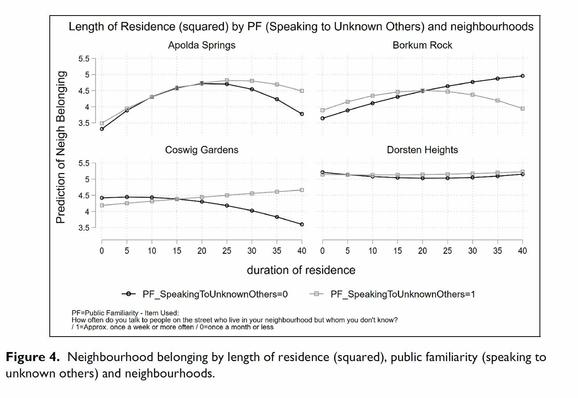
Well, the figure below clarifies that it does play a very important role how long somebody lives in C, but it is moderated through daily interactions. If someone never speaks to anyone, the longer she lives in the area, the less she feels like she belongs.

If residents communicate with unknown others, living there for all those years enhances belonging, strengthened by the chit-chat in streets/squares.
However, in other neighbourhood settings, the relationship does not work the same way.

/7

For example in A, talking to strangers does not make much of a difference for belonging. But the fall of the wall (Wende) does, which flips the relationship between length of residence and belonging if you lived there before the fall of the GDR.
But public familiarity seems to at least soften the effect.

Long story short: Length of residence affects neighborhoud belonging, but not always in a way that you might assume.

/8

Ruptures, practical #neighbourhood use but also importantly public familiarity can influence the effect of time of residency on feelings of belonging to a neighbourhood. More details and analyses of course in the article.

Written with wonderful colleagues Talja Blokland, Daniela Krüger, and Henrik Schultze.

You can (openly) access it here, have a read: https://journals.sagepub.com/doi/10.1177/00420980221136960

/9