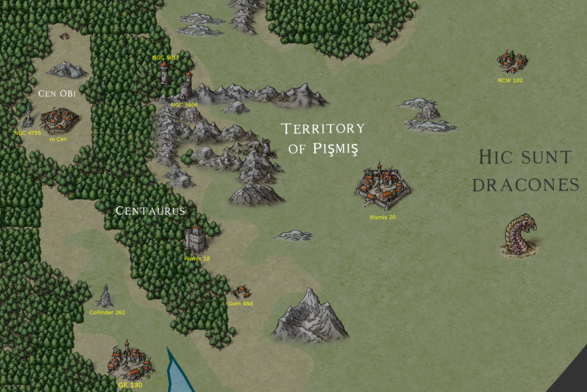
The eighth detail map of my #GaiaMissionFantasyMap series is the Territory of Pişmiş, which lies roughly in the direction of the constellation Circinus in the distant inner galaxy.
#Astronomy #Fantasy #Cartography

I named this largely uncharted territory after Paris Pişmiş, the Mexican astronomer who cataloged open star clusters in this direction in the 1950s.

Our view of much of the inner galaxy is heavily obscured by dust and the Pişmiş clusters emerge dimly through gaps in the murk. Beyond the Territory of Pişmiş, Gaia can see very little and so I have done the traditional thing and filled this region with tractless desert infested by dragons and giant sandworms.

Image: Silvia Torres-Peimbert
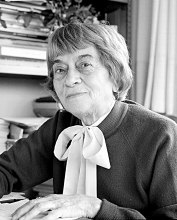
Here's some information about Pişmiş collected from Wikipedia and other sources.

Born into a family of Armenian origin, Paris Pişmiş became the first woman to get a Ph.D. from the Science Faculty of Istanbul University in 1937. She then became an assistant astronomer at Harvard College Observatory in 1939, during the observatory's golden age under the famous director Harlow Shapley.

As those who have read Dava Sobel's history, The Glass Universe, will know, Shapley's predecessor, Edward Charles Pickering, decided to hire a large group of women as "human computers" to analyze the data collected on the observatory's glass photographic plates. While Pickering arguably exploited these women as his initial motivation for hiring them was that he could pay them low wages, many of these women such as Annie Jump Cannon went on to become famous astronomers.

While at the Harvard Observatory, Pişmiş's colleagues included Dorrit Hoffleit, the maintainer of the Bright Star Catalogue, Bart Bok, who went on to manage astronomy programs in South Africa, Australia and Arizona, and Cecilia Payne-Gaposchkin, who first discovered the chemical composition of the stars.

Pişmiş also learned to analyse the data on the glass plates and fell in love with visiting Mexican astronomer Félix Recillas.

After their marriage and settlement in Mexico, Pişmiş became Mexico's most prominent astronomer, editing journals and promoting university teaching. In 1959 she published a famous article, "Nuevos cumulos estelares en regiones del sur"(New star clusters in southern regions) in which she listed a catalog of 24 open clusters and 2 globular clusters derived from glass plates imaged by Mexico's Tonantzintla Observatory.
The Pismis catalog (typically spelled without the cedillas in Pişmiş's name) added to the great exploration of the southern sky that took place in the 1950s that also included the Gum and RCW catalogs from Australia's Mount Stromlo observatory.
The Territory of Pişmiş shown on my fantasy map is dominated by the great star cluster Pismis 20. This cluster ionizes a large HII region visible in Douglas Finkbeiner's image of the hydrogen-alpha sky but that appears to be uncatalogued and unnamed. (It is also often confused with the nebula in the Cir OB1 association that is located much closer to the Sun.) A smaller and older cluster, Pismis 18, is also fairly nearby in Centaurus as are somewhat dimmer clusters, NGC 5617 and NGC 5606.