 Prof. Stefan Rahmstorf
Nuclear #fusion will not only come too late to help solve the #climatecrisis. Even in the long run it will not be the unlimited energy source that some are dreaming of. The reason is basic physics, and anyone can do the back-of-envelope calculation. 🧵1/
The problem is that all human energy use ends up as heat. That's no problem now: our current global energy use corresponds to 0.04 Watt/sqm (that's per square metre of Earth surface). The human-caused CO2 increase has a far stronger warming effect: 2.1 W/sqm, following IPCC. 2/
But our energy use (here also in W/sqm) is growing exponentially by 2.3 %/year, 10-fold per century. What does this mean for the future? The Master thesis by Peter Steiglechner @PIK_Climate investigated this in 2018 using a global climate model. Figures taken from his work. 3/
But first, back of envelope: a 10-fold increase in energy use from the current results in a heat flux of 0.4 W/sqm.
With the standard IPCC climate sensitivity that results in 0.3 °C global warming. Oops, now this is a problem, coming on top of greenhouse warming! 4/
With the standard IPCC climate sensitivity that results in 0.3 °C global warming. Oops, now this is a problem, coming on top of greenhouse warming! 4/
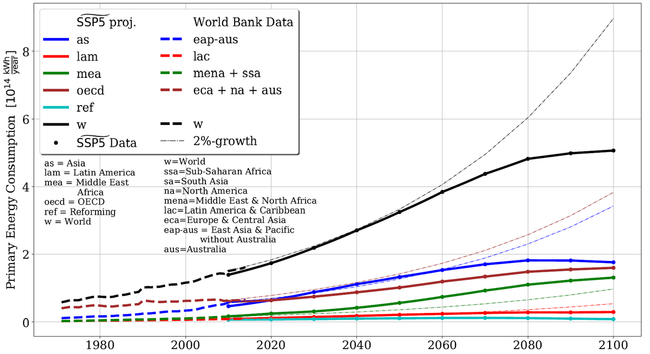
Here's two scenarios to 2100 Peter studied (black lines): 2% increase per year, and a more moderate IPCC scenario called SSP5. That’s less than a ten-fold increase. BUT: the heat release is not globally uniform. Unlike for CO2, it is concentrated where we live, on land. 5/
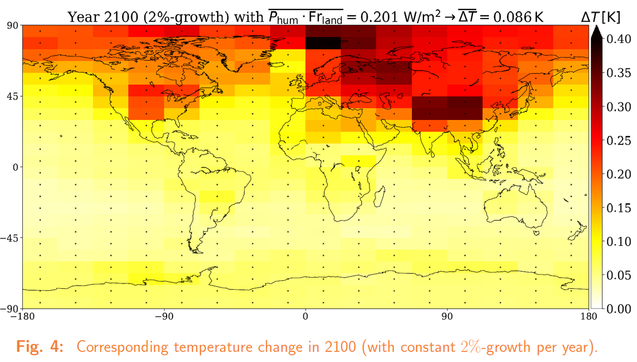
That is why the (admittedly rather coarse) climate model shows warming concentrated over Northern Hemisphere land, reaching 0.2 – 0.4 °C warming there by 2100 (not even yet in equilibrium). And we’re already struggling to prevent every 0.1 °C of further warming! /6
In terms of heat release, nuclear power (fusion or fission) is just as bad as coal.
Renewables are different: they use energy from wind, sun, tides or geothermal which is already in the climate system and will end up as heat anyway, whether we use it or not. /7
Renewables are different: they use energy from wind, sun, tides or geothermal which is already in the climate system and will end up as heat anyway, whether we use it or not. /7
(In case you want to say now: but extra heat is radiated into space! This is of course already taken into account. The Earth must get warmer to radiate more, that is what the climate sensitivity describes.) /8
The bottom line is: if humanity wants to use a lot more energy in future, nuclear power can't be the solution. Not just not for the next decades, but also in the long run renewable energies are the only sustainable solution. /9
These technologies we already have, they are growing exponentially and are safe and cheap. (And don't tell me the sun doesn't shine at night - energy system experts already account for that, believe it or not.) /10
---
RT @scienceisstrat1
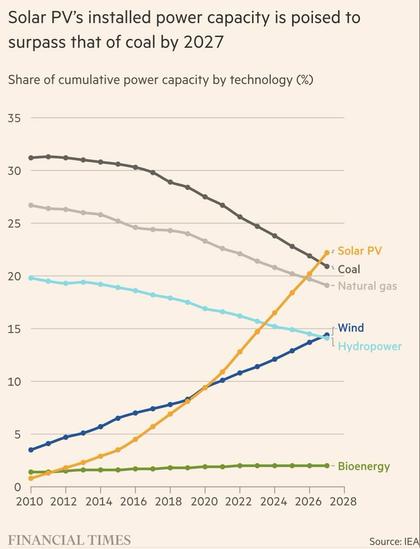
The @IEA’s bombshell new report on renewables has incredibly good news.
For example, solar is undergoing a mega boom & may surpass coal by 2027
Below is a 🧵 on genuinely good news on green ener…
https://twitter.com/scienceisstrat1/status/1601650724852895744

Science Is Strategic on Twitter
“The @IEA’s bombshell new report on renewables has incredibly good news. For example, solar is undergoing a mega boom & may surpass coal by 2027 Below is a 🧵 on genuinely good news on green energy from the IEA & beyond (1/22) Cc: @Noahpinion @JesseJenkins @ramez @dwallacewells”
A similar argument regarding waste heat was recently made in a peer-reviewed paper in Nature Physics as well. Check it out if you like. /11
https://www.nature.com/articles/s41567-022-01652-6
https://www.nature.com/articles/s41567-022-01652-6
 Marco van Burgsteden 🍋
@rahmstorf this is actually the first time that this has been brought to my attention. Hidden in plain sight. Thanks for this thread.
 Parents For Future
 )
) jfmay
jfmay@rahmstorf thanks a lot - is that thesis available somewhere (German is not a problem to me)? I would like to mention this calculation in my energy efficiency class
 anlomedad
@jfmay @rahmstorf
Steiglechner's author page on scholar-google links to a PDF for his thesis https://scholar.google.de/citations?view_op=view_citation&hl=en&user=5c924wYAAAAJ&sortby=pubdate&citation_for_view=5c924wYAAAAJ:2osOgNQ5qMEC
 Ladrillo_azul
Ok, i think this is the perfect moment for renewable energy to prove their value.
However what we are seeing is that Europe went for renewable technology and today it is not enough to replace fossil fuel.
Something doesn't add up.
 gpkvt
gpkvt@Ladrillo_azul
The current shortage only shows that our transition is too slow. In Germany we dumped Millions € worth of energy this year, because the grid wasn't able to transport (not store) it from north to south.
@rahmstorf
The current shortage only shows that our transition is too slow. In Germany we dumped Millions € worth of energy this year, because the grid wasn't able to transport (not store) it from north to south.
@rahmstorf
@Ladrillo_azul we’re simply still in transition. Germany is at 50% renewable power this year, government plans to reach 80% in 8 years. It takes time and there is stiff resistance from well-networked fossil fuel interests.
 Jim Hughes ☢️
@rahmstorf @Ladrillo_azul Germany also shut down all nuclear plants after Fukushima (and unfortunately a lot of that got replaced with fossil fuel generation).
 Nico Erfurth
@sideshow_jim @rahmstorf @Ladrillo_azul no, Fossil generation is in decline even after Fukushima. The decline could have been steeper with nuclear, but its false that nuclear was replaced by fossil. https://www.energy-charts.info/charts/energy/chart.htm?l=de&c=DE&chartColumnSorting=default&interval=year&year=-1&legendItems=001001111100001000000
Link to the Master thesis of Peter Steiglechner: https://publishup.uni-potsdam.de/frontdoor/index/index/docId/49886
publish.UP Estimating global warming from anthropogenic heat emissions
The forcing from the anthropogenic heat flux (AHF), i.e. the dissipation of primary energy consumed by the human civilisation, produces a direct climate warming. Today, the globally averaged AHF is negligibly small compared to the indirect forcing from greenhouse gas emissions. Locally or regionally, though, it has a significant impact. Historical observations show a constant exponential growth of worldwide energy production. A continuation of this trend might be fueled or even amplified by the exploration of new carbon-free energy sources like fusion power. In such a scenario, the impacts of the AHF become a relevant factor for anthropogenic post-greenhouse gas climate change on the global scale, as well. This master thesis aims at estimating the climate impacts of such a growing AHF forcing. In the first part of this work, the AHF is built into simple and conceptual, zero- and one-dimensional Energy Balance Models (EBMs), providing quick order of magnitude estimations of the temperature impact. In the one-dimensional EBM, the ice-albedo feedback from enhanced ice melting due to the AHF increases the temperature impact significantly compared to the zero-dimensional EBM. Additionally, the forcing is built into a climate model of intermediate complexity, CLIMBER-3α. This allows for the investigation of the effect of localised AHF and gives further insights into the impact of the AHF on processes like the ocean heat uptake, sea ice and snow pattern changes and the ocean circulation. The global mean temperature response from the AHF today is of the order of 0.010 − 0.016 K in all reasonable model configurations tested. A transient tenfold increase of this forcing heats up the Earth System additionally by roughly 0.1 − 0.2 K in the presented models. Further growth can also affect the tipping probability of certain climate elements. Most renewable energy sources do not or only partially contribute to the AHF forcing as the energy from these sources dissipates anyway. Hence, the transition to a (carbon-free) renewable energy mix, which, in particular, does not rely on nuclear power, eliminates the local and global climate impacts from the increasing AHF forcing, independent of the growth of energy production.
 Bernhard Klingseis
@rahmstorf thank you for sharing! So if I understood right we could at least have some nuclear fusion reactors on some remote islands to capture some GHG, right?
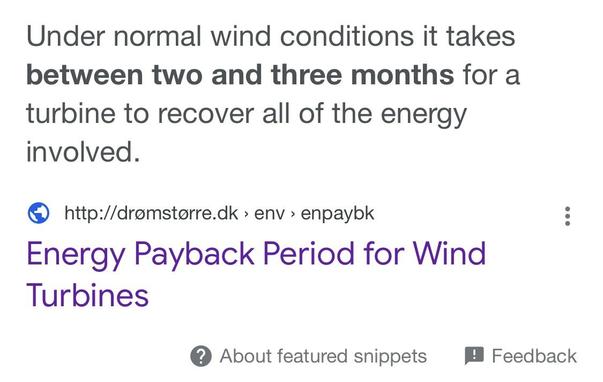
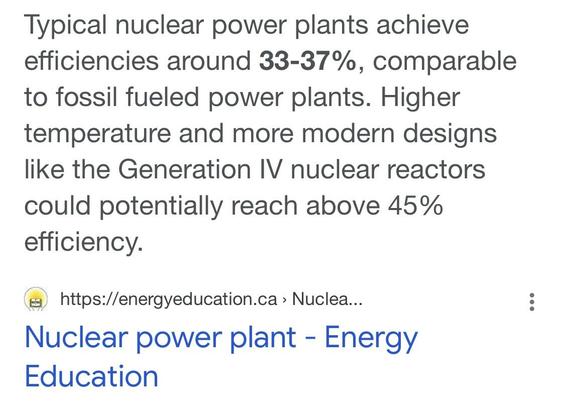
Someone brought up the energy expended in building the plant, incl. mining. For wind power that’s at most a few % of the electricity generated - in this example under 1% for 20y turbine life. Nuclear plants add 300% of the generated power as heat to the 🌍 at 33% efficiency.
 Arco
Arco@rahmstorf This calculation seems wrong to me:
- 33% efficiency, means 67% heat loss
- 67% heat loss ≈ 200% of the generated power
- 33% efficiency, means 67% heat loss
- 67% heat loss ≈ 200% of the generated power
 Wolfgang Maier
@Arco @rahmstorf I'm assuming 300% is because the generated power will end up as heat, too.
@zerodivision @rahmstorf Ah in that case ok, but the formulation sounded weird to me ^^
 Ariaflame
@Arco @rahmstorf Except of course that eventually all that generated power will also degrade to heat energy. Laws of thermodynamics.
 Michał Kawalec
@rahmstorf Does the energy emitted as heat really matter, except for maybe local effects related to availability of the cooling water? Different kinds of non-carbon energy production methods have different usefulness profiles.
 Dienstreiser Jens
@rahmstorf Just read the related chapter in the book #WeltuntergangFälltAus from @JanHegenberg.
it's remarkable how much more Power you can generate with a wind turbine, compared to a coal plant with the same amount of minerals mined from the ground.
it's remarkable how much more Power you can generate with a wind turbine, compared to a coal plant with the same amount of minerals mined from the ground.
 DS
DS@rahmstorf Thanks for this thread. 👍🏻
Thank you very much for this thread.
It will help me to shorten discussions and save me a lot of time.
 kampfschwaetzer
@rahmstorf
In my eyes a bit over simplistic. This only holds as long as the efficiency with wich the heat is used to produce electricity will stay as it is. If it will be doubled - and coming from such a low basis should be not so difficult - would change the picture. Next: No one who is sane talks about fusion as the only source as no one talks about solar as the only source.
But for sure: It will be more then late and is still not really understood from a engineering point of view.
In my eyes a bit over simplistic. This only holds as long as the efficiency with wich the heat is used to produce electricity will stay as it is. If it will be doubled - and coming from such a low basis should be not so difficult - would change the picture. Next: No one who is sane talks about fusion as the only source as no one talks about solar as the only source.
But for sure: It will be more then late and is still not really understood from a engineering point of view.
 Christian Schwägerl
@rahmstorf Isn’t real problem in this scenario the 10-fold increase in energy use? Covering it with renewable energy sources wd create very real problems, too, ranging from mining for minerals to impacts on biodiversity. Plus, we use most energy as heat which wd need to be generated from renewable sources x10, too. Question rather how to minimize waste part in heat (like using fusion process heat instead of cooling towers) and how to design life around less energy use/waste?
 CooperJ
@christianschwaegerl @rahmstorf There is already a discipline around designing life to run on far less energy. It's called Transition Engineering. The only problem that I've found with it is that most Western people don't want to change the way that they live.
@CooperJ @rahmstorf It‘s incredible how many ressources are exhaustible but not modern humans’ capability of clinging to a way of life that destroys life on Earth. Death by convenience.
„Routine breaking“ should be a sub-discipline of climate science in its own right.
@christianschwaegerl @rahmstorf "Death by Convenience" is a great way of putting it. Transition Engineering aims to design communities where the most convenient way also expends the least energy. But it involves changing things like zoning, removing car parking, building bike paths etc and is seen as "interference".
@CooperJ @rahmstorf I understand this is linked to the Transition Town movement?
 Carlos Jiménez
@christianschwaegerl @rahmstorf indeed, a further 10x increase in #energyconsumption is just not going to happen. Haven’t seen any analysis that suggests we would even have the #minerals available to get us there. In turn, if the world will have to settle on a low-kWh diet, #thermalpower like #nuclearfusion may well have an important role to play - if it ever works; which is a big if.
@cjimenez @rahmstorf I wouldn’t bet on fusion but a lot is happening there and it might be a very good supplement to renewables after 2050. No immediate effect for energy policy but definitely good reason to push R&D.
 Felipe
So, perhaps I'm misunderstanding something, but not all human energy consumption ends up as heat, does it?
What about LED lights? What about motion? Sure, there is friction in motion but that doesn't account for all the energy, or does it?
As an engineering guy, I'm genuinely interested in this concept. If you could clarify it, that would be great.
@FelipeW @rahmstorf light gets absorbed, gradually heating up the item which then radiates it out
Seriously? LED light, which doesn't contain much infrared waves, heats up all the objects around?
I am not saying that's impossible, but it doesn't sound right to me...
That would mean that moonlight (a very blue light) would also heat up the earth - though it's much less than the sun of course...
@FelipeW @rahmstorf tiny amounts, but the light gets absorbed and the energy has to go somewhere. All of it eventually ends up as useless heat
But the color white reflects almost all light, right?
But then it hits other surfaces which aren't white... I get it, I guess!
I didn't get yet how motion is completely turned into heat, though.
@FelipeW @rahmstorf friction. With air, any mechanical components etc.
Oh wow. Now I get it!
Motion is infinite in space because of a lack of friction. Any object on earth that is put into motion, stops eventually due to friction - this friction is of course generating heat, even though it's usually very little.
Sometimes it's really a lot though, thinking of car brakes!
So all motion ends with friction and all friction ends with heat and now I get it.
But back to LEDs: those 2 W of electricity going into the diode = 2W heat! Right?
 CapritiaJH
@FelipeW @rahmstorf
Any use of energy inevitably results in some waste heat -- including LEDs and motion. Some atoms wind up with some extra energy: waste heat.
But from sources like wind or solar, that energy would have arrived on earth anyway -- you just borrow some of it for your own purposes. Whereas fusion or fission or burning fossil fuels release otherwise latent energy into the biosphere from atomic or chemical reactions. At useful scales, those heat the planet.
Any use of energy inevitably results in some waste heat -- including LEDs and motion. Some atoms wind up with some extra energy: waste heat.
But from sources like wind or solar, that energy would have arrived on earth anyway -- you just borrow some of it for your own purposes. Whereas fusion or fission or burning fossil fuels release otherwise latent energy into the biosphere from atomic or chemical reactions. At useful scales, those heat the planet.
 IonTichy
@patriciajhawkins @FelipeW @rahmstorf if I have a total amount of kinetic wind energy, that is nearly constant over time and I use a part of this total amount to power turbines and transform it in different energy forms more heat is generated then if we leave the air flow as it is. But to be fair the numbers are way lower then by burning fossil fuels (nearly not countable given todays consumption)
@PilotPirx @patriciajhawkins @rahmstorf
Yeah, I get all that. And I'm not doubting that wind turbines generate more heat than no wind turbines.
I'm just trying to understand how all electricity is turned into heat eventually, considering that motion is not all about heat dissipation.
@FelipeW @PilotPirx @rahmstorf
But motion IS heat! Heat IS "the vibration of molecules and atoms!" ALL energy eventually dissipates as waste background heat, though it can go through a number of other forms first. Why we can't have perpetual motion machines: when energy changes form, some always becomes heat -- can't change form for free. #DisapointingThingsLearnedFromMyFather
https://byjus.com/physics/heat-introduction-classification/
But motion IS heat! Heat IS "the vibration of molecules and atoms!" ALL energy eventually dissipates as waste background heat, though it can go through a number of other forms first. Why we can't have perpetual motion machines: when energy changes form, some always becomes heat -- can't change form for free. #DisapointingThingsLearnedFromMyFather
https://byjus.com/physics/heat-introduction-classification/

@patriciajhawkins @FelipeW @rahmstorf You are right on an eternal point of view, but I doubt you are in the relevant Intervall for the referenced scenarios. It does matter if energy is kept in a specific state (like the kinetic energy of air molecules) for a finite interval of time. Changing its energy form will simply produce more heat loss then keeping its temporarily state (finite time frame).Even though I like the whole discussion a lot.Merry Xmas
@PilotPirx @FelipeW @rahmstorf
Not to mention the srecent fusion "breakthrough" wasn't one -- useful fusion is STILL decades off -- so calculating its additional heat output isn't even relevant, though IMO real use of fusion would definitely need us to think about that. See: https://bigthink.com/the-future/fusion-power-nif-hype-lose-energy/
Not to mention the srecent fusion "breakthrough" wasn't one -- useful fusion is STILL decades off -- so calculating its additional heat output isn't even relevant, though IMO real use of fusion would definitely need us to think about that. See: https://bigthink.com/the-future/fusion-power-nif-hype-lose-energy/

@FelipeW @PilotPirx @rahmstorf
Just one thing -- wind turbines don't generate heat; the energy they produce is present in the wind. The wind slows down a little, the energy from the wind is used to drive a turbine -- all of that is using the energy from the wind. You COULD use that energy to create friction against wood and start a fire -- concentrating the wind energy to do that -- but the energy from the fire is stored in the wood. Conservation of energy.
Just one thing -- wind turbines don't generate heat; the energy they produce is present in the wind. The wind slows down a little, the energy from the wind is used to drive a turbine -- all of that is using the energy from the wind. You COULD use that energy to create friction against wood and start a fire -- concentrating the wind energy to do that -- but the energy from the fire is stored in the wood. Conservation of energy.
@patriciajhawkins @PilotPirx @rahmstorf
Thank you! The more I get into the issue, the more sense it makes!
@PilotPirx @FelipeW @rahmstorf
One source of heat, wind: already present in biosphere; caused by solar energy; will soon dissipate as waste heat no matter how used. Scale: days.
Fossil, fission, fusion: are latent chemical or atomic forces. Dissipate either not at all (fossil) or over long periods. Scale: years, eons, or whenever sun goes nova
ALL is either harm reduction or mitigation OR fitting human processes back into the beneficial ecosystem cycles (carbon, water, nutrient...)
One source of heat, wind: already present in biosphere; caused by solar energy; will soon dissipate as waste heat no matter how used. Scale: days.
Fossil, fission, fusion: are latent chemical or atomic forces. Dissipate either not at all (fossil) or over long periods. Scale: years, eons, or whenever sun goes nova
ALL is either harm reduction or mitigation OR fitting human processes back into the beneficial ecosystem cycles (carbon, water, nutrient...)
 Kelsey Jordahl
@FelipeW @rahmstorf
For lighting, only the fraction that actually radiates into space would not end up as heat (a tiny fraction, especially if lighting is efficient, not pointing upwards outdoors, etc.). Motion too eventually will be lost to friction and heat (temporarily in kinetic energy of moving vehicles, active flywheels, etc., but never forever). The 2nd law of thermodynamics always prevails.
For lighting, only the fraction that actually radiates into space would not end up as heat (a tiny fraction, especially if lighting is efficient, not pointing upwards outdoors, etc.). Motion too eventually will be lost to friction and heat (temporarily in kinetic energy of moving vehicles, active flywheels, etc., but never forever). The 2nd law of thermodynamics always prevails.
 Justin Ribeiro, Ph.D.
@rahmstorf We forget the human rights abuses that are hidden in the cost of the idea that solar PV (or wind turbines for that matter) is "cheap"; the majority of that solar PV production is in Xinjiang where forced labor is rampant (hence the import restrictions in the UFLPA), let alone the supply chain that powers that production (e.g. child labor in places like the DRC for minerals).
 PaulM
PaulM@rahmstorf @justin
I don’t think we do - but fossil fuel extraction presents at least equal challenges, and with will, the issues with renewables supply chains could be fixed.
“Winston - you’re drunk!”
“Bessie, you’re ugly - and in the morning, *I* shall be sober!”
I don’t think we do - but fossil fuel extraction presents at least equal challenges, and with will, the issues with renewables supply chains could be fixed.
“Winston - you’re drunk!”
“Bessie, you’re ugly - and in the morning, *I* shall be sober!”
@onebiskuit @rahmstorf "fossil fuel extraction presents at least equal challenges": absolutely agree and not arguing they're not worse (e.g., Shell in Nigeria in the 1990's is a travesty). "the issues with renewables supply chains could be fixed" it's a very complex issue, but NGOs and gov'ts are forcing that issue by pressuming corps to audit their suppliers (which is a great first step).
I am wholeheartedly for renewables; I just hope that we don't lose the humanity in the economic argument.
 Astro3000
@rahmstorf why is the amount of hydro power dropping as function of time ? Is that a climate change/less rain related ?