 Prof. Stefan Rahmstorf
Nuclear #fusion will not only come too late to help solve the #climatecrisis. Even in the long run it will not be the unlimited energy source that some are dreaming of. The reason is basic physics, and anyone can do the back-of-envelope calculation. 🧵1/
The problem is that all human energy use ends up as heat. That's no problem now: our current global energy use corresponds to 0.04 Watt/sqm (that's per square metre of Earth surface). The human-caused CO2 increase has a far stronger warming effect: 2.1 W/sqm, following IPCC. 2/
But our energy use (here also in W/sqm) is growing exponentially by 2.3 %/year, 10-fold per century. What does this mean for the future? The Master thesis by Peter Steiglechner @PIK_Climate investigated this in 2018 using a global climate model. Figures taken from his work. 3/
But first, back of envelope: a 10-fold increase in energy use from the current results in a heat flux of 0.4 W/sqm.
With the standard IPCC climate sensitivity that results in 0.3 °C global warming. Oops, now this is a problem, coming on top of greenhouse warming! 4/
With the standard IPCC climate sensitivity that results in 0.3 °C global warming. Oops, now this is a problem, coming on top of greenhouse warming! 4/
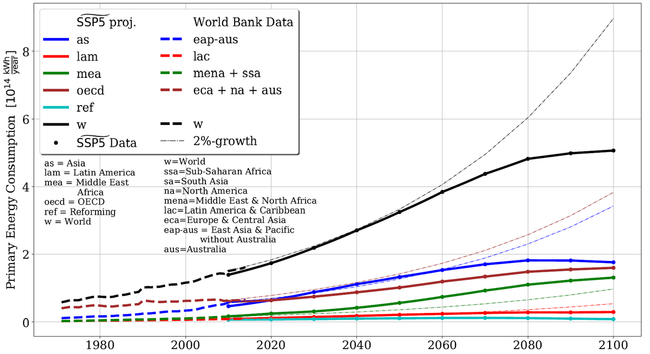
Here's two scenarios to 2100 Peter studied (black lines): 2% increase per year, and a more moderate IPCC scenario called SSP5. That’s less than a ten-fold increase. BUT: the heat release is not globally uniform. Unlike for CO2, it is concentrated where we live, on land. 5/
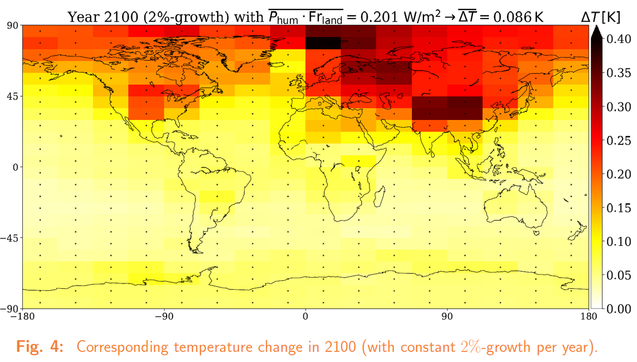
That is why the (admittedly rather coarse) climate model shows warming concentrated over Northern Hemisphere land, reaching 0.2 – 0.4 °C warming there by 2100 (not even yet in equilibrium). And we’re already struggling to prevent every 0.1 °C of further warming! /6
In terms of heat release, nuclear power (fusion or fission) is just as bad as coal.
Renewables are different: they use energy from wind, sun, tides or geothermal which is already in the climate system and will end up as heat anyway, whether we use it or not. /7
Renewables are different: they use energy from wind, sun, tides or geothermal which is already in the climate system and will end up as heat anyway, whether we use it or not. /7
(In case you want to say now: but extra heat is radiated into space! This is of course already taken into account. The Earth must get warmer to radiate more, that is what the climate sensitivity describes.) /8
The bottom line is: if humanity wants to use a lot more energy in future, nuclear power can't be the solution. Not just not for the next decades, but also in the long run renewable energies are the only sustainable solution. /9
These technologies we already have, they are growing exponentially and are safe and cheap. (And don't tell me the sun doesn't shine at night - energy system experts already account for that, believe it or not.) /10
---
RT @scienceisstrat1
The @IEA’s bombshell new report on renewables has incredibly good news.
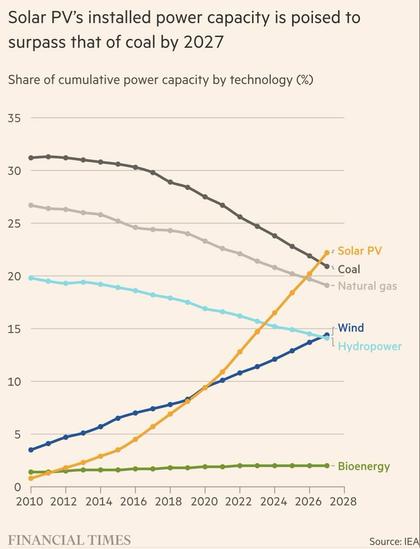
For example, solar is undergoing a mega boom & may surpass coal by 2027
Below is a 🧵 on genuinely good news on green ener…
https://twitter.com/scienceisstrat1/status/1601650724852895744

Science Is Strategic on Twitter
“The @IEA’s bombshell new report on renewables has incredibly good news. For example, solar is undergoing a mega boom & may surpass coal by 2027 Below is a 🧵 on genuinely good news on green energy from the IEA & beyond (1/22) Cc: @Noahpinion @JesseJenkins @ramez @dwallacewells”
A similar argument regarding waste heat was recently made in a peer-reviewed paper in Nature Physics as well. Check it out if you like. /11
https://www.nature.com/articles/s41567-022-01652-6
https://www.nature.com/articles/s41567-022-01652-6
 Felipe
So, perhaps I'm misunderstanding something, but not all human energy consumption ends up as heat, does it?
What about LED lights? What about motion? Sure, there is friction in motion but that doesn't account for all the energy, or does it?
As an engineering guy, I'm genuinely interested in this concept. If you could clarify it, that would be great.
 CapritiaJH
@FelipeW @rahmstorf
Any use of energy inevitably results in some waste heat -- including LEDs and motion. Some atoms wind up with some extra energy: waste heat.
But from sources like wind or solar, that energy would have arrived on earth anyway -- you just borrow some of it for your own purposes. Whereas fusion or fission or burning fossil fuels release otherwise latent energy into the biosphere from atomic or chemical reactions. At useful scales, those heat the planet.
Any use of energy inevitably results in some waste heat -- including LEDs and motion. Some atoms wind up with some extra energy: waste heat.
But from sources like wind or solar, that energy would have arrived on earth anyway -- you just borrow some of it for your own purposes. Whereas fusion or fission or burning fossil fuels release otherwise latent energy into the biosphere from atomic or chemical reactions. At useful scales, those heat the planet.
 IonTichy
@patriciajhawkins @FelipeW @rahmstorf if I have a total amount of kinetic wind energy, that is nearly constant over time and I use a part of this total amount to power turbines and transform it in different energy forms more heat is generated then if we leave the air flow as it is. But to be fair the numbers are way lower then by burning fossil fuels (nearly not countable given todays consumption)
@PilotPirx @patriciajhawkins @rahmstorf
Yeah, I get all that. And I'm not doubting that wind turbines generate more heat than no wind turbines.
I'm just trying to understand how all electricity is turned into heat eventually, considering that motion is not all about heat dissipation.
@FelipeW @PilotPirx @rahmstorf
But motion IS heat! Heat IS "the vibration of molecules and atoms!" ALL energy eventually dissipates as waste background heat, though it can go through a number of other forms first. Why we can't have perpetual motion machines: when energy changes form, some always becomes heat -- can't change form for free. #DisapointingThingsLearnedFromMyFather
https://byjus.com/physics/heat-introduction-classification/
But motion IS heat! Heat IS "the vibration of molecules and atoms!" ALL energy eventually dissipates as waste background heat, though it can go through a number of other forms first. Why we can't have perpetual motion machines: when energy changes form, some always becomes heat -- can't change form for free. #DisapointingThingsLearnedFromMyFather
https://byjus.com/physics/heat-introduction-classification/

@patriciajhawkins @FelipeW @rahmstorf You are right on an eternal point of view, but I doubt you are in the relevant Intervall for the referenced scenarios. It does matter if energy is kept in a specific state (like the kinetic energy of air molecules) for a finite interval of time. Changing its energy form will simply produce more heat loss then keeping its temporarily state (finite time frame).Even though I like the whole discussion a lot.Merry Xmas
@PilotPirx @FelipeW @rahmstorf
Not to mention the srecent fusion "breakthrough" wasn't one -- useful fusion is STILL decades off -- so calculating its additional heat output isn't even relevant, though IMO real use of fusion would definitely need us to think about that. See: https://bigthink.com/the-future/fusion-power-nif-hype-lose-energy/
Not to mention the srecent fusion "breakthrough" wasn't one -- useful fusion is STILL decades off -- so calculating its additional heat output isn't even relevant, though IMO real use of fusion would definitely need us to think about that. See: https://bigthink.com/the-future/fusion-power-nif-hype-lose-energy/
