 Prof. Stefan Rahmstorf
Nuclear #fusion will not only come too late to help solve the #climatecrisis. Even in the long run it will not be the unlimited energy source that some are dreaming of. The reason is basic physics, and anyone can do the back-of-envelope calculation. 🧵1/
The problem is that all human energy use ends up as heat. That's no problem now: our current global energy use corresponds to 0.04 Watt/sqm (that's per square metre of Earth surface). The human-caused CO2 increase has a far stronger warming effect: 2.1 W/sqm, following IPCC. 2/
But our energy use (here also in W/sqm) is growing exponentially by 2.3 %/year, 10-fold per century. What does this mean for the future? The Master thesis by Peter Steiglechner @PIK_Climate investigated this in 2018 using a global climate model. Figures taken from his work. 3/
But first, back of envelope: a 10-fold increase in energy use from the current results in a heat flux of 0.4 W/sqm.
With the standard IPCC climate sensitivity that results in 0.3 °C global warming. Oops, now this is a problem, coming on top of greenhouse warming! 4/
With the standard IPCC climate sensitivity that results in 0.3 °C global warming. Oops, now this is a problem, coming on top of greenhouse warming! 4/
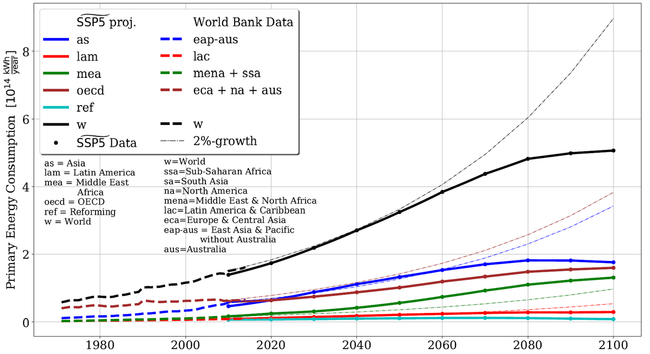
Here's two scenarios to 2100 Peter studied (black lines): 2% increase per year, and a more moderate IPCC scenario called SSP5. That’s less than a ten-fold increase. BUT: the heat release is not globally uniform. Unlike for CO2, it is concentrated where we live, on land. 5/
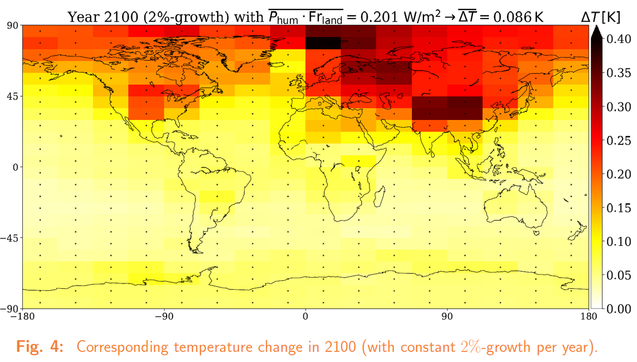
That is why the (admittedly rather coarse) climate model shows warming concentrated over Northern Hemisphere land, reaching 0.2 – 0.4 °C warming there by 2100 (not even yet in equilibrium). And we’re already struggling to prevent every 0.1 °C of further warming! /6
In terms of heat release, nuclear power (fusion or fission) is just as bad as coal.
Renewables are different: they use energy from wind, sun, tides or geothermal which is already in the climate system and will end up as heat anyway, whether we use it or not. /7
Renewables are different: they use energy from wind, sun, tides or geothermal which is already in the climate system and will end up as heat anyway, whether we use it or not. /7
(In case you want to say now: but extra heat is radiated into space! This is of course already taken into account. The Earth must get warmer to radiate more, that is what the climate sensitivity describes.) /8
The bottom line is: if humanity wants to use a lot more energy in future, nuclear power can't be the solution. Not just not for the next decades, but also in the long run renewable energies are the only sustainable solution. /9
These technologies we already have, they are growing exponentially and are safe and cheap. (And don't tell me the sun doesn't shine at night - energy system experts already account for that, believe it or not.) /10
---
RT @scienceisstrat1
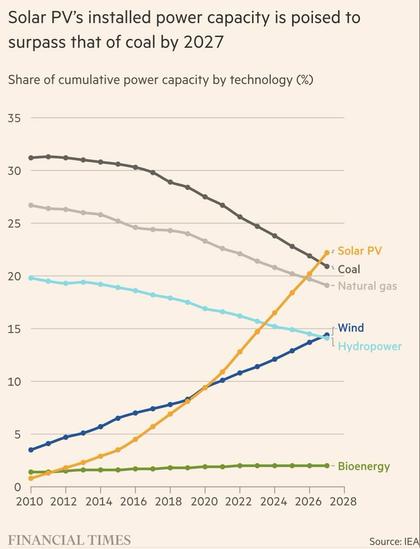
The @IEA’s bombshell new report on renewables has incredibly good news.
For example, solar is undergoing a mega boom & may surpass coal by 2027
Below is a 🧵 on genuinely good news on green ener…
https://twitter.com/scienceisstrat1/status/1601650724852895744

Science Is Strategic on Twitter
“The @IEA’s bombshell new report on renewables has incredibly good news. For example, solar is undergoing a mega boom & may surpass coal by 2027 Below is a 🧵 on genuinely good news on green energy from the IEA & beyond (1/22) Cc: @Noahpinion @JesseJenkins @ramez @dwallacewells”
A similar argument regarding waste heat was recently made in a peer-reviewed paper in Nature Physics as well. Check it out if you like. /11
https://www.nature.com/articles/s41567-022-01652-6
https://www.nature.com/articles/s41567-022-01652-6
 Ladrillo_azul
Ok, i think this is the perfect moment for renewable energy to prove their value.
However what we are seeing is that Europe went for renewable technology and today it is not enough to replace fossil fuel.
Something doesn't add up.
@Ladrillo_azul we’re simply still in transition. Germany is at 50% renewable power this year, government plans to reach 80% in 8 years. It takes time and there is stiff resistance from well-networked fossil fuel interests.
 Jim Hughes ☢️
@rahmstorf @Ladrillo_azul Germany also shut down all nuclear plants after Fukushima (and unfortunately a lot of that got replaced with fossil fuel generation).
 Nico Erfurth
@sideshow_jim @rahmstorf @Ladrillo_azul no, Fossil generation is in decline even after Fukushima. The decline could have been steeper with nuclear, but its false that nuclear was replaced by fossil. https://www.energy-charts.info/charts/energy/chart.htm?l=de&c=DE&chartColumnSorting=default&interval=year&year=-1&legendItems=001001111100001000000