Albert Michelson, pioneer of optical interferometry, was born #OTD in 1852.

Michelson refined measurements of the speed of light, failed to find evidence of the aether, and developed a method that now underlies gravitational wave detection.

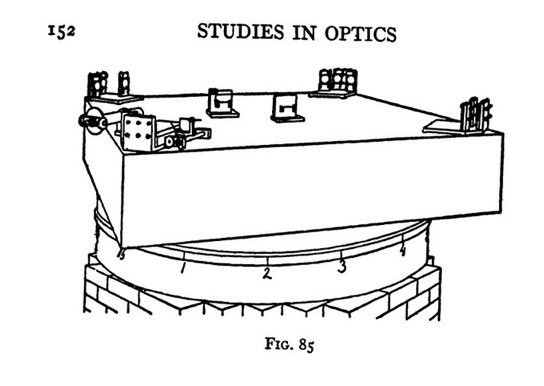
Photo: “Practical Physics,” Millikan & Gale
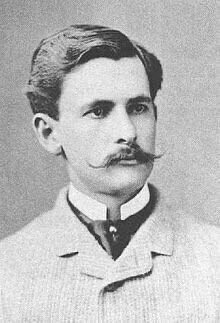
Michelson was born in Prussia but moved to the US at a young age. He grew up in little mining towns across California and Nevada.

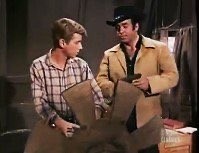
In Nevada they lived in Virginia City, which was the setting for the TV show “Bonanza.” This was too good for the writers to pass up!

In the episode “Look to the Stars,” a young Michelson performs various experiments and measures the speed of light. The plot involves the Cartwrights helping him gain admission to the US Naval Academy.

Michelson did attend the Naval Academy. While in the Navy, he repeated Foucault's experiment to determine the speed of light. His result was more accurate than the value I use in my intro physics class. By 1883 he had measured 299,853 ± 60 km/s. The lower end of that error bar grazes the actual value of 299,792 km/s.

Michelson is best known for the experiment conducted with Edward Morley, attempting to detect Earth’s motion through a luminiferous aether. This experiment is the basis for modern optical interferometry and the method is used by @LIGO to detect gravitational waves.

In 1865, James Clerk Maxwell published "A Dynamical Theory of the Electromagnetic Field." He showed that electromagnetic waves propagate with a velocity close to the known speed of light, and concluded that light must be an EM wave.

Maxwell and everyone else assumed that electromagnetic waves, like all other waves known at the time, required a medium. They called it the "luminiferous aether." Maxwell's equations would only be valid in the rest frame of this aether.

Of course, no one could come up with an experiment that directly sampled the aether. You couldn't bottle it, isolate it in a lab, or explain why planets didn't slow down from drag as they sloshed through it.

But it must be there! Waves require a medium. Right?

In 1881, Michelson began work on an indirect test.

The idea was that light should propagate at different speeds in the directions parallel and perpendicular to any motion through the aether.

So Michelson designed an interferometer that would send light down and back two perpendicular legs of identical length. If light traveled at different speeds along the two legs, an interference pattern would appear when they recombined.

The first experiment wasn't sensitive enough to show anything conclusive.

In 1885 Michelson began his collaboration with Morley, building a larger and more sensitive version of the interferometer. They performed their experiment over a few months in 1887.

Here is Michelson's diagram of the apparatus (on a stone block floated on a pool of mercury) and beam paths. Multiple reflections increased the effective length of the arms of the interferometer, enhancing the effect they were looking for.

The effect depends on the ratio v/c, where v is the speed relative to the aether and c is the speed of light through the aether.

Michelson and Morley took advantage of the largest v they had access to — the Earth moving at 30 km/s in its orbit around the sun.

If the direction of the Earth's motion through the aether was just right, they might get the same effect along both optical paths. To rule that out they performed the experiment multiple times throughout the year. The direction of Earth's velocity would be different each time.

To make a long story short, they didn't see what they expected to see.

If there was an aether, then their experiment should have shown a time difference along the two legs. But no matter how they looked, it simply wasn't there. This is the most famous "null result" in all of physics!

No one knew quite what to make of this.

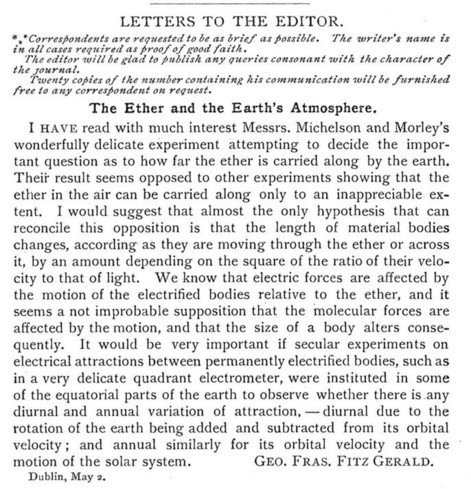
George Fitzgerald was the first to propose that perhaps objects somehow became shorter in the direction parallel to the motion through the aether. That would explain why light took the same time to travel both paths.

Ref: https://www.science.org/doi/10.1126/science.ns-13.328.390.a

That makes a sort of sense. Maybe plowing through the aether would buffet an object and compress it somehow? But if it could interact with matter this way, why wouldn't it produce any sort of drag?

Hendrik Lorentz took this idea even further. In 1892 he proposed a formula for the contraction of lengths in the direction of motion through the aether. His result would later be relevant in another context, but he was still trying to reconcile the null observations with the existence of an aether.

Michelson and Morley knew what they were looking for and how to measure it; it just wasn’t there. But faced with this null result, which Michelson and Morley continued to refine, physicists still clung to the idea of an aether. How else could you have waves?

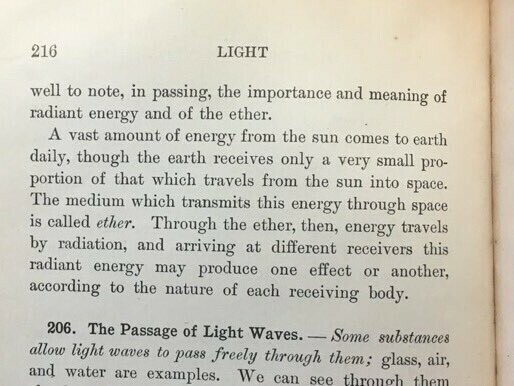
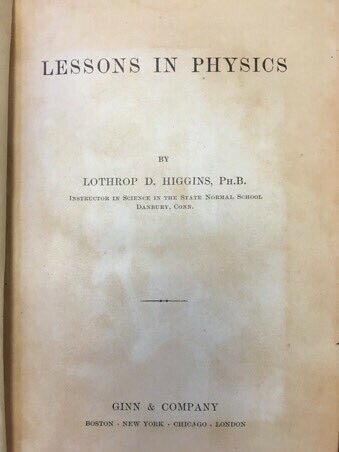
Here is a page from "Lessons in Physics," a textbook written by Lothrop Higgins in 1903 – over 15 years after the Michelson-Morley experiment! – that presents the aether as a matter-of-fact.

Finally, in 1905, Albert Einstein took Michelson and Morley's null result completely seriously.

Einstein elevated Maxwell's Equations to the status of fundamental laws that hold in all inertial reference frames. Therefore there is no need for a special "rest frame" for electrodynamics.

"The introduction of a “luminiferous ether” will prove to be superfluous inasmuch as the view here to be developed will not require an “absolutely stationary space” provided with special properties..."

Einstein, "On the Electrodynamics of Moving Bodies" (1905)

So Michelson's interferometry work, culminating in his "failed experiment" with Morley, was an essential step in Einstein’s discovery of special relativity.

But it was also central to a remarkable direct test of *general* relativity!

The interferometers used by @LIGO to detect gravitational waves, while differing in size and sophistication, employ the same principles as Michelson's original design.

https://www.ligo.caltech.edu/page/ligos-ifo

LIGO's Interferometer

Bringing together "What is LIGO" and "What is an Interferometer?" content to explain LIGO's IFO design.

LIGO Lab | Caltech
☝️Albert Michelson, aether, gravitational waves, and... the TV show Bonanza?
@mcnees Hoss is a major source of gravity Waves while his and the boys’ dad is a major source of Gravitas Waves
@LIGO @mcnees Michelson and Morley and others kept testing for aether for decades. My favourite experiment was an interferometer carried up by a balloon. The motivation was to avoid the layer of aether possibly being dragged along by the earth.
https://www.gsjournal.net/Science-Journals/Historical%20Papers-Astrophysics/Download/2600
@mcnees from 1889? Wow. Lorentz put the math together for him and then Einstein laid down the theory. Very interesting. Thanks for sharing this.
@jadarling Yeah, Lorentz got much of the math correct, but not quite for the right reasons. He was sure there was an aether.
@mcnees I knew Einstein said to follow Lorentz but I wasn't aware of the Fitzgerald connection. That made my morning.
@mcnees I seem to recall that with the first experiment, it wasn't so much a matter of not being sensitive enough, but of the noise (dominated by horse hoofs on cobblestones of nearby streets) being too great. Am I misremembering?
@mpoessel @mcnees You're not mis-remembering! Michelson had to move to the suburbs and then work at night because his kit was so sensitive. #ClassicKit https://www.chemistryworld.com/opinion/michelsons-interferometer/6660.article
Michelson's interferometer

Science at the speed of light

Chemistry World
@mcnees 'A pool of mercury'... those were the days 😬