Why do our brains believe lies?

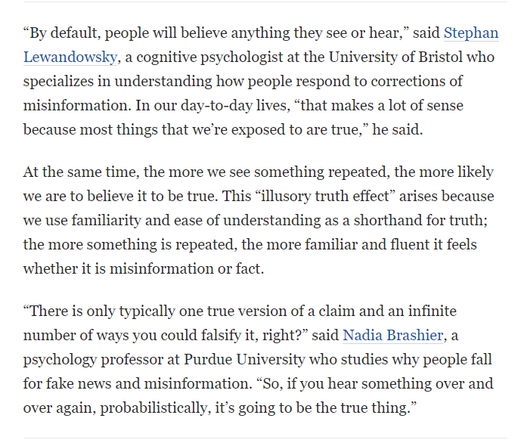
"the more we see something repeated, the more likely we are to believe it to be true.

This “illusory truth effect” arises because we use familiarity and ease of understanding as a shorthand for truth; the more something is repeated, the more familiar and fluent it feels whether it is misinformation or fact."
~https://www.washingtonpost.com/wellness/2022/11/03/misinformation-brain-beliefs/

#Propaganda #Disinformation #Misinformation
#Lies #FakeNews #USPolitics #News
Why do our brains believe lies?

Many of the decisions we make depend on accurate information, but our psychological biases and predispositions make us vulnerable to the spread of falsehoods.

The Washington Post

"But these shortcuts do not work so well in our current political environment and social media, which can repeat and amplify falsehoods.

One study found that even a single exposure to a fake headline made it seem truer.

Politicians often repeat lies and seem to be aware of the power of the illusory truth effect"
~https://www.washingtonpost.com/wellness/2022/11/03/misinformation-brain-beliefs/

#Propaganda #Disinformation
#Misinformation
#Lies #FakeNews #USPolitics #Politicians
#Journalism #Journalists

Why do our brains believe lies?

Many of the decisions we make depend on accurate information, but our psychological biases and predispositions make us vulnerable to the spread of falsehoods.

The Washington Post

'Why misinformation resists correction

Once we have heard misinformation, it is hard to uproot even when we want to know the truth.

Multiple studies have found that misinformation can still influence our thinking even if we receive a correction and believe it to be true, a phenomenon known as the “continued influence effect.”
~https://www.washingtonpost.com/wellness/2022/11/03/misinformation-brain-beliefs/

#Propaganda #Disinformation
#Misinformation
#Lies #USPolitics #Politicians
#Journalism #Journalists

Why do our brains believe lies?

Many of the decisions we make depend on accurate information, but our psychological biases and predispositions make us vulnerable to the spread of falsehoods.

The Washington Post
@ZhiZhu Seriously? Maybe for some but not for all. That’s the whole idea of learning. And I must say, rudely I’m afraid, those that ferociously cling to one thought or idea when presented with alternatives are some kind of. No I won’t say it. As fearless Captain Kirk was wont to say “Gentlemen, I want that third option”