Why do our brains believe lies?

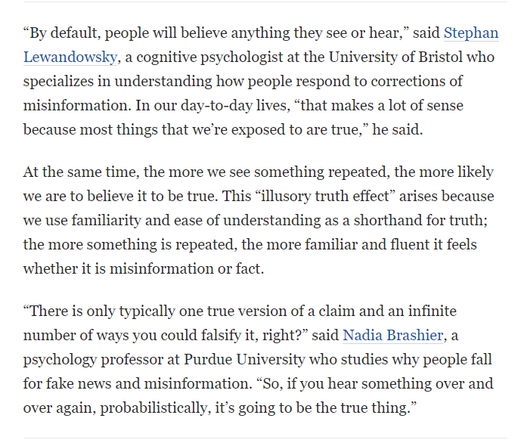
"the more we see something repeated, the more likely we are to believe it to be true.

This “illusory truth effect” arises because we use familiarity and ease of understanding as a shorthand for truth; the more something is repeated, the more familiar and fluent it feels whether it is misinformation or fact."
~https://www.washingtonpost.com/wellness/2022/11/03/misinformation-brain-beliefs/

#Propaganda #Disinformation #Misinformation
#Lies #FakeNews #USPolitics #News
Why do our brains believe lies?

Many of the decisions we make depend on accurate information, but our psychological biases and predispositions make us vulnerable to the spread of falsehoods.

The Washington Post

"But these shortcuts do not work so well in our current political environment and social media, which can repeat and amplify falsehoods.

One study found that even a single exposure to a fake headline made it seem truer.

Politicians often repeat lies and seem to be aware of the power of the illusory truth effect"
~https://www.washingtonpost.com/wellness/2022/11/03/misinformation-brain-beliefs/

#Propaganda #Disinformation
#Misinformation
#Lies #FakeNews #USPolitics #Politicians
#Journalism #Journalists

Why do our brains believe lies?

Many of the decisions we make depend on accurate information, but our psychological biases and predispositions make us vulnerable to the spread of falsehoods.

The Washington Post

'Why misinformation resists correction

Once we have heard misinformation, it is hard to uproot even when we want to know the truth.

Multiple studies have found that misinformation can still influence our thinking even if we receive a correction and believe it to be true, a phenomenon known as the “continued influence effect.”
~https://www.washingtonpost.com/wellness/2022/11/03/misinformation-brain-beliefs/

#Propaganda #Disinformation
#Misinformation
#Lies #USPolitics #Politicians
#Journalism #Journalists

Why do our brains believe lies?

Many of the decisions we make depend on accurate information, but our psychological biases and predispositions make us vulnerable to the spread of falsehoods.

The Washington Post
@ZhiZhu I think this article is pablum bullshit.
There are those who do quite well at removing disinformation from their brains
https://misinforeview.hks.harvard.edu/article/right-and-left-partisanship-predicts-asymmetric-vulnerability-to-misinformation/
Right and left, partisanship predicts (asymmetric) vulnerability to misinformation | HKS Misinformation Review

We analyze the relationship between partisanship, echo chambers, and vulnerability to online misinformation by studying news sharing behavior on Twitter. While our results confirm prior findings that online misinformation sharing is strongly correlated with right-leaning partisanship, we also uncover a similar, though weaker, trend among left-leaning users. Because of the correlation between a user’s partisanship

Misinformation Review