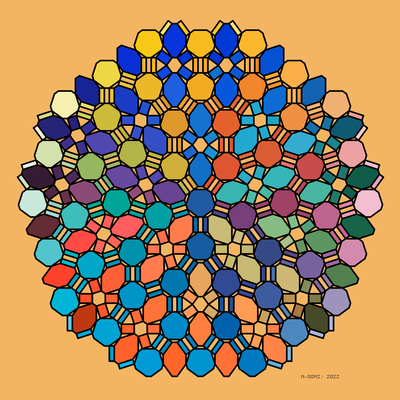
 n-gons
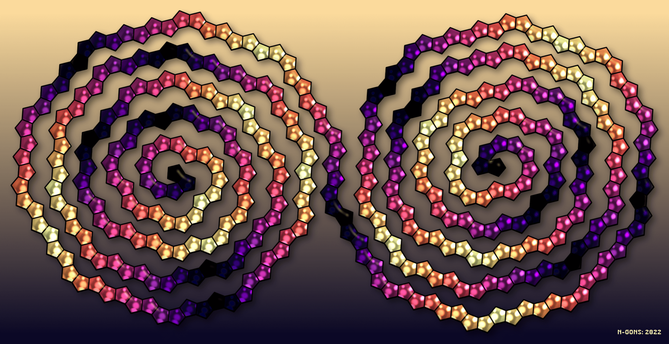
A double spiral from 387 tiled pentagons. This is as tight as it can be wound with only the joining edges touching - nice and squiggly :) #mathsart #mathart #mastoart
Neat!
Related question:
Attaching \(n\) equal tetrahedra face-to-face in some 3D-sequence, how close (in terms of a positive fraction of edge length) can two vertices be, as a function of \(n\) ?
@ngons
Take 4 participants:
- \(A\) states a signal indication +
- \(A\) receives the corresp. signal front echos from \(B\) + \(C\) + \(D\) **in coinc**.
Likewise all, mutually.
Also a fifth:
- \(M\) states a signal ind. +
- \(M\) rec. the corr. s. f. echos from \(A\) and \(B\) **in coinc** +
- \(A\) states a signal ind., +
- \(A\) rec. \(M\)'s echo, and
- \(A\) rec. the corr. s. f. echos from \(B\) + \(C\) + \(D\) + \(M\)'s echo of \(A\)'s echo of \(M\)'s echo, **in coinc**.
Etc.
 Frank Wappler