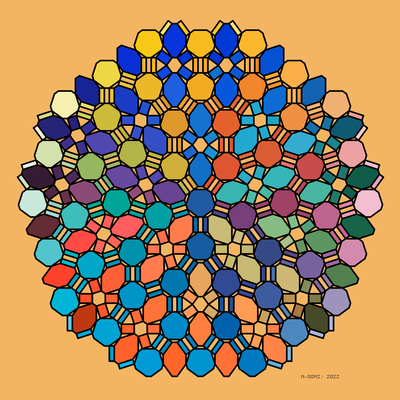
A double spiral from 387 tiled pentagons. This is as tight as it can be wound with only the joining edges touching - nice and squiggly :) #mathsart #mathart #mastoart
@ngons

https://media.mathstodon.xyz/media_attachments/files/109/508/095/623/465/923/original/8e491ea678a51830.png

Neat!
Related question:
Attaching \(n\) equal tetrahedra face-to-face in some 3D-sequence, how close (in terms of a positive fraction of edge length) can two vertices be, as a function of \(n\) ?

#PingCoincidenceLattice #Spacetime

@MisterRelativity imagine you have your honeycomb and paint a sequence of units, they are still on a regular honeycomb that defines the distances, right? With pentagons things are trickier,as they can’t tile the plane
@MisterRelativity I could be wrong. I am begging to grasp the idea of the pings now. You're sending a signal from one node outwards (is this along grid lines or spherically), and nodes send signals when they are hit. So we want to see/understand the how these signals fire over time. I probably can make that visible in python...

@ngons
Take 4 participants:

- \(A\) states a signal indication +
- \(A\) receives the corresp. signal front echos from \(B\) + \(C\) + \(D\) **in coinc**.

Likewise all, mutually.

Also a fifth:
- \(M\) states a signal ind. +
- \(M\) rec. the corr. s. f. echos from \(A\) and \(B\) **in coinc** +
- \(A\) states a signal ind., +
- \(A\) rec. \(M\)'s echo, and
- \(A\) rec. the corr. s. f. echos from \(B\) + \(C\) + \(D\) + \(M\)'s echo of \(A\)'s echo of \(M\)'s echo, **in coinc**.
Etc.

@MisterRelativity bookmarked for a rainy day :)

@ngons wrote:
> <em> have your honeycomb and paint a sequence of units, they are still on a regular honeycomb </em>

Yes the tetrahedral-octahedral honeycomb can be extended "regularly"; cmp. Sierpinski tetrahedra (of any order)

But glue them "less orderly", cmp. [The Quadrahelix: A Nearly Perfect Loop](https://arxiv.org/abs/1610.00280) ...

> <em> With pentagons things are trickier [...] </em>

Dodecahedra get tricky -- namely to determine by #PingCoincidence whether ambient #SpaceTime is flat, or not

The Quadrahelix: A Nearly Perfect Loop of Tetrahedra

In 1958, S. Świerczkowski proved that there cannot be a closed loop of congruent interior-disjoint regular tetrahedra that meet face-to-face. Such closed loops do exist for the other four regular polyhedra. It has been conjectured that, for any positive ε, there is a tetrahedral loop such that its difference from a closed loop is less than ε. We prove this conjecture by presenting a very simple pattern that can generate loops of tetrahedra in a rhomboid shape having arbitrarily small gap. Moreover, computations provide explicit examples where the error is under $10^{-100}$ or $10^{-10^{6}}$. The explicit examples arise from a certain Diophantine relation whose solutions can be found through continued fractions; for more complicated patterns a lattice reduction technique is needed.

arXiv.org