AI's aren't sentient. They can't "steal."

Programmers and institutions select the data with which to train the model. They take art and writing from artists and authors without credit or payment. The software then remixes and mimics what it is given.

Displacing agency by attributing intent to the AI is exactly how people and institutions erase human action in the creation of technology. It also leads to further perceptions of technology as acultural, unbiased, and, in essence, magical.

@Manigarm All this controversy has had me wonder: why not train the AIs with only art in the public domain? That, at least, would be less problematic, wouldn't it?

Also, they should be made to list and credit their sources, regardless.

@GraysonBell
Because taggimg correctly the licence on content that you crawl from the internet does not automate well. Or philosophically very much at all.
@Manigarm

@yacc143 @Manigarm But they don't have to blindly crawl the internet. They could set up a database and fill it with public domain art for the AI to crawl instead.

Yes, it would be more work, but from an ethical standpoint would be worth it.

@GraysonBell @yacc143 @Manigarm

You answered your own question - it would be more work. It would also have a smaller sample size, so AI art would not be as variable.

@sinboy @yacc143 @Manigarm

I did some digging, and the Smithsonian released 2.8 million pieces of art to the public domain in a database anyone can access.

The existence of such databases makes it much less work.

https://www.artdex.com/what-is-public-domain-art-2/

What is Public Domain Art? – ARTDEX

When a piece of creative work is no longer protected by copyright, it’s considered ā€œpublic domainā€ art. Artists can lose copyright protection or the right to profit from a piece of art by surrendering or transferring it.

ARTDEX

@sinboy @GraysonBell @Manigarm Dramatically more work for a much more limited, one sided training data.

Plus conceding the precedent without even losing in court.

@yacc143 @GraysonBell @Manigarm If it ends up in court, all it will do is encourage artists to not put anything up online anymore, and take down what's there.
@sinboy @GraysonBell @Manigarm Technically, the first suit that will be setting precedents is already in court (about Github's abusing all the cool code they host to train Copilot, OTOH, their specific corporate/legal setup they used to distance Microsoft from the possible fallout might make it less useful as precedent).

@GraysonBell

Honestly, because the approach wouldn't solve the underlying issue. With machine learning algorithms data science can train
and then actually develop "original works of art" using the same style/flavor/voice of the original.

Essentially, we can teach a robot to think/do the same things we believe Grayson Bell would think/do in the same scenario.

Unlike humans, computers can't make leaps of intuition. So you can know that fire is hot even though you've never touched it. AI/ML can't do that - it pretends by sheer brute force simulation. The computer asks itself twenty million times how something could be and records what answers it came up with and then references that sheet whenever you ask it a question.

The sheer amount of effort from humans to even train the smallest decisions is substantial. Entire companies
exist to just make the concept of "I asked an AI to read all of XYZ" possible within a 'reasonable' timeframe.

Ethics always fall behind the technology curve. Business doesn't want to invest in morals - they want to invest in profits. Morals and ethic business practices are what happens AFTER someone gets the first.

@Manigarm
@mentallyalex @GraysonBell @Manigarm
When you get down to the bottom layer, AI is all just adding and subtracting ones and zeroes, really fast.
That's not exactly what goes on in nervous tissue.
@Manigarm I'm increasingly reading "AI" as artificial innocence. Much accurate description of what it actually is + who's responsible for its endless misgivings

@lochlomondwhiskey @Manigarm

and my default reading is Al, as in "you can call me Al"

@Manigarm Love this, I am not an AI and I may have to steal "AIs aren't sentient. They can't steal." Big conversation this week. Lol.
@Manigarm there are some incredible artists using ai, who are producing really creative stuff. They’re no more plagiarists than a writer who reads other literature or a photographer who uses Photoshop or a visual artist who gets inspiration from other artists. I’m not an artist, just do it for fun and a creative outlet, and for academic research, and use the various apps as a creative generator. I frequently don’t use any artists at all, just style modifiers, or try just using the names of long dead ones, and I do heaps of extra work/mashups in Photoshop. There’s a big difference between some of the more complicated ai art apps such as Disco Diffusion and local installs/Colabs of Stable Diffusion (outputs can be really random) and say, some Midjourney outputs.
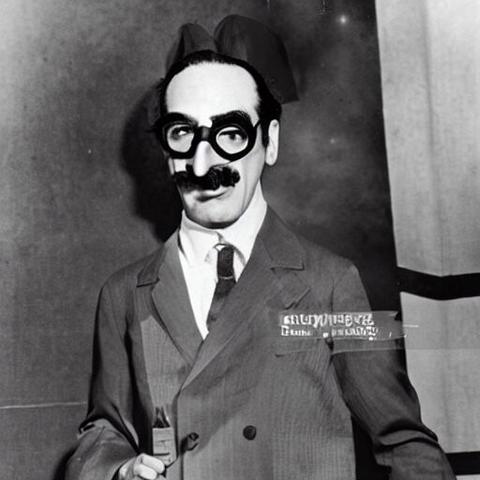
@Manigarm Then explain this prompt I made of "Groucho Marx dressed as Batman". The image is terrible, BUT you can clearly see the Getty Images watermark.
@JDWr1ghtBra1n @Manigarm isn't that simply AI with a flawed dataset. If you feed it a set of labelled data and there's a consistency such as a watermark, will it not attempt to recreate the watermark for each matching input prompt? It becomes a style to have the watermark.
@Manigarm It’s like saying that crowbars are breaking into houses.
@Manigarm Similarly, algorithms aren't flawed because they are gender or racially biased, only the unexamined assumptions of programmers can cause that.
@Manigarm Okay, but these people and institutions are still doing a shitty thing when they use the products of working artists without consent, credit or compensation to build a for-profit venture.
@PaulInRainCity Yes? That's my point. That it's people who are doing it. As opposed to framing the problem as something the AI is doing.
@Manigarm Gotcha. Think I misread part of what you said.
@PaulInRainCity @Manigarm as an artist, who has been neural network stuff since 2015, I believe that we need to move beyond the old IP paradigm. Most artists can't make a living as is. Mechanical reproduction put most of us out of work over a century ago and digital reproduction almost 2 decades ago. New paradigm is needed.

@Manigarm I find it hard to really see how AI software should credit the original artist.
As long as
1) They software company don't try to capitalize of those names, like "in the style of X".
Or
2) Actually re-create existing work.

If the AI creates truly new and unique work, how is that any different than us humans getting inspired by existing art.
I don't have to credit Hirst no matter how much I try to copy him.
It might not be considered art, but I'm perfectly free to do that.

@Manigarm you're actually missing the point that is you make a piece too derivitive of Hirst he won't hesitate to sue you to the moon & he does it to other artists quite often.

@floede @Manigarm You can, right this minute, ask an AI for art "in the style of X," and it will produce exactly that.

The extent to which they re-create X's existing work depends on (1) exactly what mathematical manipulation the algorithm does, and (2) how large the X corpus in the training dataset is.

@kewms @Manigarm Yes I know. What I meant was: they can't, or shouldn't be allowed to, use that in a commercial app.
You can't market something, using another product name, and it should be same here.

@Manigarm don't artists steal from artists? Don't artists steal daily stuff or situations and call it art?

Copy from one resource and it will be called plagiarism, copy from many and it will be called a research.

According to that, AI is doing its research and with pretty good results.

@Manigarm It's humans programming them to steal.
@Manigarm an outstanding point and a linguistic clue to attitudes and often intent.

@Manigarm

I keep thinking of Sturgeon's law:

https://en.wikipedia.org/wiki/Sturgeon's_Law

Which means we are producing automated BS artists. While it is true that this demonstrates human level intelligence, neither do I think that is worth any effort.

Unless you want to spend eternity reading Finnegan's Wake over and over agian.

Sturgeon's law - Wikipedia

@Manigarm you'd be surprised at how many people feel they can't be doing something wrong if they don't understand why.

@Manigarm

My dog ate my essay but an AI managed to borrow one from the internet for me. I plan to return it after it’s marked.

@Manigarm This is an interesting point, and certainly correct.

It's also exactly how humans learn to become artists and writers - by studying, mimicking, and eventually adding to the existing body of work. We don't generally consider that theft, unless the copying is exact or deceptive.

Yet AI feels somehow different, much more like plagiarism. Perhaps it's that the ONLY input an ML system has is others' art, with no real-world human experience of its own to contribute.

@mattblaze

In my high school arts classes, when we did reproductions of renowned art, it was known as a "Master's study" to attempt to learn, first hand, how the original creator may have gotten to an end product by attempting to mimic their output as precisely as possible.

I do not know if that nomenclature is widespread?

Steve Jobs uttering "good artist copy, great artists steal" can be attributed at least as far back as Picasso. Others cite T.S. Eliot: https://quoteinvestigator.com/2013/03/06/artists-steal/

@Manigarm

Quote Origin: Good Artists Copy; Great Artists Steal – Quote InvestigatorĀ®

@Manigarm I think part of it is that we expect art and literature to have a creator, an actual person whose work expresses a human point of view, one that encompasses something beyond the literal work itself. By lacking an author who stands behind it, is AI-generated art somehow inherently fraudulent? Maybe.
@Manigarm Is the person who runs an AI-based art generator and selects which ones are "good" any less an artist than Duchamp with his readymades?

@Manigarm It seems relevant that similar discussions seem to have occurred throughout history every time a new artistic medium is introduced, especially those involving some kind of automation.

Is photography art? What about music played on synthesizers? Acrylic paints? And so on. Much impassioned hand-wringing about the "end of art" with all of these, all of it seeming very silly in retrospect.

@Manigarm Anyway, my apologies for responding with a long thread of thoughts. I didn't want to hijack your interesting and important point.
@mattblaze @Manigarm And photography was once (and sometimes still) thought of as not art, since the camera did all the work.
AI is a medium, just like oil paint, bronze sculpture, photography, and many, many more.

@mattblaze @Manigarm

I'm only mostly comfortable saying that someone who writes his name on a urinal is not thereby making art.

I'm ENTIRELY comfortable saying that someone who commissions an artist to make a bunch of pictures is not the one making art, and that this doesn't change if you replace the (actual) artist with a machine.

@byterhymer Didn't the Steve Jobs version of that aphorism famously end, at least by implication, with "but not from me"?

I also think the comparison to training an AI and human learning, while somewhat clever, ultimately misses the mark. A human studying the old masters (or any other source of inspiration) is making conscious decisions about what to emulate.

They're not making a spreadsheet of every element of every artwork they've ever seen and picking out the elements with the strongest statistical correlation with keywords they were given.

@linebyline @Manigarm @byterhymer A film director doesn't generally directly do any of the things involved in making a movie. They just tell others what to do. Yet we generally consider the director to be the principal artist of a film.
@mattblaze Of course, the extent to which that is actually true varies wildly. In cases where it's warranted, the director is actually providing creative direction (hence the name) beyond just punching in a list of keywords and picking which completed movie they like best.
@mattblaze @linebyline @Manigarm @byterhymer That might be because with film, like with symphonies, the impact of the whole stands or falls with unity, direction, overall arc, rhythm and tensions. So much is not just in the action, but also in combining it on the cutting table and with soundtracks. The orchestra conductor combines it with that extra pause, the invitation to share a deeper well. They're teams with relationships. They're co-creating.

@mattblaze @Manigarm I think photography is another useful reference--the photographer doesn't create the imagery they capture from nothing, but they choose what to photograph, tuning parameters of the camera (which they probably didn't build either), making tweaks to an image after the fact, etc.

We don't have as much trouble assigning a creator in those instances--are the AI designers like the camera makers? are the images input into the model like the made objects that appear in a photo?

@zalcarik @Manigarm Yes, I think photography is a good example. When I make a photograph (and I use the word "make" quite deliberately instead of "take"), I'm trying to produce art. We can argue about whether it's good art or bad, but there's no longer any serious question, here in the 21st century, done with intention, that photographs can be art.

Why is selecting the input and curating the output of an AI system any different?

@zalcarik @Manigarm @mattblaze because the input sources are different - with a camera, you have to find or make something to aim the camera at; with AI generation, you’re amalgamating the set of training images (which were already found and/or made by other people). If you want to treat them similarly, AI generation should follow the same rules about including others’ work in the training set, and at best we don’t have documentation of that being the case
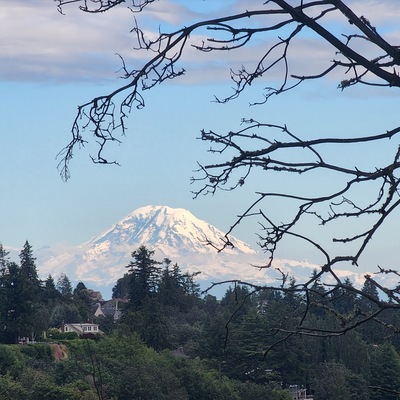
@ShadSterling @mattblaze Suppose I want a photograph of, say, a mountain framed by tree branches. I could look at parks on google, see other people have taken such photographs at a specific place, go to the park, and take my own photograph. I had to find something, sure, but I used other people to do that--nothing I found hadn't, in it's general nature, not been found before. My photograph will still be different, influenced by my own actions but also the random vagaries of nature.
@ShadSterling That strikes me as fairly analogous to asking the AI for a "picture of a mountain framed by tree branches"--what it produces will be influenced by what came before, but the random nature of what it shows to me will be unique, and I retain an ability to curate and fiddle with the results it presents to me. (Certainly as it pertains to my own participation and authorship in the process)
@zalcarik but the AI can’t take a picture of the real world, all it can do is create derivative works based on the pictures in its dataset. It’s more analogous to you overlaying existing images and adjusting the result by tuning how strongly each appears in the result - and claiming that image is originally yours without crediting the creators of the existing images. And it wouldn’t include any actual change in the view from the park, as a new picture on site would

@ShadSterling I think that's a common misconception, these AI models almost never work in a way analogous to that. To carry on the analogy about finding a photo spot (where "I" am acting like the AI now), it would be if I looked at the google image results to learn what the place looked like, then stepped over to a canvas and painted a picture of what I remembered.

A novel work is being created, but yes also one that is intrinsically derivative of the work of others.

@ShadSterling But that's pretty on par with what human artists need to do. Consider not the scenic photo spot, but instead something like a dragon--there's no real-world example an AI or human could draw from, they need to make reference to existing art.

I think that's all still mostly tangential to the issue of authorship and creative/artistic input. The AI/camera are backboxes, that take inputs and allow for creative input in turning those inputs to outputs.

@zalcarik it’s more elaborate than my analogy, but that doesn’t make it not analogous; the best introview I’ve seen is https://youtu.be/1CIpzeNxIhU . There’s no experience, no context, no story, no mental model of growth or movement or weather, just numerical calculation with a large number of tuning parameters set by the prompt.
How AI Image Generators Work (Stable Diffusion / Dall-E) - Computerphile

YouTube
@zalcarik If you were to paint a branch, you would draw on a lifetime of seeing them in trees and on the ground, picking them up, maybe building things with them, maybe whittling them and so on. You have mental models of how they grow, how they bend, the different between wet and dry, maybe differences between different plants, and so on. Far more than could be encoded in images alone, or be included in this kind of AI
@zalcarik if you were to paint a dragon, you might not have the same experience, but you could have in mind a mental model of how a dragon physically moves, of its skeleton and muscles and mind, of the physics of flight, and beyond that of the context of the picture, the story in which the dragon lives, and who else lives there. I’ve never heard of any AI coming anywhere near that kind of creative process
@zalcarik All these AIs can work with is the training data. Anything recognizable in their output is a result of deriving it from the training data and nothing else. And you can see that in the parts of the images that don’t make sense. We could be creating these as tools for artists, to expand art, figuring out how to share credit (and payments) between the creators of the training images and the prompt writers, treating them like the collaborations they are, but that’s not what we’re doing
@zalcarik (ā€œintroviewā€ came from indecision between ā€œintroductionā€ and ā€œoverviewā€, but I kindof like it)