Further thoughts on today's argument in 303 Creative case, which involves a website company that claims a constitutional right to decline to provide wedding websites to same-sex couples while providing to opposite-sex couples.

• Conventional wisdom going into arg. was that 303 Creative would prevail, with uncertainty about (a) how broad ruling would be, and (b) whether it would be 6-3 or 5-4. Strongest indication CW was right? CJ Roberts' narrow (mis)reading of his own maj. opinion in FAIR.

1/
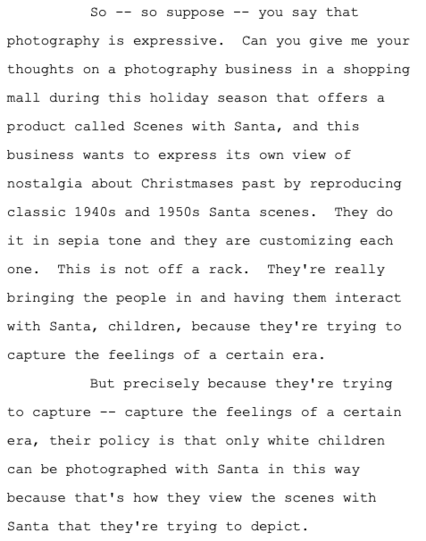
• Uncertainty remains after argument as to how broad ruling will be, but I suspect post-argument CW will be that 303 is likely to win 6-3.

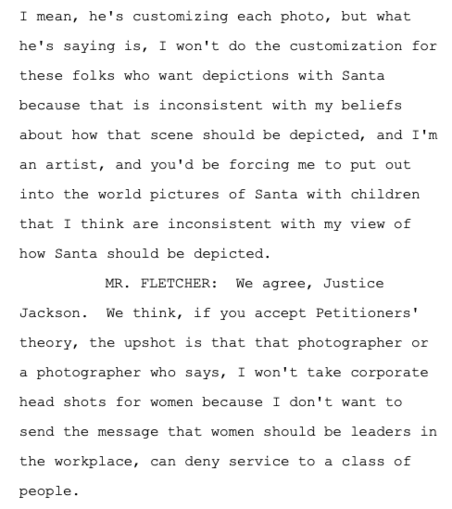
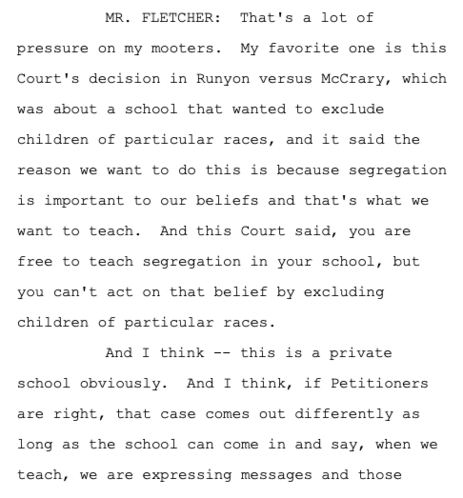
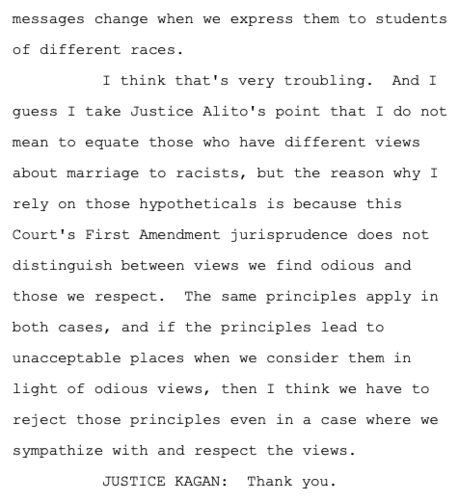
• That said, U.S. Deputy SG Brian Fletcher was was stellar in support of Colorado, and the hypos he and Justice Jackson raised (see screenshots below) present real problems for Court ruling for 303.

• Also, counsel for 303 offered very broad arguments, and I suspect JR/BK/ACB will be looking to write narrower opinion(s).

2/

• At opening of Colorado SG's argument, Justice Thomas asked if there was precedent for nondiscrimination law being applied in manner that would impact expressive activities. Best answer was given by US Deputy SG Fletcher toward end of his argument - Runyon - and Fletcher also very nicely pivoted to addressing Justice Alito's race-is-different argument by pointing out that "this Court's First Amendment jurisprudence does not distinguish between views we find odious and those we respect."

3/

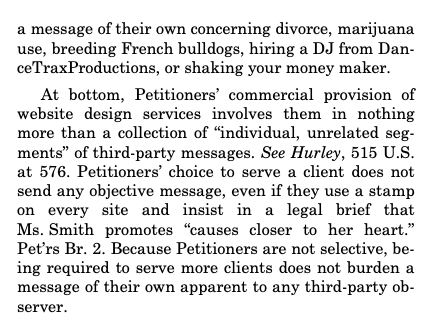
• Two key issues that warranted more attention than they received today are (1) role of selectivity in determining whether vendor's provision of service is sending their own message or the customer's message, and (2) the role of third-party perception. Justice Alito asked questions about former, and Justice Jackson about the latter, but I don't recall anyone discussing how the two issues interact, which we do on pages 6-15 of this brief: https://www.supremecourt.gov/DocketPDF/21/21-476/234068/20220819151646685_303%20amicus%208.19.22%20CLEAN.pdf

4/

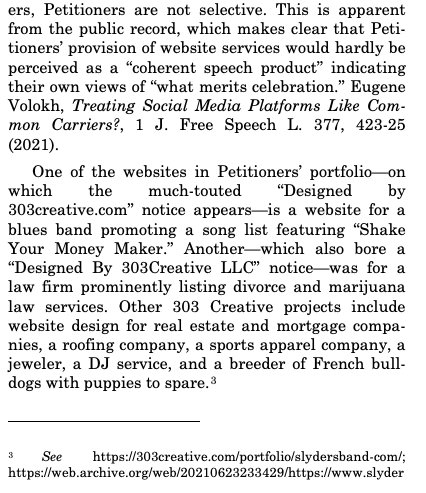
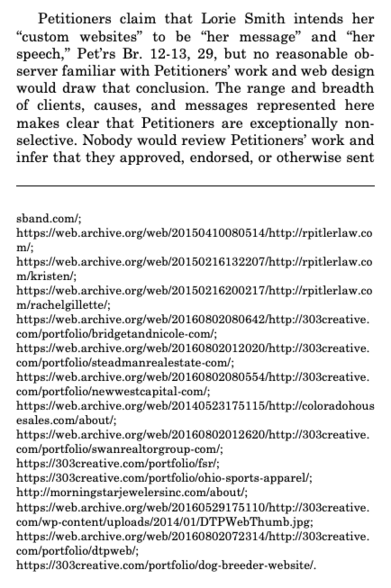
• The lack of factual development in the case record was referenced several times during argument today, but absent was any discussion of the public record, which shows that much of 303 Creative's website work is inconsistent with its claim that every website it designs expresses its *own* message or endorsement, as we explained in our brief: https://supremecourt.gov/DocketPDF/21/21-476/234068/20220819151646685_303%20amicus%208.19.22%20CLEAN.pdf

5/

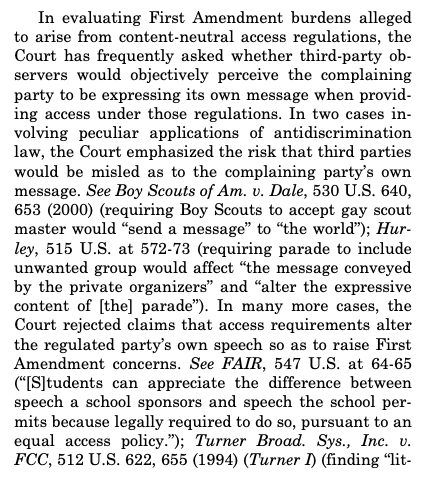
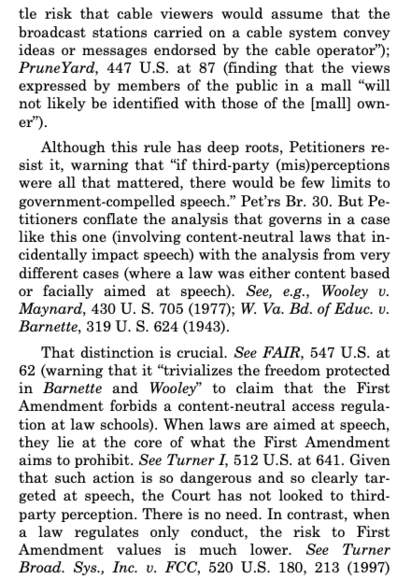
• ADF recognizes this problem, which is why it resists the objective test that looks to 3rd-party perception of vendor's service and whether it sends vendor's own message.

But as we point out in our brief, the Court has consistently looked to 3rd-party perception in incidental-burden/compelled speech cases:

6/end

#303Creative #SCOTUS #SupremeCourt #FreeSpeech #Speech #FirstAmendment #LGBTQ #Equality #CivilRights