 Fannyi
 John Ross
The only way this makes any sense is to assume that the US healthcare system was designed to make money, and not to take care of patients
@flakmagnet @johnrossmd True. For those who don't know, part-time employers don't pay benefits (health care, social security). There's ppl working 2 part-time jobs, often in the same franchise, bc they won't get hired full-time.
There are employers paying starvation wages instructing their employees how to get public assistance. Taxpayers subsidizing corporate greed.
Healthcare is not a system. It's a market.
1/
@johnrossmd Your friendly reminder that #TheSoCalledUSHealthCareSystem - the wedding of health insurance to employment benefits - was founded to suppress worker wages during wartime.
Our system originated quite literally in giving business interests leverage in the market for labor, and they subsequently took it and ran with it. Since then all sorts of profit (and political) motives have brought other interests in like sharks smelling blood in the water.
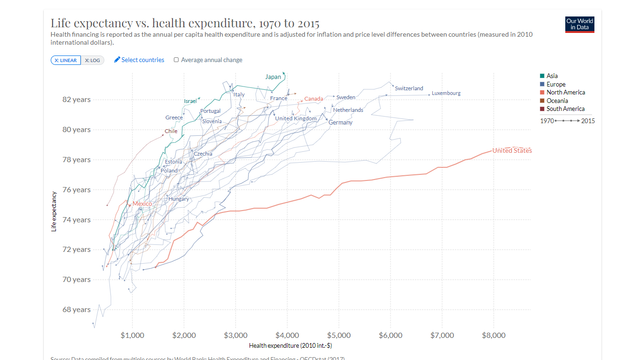
The US pays more healthcare dollars per capita than any other industrialized nation, has a low life expectancy, has a higher infant mortality, and not all citizens have health insurance!
This is insane.
My only conclusion is that once one lives in a broken house long enough, the they forget what needs to be fixed.
The US is profoundly wealthy, as a nation, there is no moral or economic justification for not have a society funded healthcare system for all.
@johnrossmd Hmmm...
I would have said it is intended to make money. It cares for patients when that is a means to that end. What it is not designed to do is to improve population health.
@johnrossmd Or, explain network discounts, preapprovals, geographic treatment differentials (like Caesarians). Complete lack of public health, and toleration of health inequities with no universal care.
OTOH, when Mexico and Slovenia are cleaning our clock, you would *think* someone would find that to be a rectifiable problem.
 Dr. Rebecca
 progenetix
 mbaudis
 GLW
GLW Steve Anderson
 Flakmagnet
 FearlessJuan
 John Swayne MD
 LynneJones
 John M Flores
 Siderea, Sibylla Bostoniensis
 Robert DeWolfe 🌹
 Stargeezer Smith
 WTF
WTF CarrieJL
 Karl Morant 🇨🇦
  🖖
🖖 Bill Gardner
 WndlB
WndlB Jasper Jenkins👵✡️♌️🇺🇲🇺🇦
 Aatos Lehtila
 LindaNYC2VT Ⓥ 🌊🐖🐄🐓🦃🐬🐝🦋🦇