 Josh Braun
I've seen plenty of discussions in recent days over the network structure of Mastodon and whether it can remain decentralized as large commercial players begin taking an interest in the fediverse. I am neither an engineer nor an economist, but I do research the way media and information get distributed and I have some thoughts on this. A thread…
Matthew Hindman, in his book "The Internet Trap" <http://assets.press.princeton.edu/chapters/s13236.pdf>, notes that most research on the internet has focused on its supposedly decentralized nature, leaving us with little language to really grapple with the concentrated, oligopolistic state of today's online economy, where the vast majority of attention and revenue accrue to a tiny number of companies. 1/
This is a really nice observation. While it's true that the research on concentration in new media is laggy, I'd suggest it's useful here to look to the political economy and material realities of previous communication systems. In particular, there are a number of important dynamics that have historically tended to shape the organization of telecommunication networks that have interesting implications for Mastodon. 2/
To start with, consider the physical infrastructure of older point-to-point communication networks like the telegraph and telephone. Economies of scale for these networks work in an entirely different fashion than in industries, like retail or manufacturing, that come most readily to mind when considering how markets work. 3/
To wit, if you run a traditional business where you make a product—ice cream, say—economies of scale work in your favor. As you produce more ice cream, you can drive down the production cost per unit by negotiating better rates with your suppliers, who'll charge you less for milk and sugar if they know you're going to buy in bulk. 4/
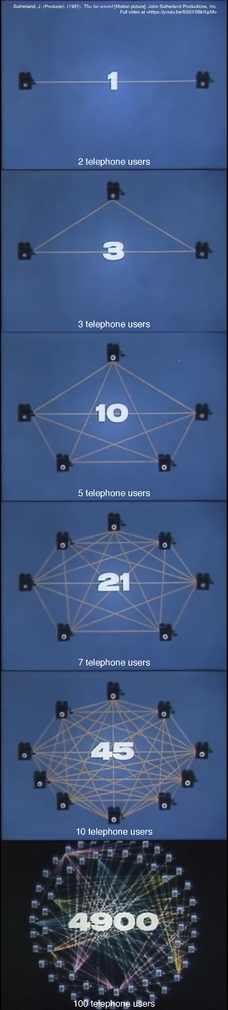
If you run a telephone network, on the other hand, your costs go up faster as you sign up new subscribers. That's because the infrastructure necessary to connect all these people scales quadratically. To see what I mean, take a look at these stills from "The Far Sound," and old film about the Bell system: 5/
Edit: Fixed wrong word choice. Thanks to those who noticed.
 IdiotBird
@josh I'm having trouble finding this in the '73 AT&T "The Far Sound" are you sure it came from there? Additionally, this is not an accurate representation of the telephone network as the telephone network is hierarchically switched, not mesh. Because of this, the assertions about how telecom networks scale are wrong: problems of scale are managed through hierarchical switching systems in which higher level exchanges (higher level switches aggregating connectivity to keep low-demand, high-cost circuits at manageable levels). It's also worth noting that all this telephony is at a higher level of abstraction than the physical layer (which has its own hierarchical structure) you seem to be reasoning about here. I think you need more knowledge of telecommunications to use this analogy effectively to reason about other phenomena.
 Peter
Peter@IdiotBird @josh it’s from The Far Sound, on AT&T’s YouTube channel. (https://youtu.be/SS5X5BkIKpM) The video isn’t saying that the telephone network connects all users via point-to-point circuits (of course), it’s illustrating why they route traffic through COs.
