 Kevin Larsen 📚
#success #twittermigration #twitterexodus #Mastodon #inspiration
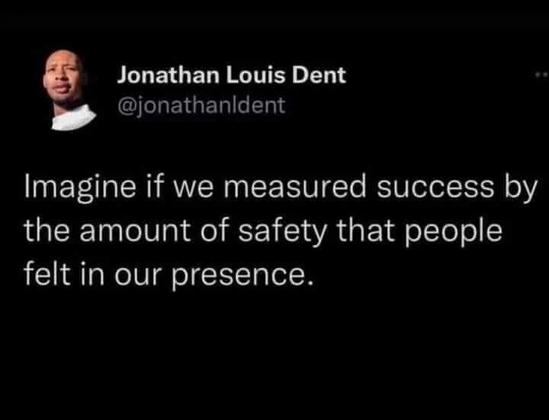
"Imagine if we measured success by the amount of safety that people felt in our presence."
#success #twittermigration #twitterexodus #Mastodon #inspiration
"Imagine if we measured success by the amount of safety that people felt in our presence."
@kevlarsen I find this meme quite disturbing for two reasons.
First, I frequently call people to question their values and what they thought they trusted. I make people feel less safe by calling what they felt was safe into question.
Second, racists make other racists feel safe by keeping those "colored folks" in their place.
Neither of these is what we're after.
@longobord @kevlarsen
I'm curious about two things:
1. How are you defining 'success' because the meme obviously doesn't define it and depending on the definition 'success' could be a good thing or a bad thing
2. When you say you call people to question their values, do you mean you're challenging their assumptions/world view and pushing them out of their comfort zone?
I think there's a key difference between feeling safe and feeling comfortable. If you're safe you can still be uncomfortable.
@longobord @kevlarsen I'd encourage everyone (White people especially) to be uncomfortable but to try and provide safety to those who are marginalized or those who have never known safety.
Safety allows for growth and development. Discomfort requires education and adjustment and hopefully leads to enlightenment.
@kevlarsen @longobord
I'm not a psychologist, but I consider 'being safe' as relating to psychological and emotional safety, while 'being comfortable' has more to do with being in a context that supports you.
Safe spaces can and should be both a place where one feels psychologically safe and contextually accepted.
On the other hand a Skinhead could be in a safe space with like-minded individuals and be comfortable that what spews from their mouth will be met with acceptance.
@kevlarsen @longobord
Nearly everyone has a safe space by themselves or with others where they feel accepted and comfortable.
In conversations about race White people invariably steer the conversation into a context in which they feel comfortable. It's not exclusive to White people, but it's the predominant problem in conversations about race.
Just the notion, the words, 'White Fragility' puts folks on the defensive saying anything to bring the context back to a place they feel comfortable.
@kevlarsen
Good article but didn't explain how hiding conversation about race behind a trigger warning is anything more than protecting White feelings.
In fact it seems to be the very silencing the article talks about and so I find it ironic.
@kevlarsen I'm saying the author is not arguing to keep White people comfortable. She's exclaiming how every time marginalized people - specifically Black people in her case - speak truth to power they are silenced.
Do you not see the problem of hiding discussions of race and racism behind a content warning? Who is it protecting? Black people want, indeed NEED White people to talk about race.
What if I am Black? Does the content warning not silence me?
(Spoiler Alert: I'm not, but it would.)
@kevlarsen Oh good. We're on the same page then. The trigger warning is for White people, not marginalized people.
I have seen the 'go find your own instance' remarks and it's demeaning and degrading.
What it's really saying is, 'You're not welcome here. Go away!'
While it's possible for such instances to exist (and perhaps they do), it's nothing short of blatant racism and division. Twitter-that-was had its problems but it gave a voice to marginalized people. Mastodon is failing to do that.
 Christie Dudley
 MagnaCorpus
