 Rob
Rob Gynvael Coldwind 🐈
Added two more to my list.
tags: #programming #programminglanguages #python #javascript #cpp #c
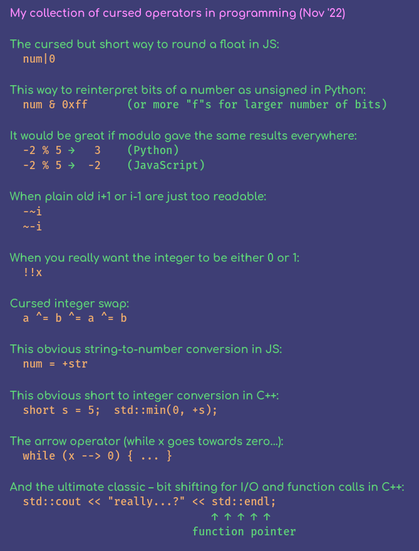
Added two more to my list.
tags: #programming #programminglanguages #python #javascript #cpp #c
@gynvael wat
i thought std::endl was a platform dependent constant??
@meena In all honesty that's what I thought as well for years! Then, when I was writing some article or something, I wanted to find the exact definition in the headers... and found a function.
After checking in the standard's draft (http://eel.is/c++draft/ostream.manip#2) it turned out that apart from this being a platform specific constant, it also does a flush() 🤷
@probably Yeah, TBH I use it as well. It has however a nasty side effect - it also truncates numbers number to a 32-bit integer value (even though JS's number type can store integers safely to around 2**53ish).
0x7fffffff|0
2147483647
(0x7fffffff+1)|0
-2147483648
(0x100000000)|0
0

 Tamir Bahar
 MkayBoomer
 Mina
Mina Miły Gość