
The biggest mistake web devs ever made was focusing on corporate-owned APIs instead of on new and innovative open protocols.

I don't care how all-encompassing Big Social becomes -- or whether Google or Apple can keep their market valuations ongoing.

Those "critical" APIs can be yoinked at any moment.

However, SMTP and HTTP have now been used for decades. So why not build on the next generation of open protocols?

Also, when Twitter yoinked API access from 3rd party developers, that convinced VCs that continuing a bait-and-switch with APIs was lucrative.

That they could fund the next potential monopoly.

The result was competing walled gardens -- and that has hindered the Internet's development, perhaps set it back for decades.

People often forget that a core selling point of Web 2.0 was interoperability.

Yay! You could embed! You could build plug-ins and themes!

But so much of it was a mirage because too much of Web 2.0 was built off corporate-owned APIs instead of open protocols.

As long as I'm talking about the value of open protocols, I might as well give a shout-out to @[email protected] -- who co-authored #ActivityPub and is working on #Spritely.
@atomicpoet @cwebber I am not sure if you are asking us but we were just pointing out that @spritelyinst are here too since you didn't @ them. We presumed you forgot.
@atomicpoet There was a brief moment where it felt like that would turn over and we’d start building interoperable protocols, but then investors saw $$$ and ruined it.
@ramsey Yep! Investors didn't want interoperability. They wanted monopolies.
@atomicpoet oh boy, I do remember the promise of "website mashups" and I didn't believe it for a second...
@hisham_hm Thank you for remembering what I'm talking about!
@atomicpoet this is really visible in how the material infrastructure of the internet has developed since the end of the dot-com bust. Web2.0 is really just a tool for geopolitics but the decentralized Web3 and WebBlue projects have experienced painfully slow starts.
@atomicpoet I hardcore remember that much of this was tied to XML specs as well for grandiose visions of "web graffiti" and "content mashups". Instead we got walled gardens.
@atomicpoet just thinking about the Dark Sky API bait-and-switch 😭
@dmitry @atomicpoet yes that sucked. I really enjoyed dark sky.
@atomicpoet So … are there new protocols coming? Why do we need them? I agree with you 100% about corporate APIs. But those corporate APIs worked over HTTPS, right?

@negative12dollarbill There are new protocols coming. You need them for your long term survival.

And sure, those corporate APIs worked over HTTPS, but that doesn't mean that you should build your company on someone else's APIs.

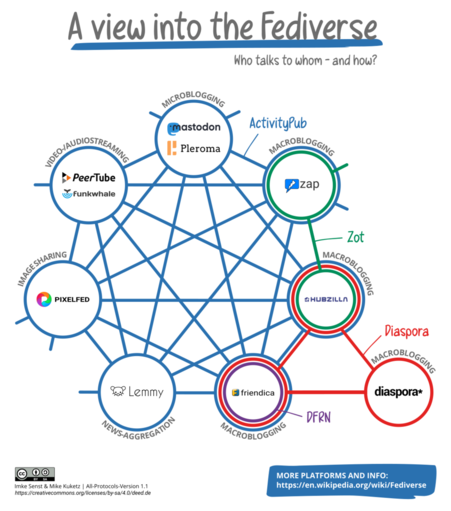
@atomicpoet what are the next generation of open protocols - the ones underlying the fediverse? Or do you have others in mind?
@PlaneSailingGames Here's a helpful chart.

@atomicpoet thanks! and ActivityPub is the protocol which glues it all together?

https://www.w3.org/TR/activitypub/

ActivityPub

The ActivityPub protocol is a decentralized social networking protocol based upon the [ActivityStreams] 2.0 data format. It provides a client to server API for creating, updating and deleting content, as well as a federated server to server API for delivering notifications and content.

@atomicpoet New player (microbloging/news aggregation) - https://kbin.pub :)

The main, English-speaking instance will be built soon...

@PlaneSailingGames

Home | kbin.pub - Fediverse of content

@atomicpoet @PlaneSailingGames меня если честно напрягает то, что все пытаются выбрать именно activitypub: федивёрс вокруг одного протокола – весьма опасно как по мне

Но кредит доверия большой, жду и надеюсь
@PlaneSailingGames There is also matrix <https://matrix.org/>. Mostly used for instant messaging, but capable of much more.
@atomicpoet
Writing and publishing content

Matrix is an open standard for interoperable, decentralised, real-time communication

Matrix.org
@atomicpoet Totally! I've been teaching my friends to go back to email for comms since it's the only messaging system that isn't designed to screw people over (and is built into every device).. and lots of other reasons here: https://bookofadamz.com/the-smartest-messaging-method-is-not-a-segregated-mess-of-whatsapp-signal-telegram-sms-slack-teams-facebook-instagram-wechat-etc/
@atomicpoet the value lies in the data/functionality behind the APIs though. Wouldn’t focusing on protocols just see them adopted by big tech to wall garden the same way as they do any HTTP API?

@secretlyextrovert My concern isn't about whether or not Big Tech will adopt open protocols -- that should just be assumed.

My concern is about the long term viability of Internet tech, as well as the future long term success of a web dev's career.

Once a protocol is open, access can't be taken from you.

@atomicpoet in my personal experience, having something like “integrated with Twitter api to do XYZ” on your CV is going to hold more sway than “working with some bleeding edge protocol”.

I don’t think im getting you though. You say the protocol can’t be taken away - that’s not what companies are doing though? The likes of Twitter have deprecated access to the data…

@secretlyextrovert But I was around when Twitter pretty much did their big API yoink. Lots of colleagues lost their livelihoods over night.

I was one of the lucky ones in that the software I helped build was too popular to kill.

Furthermore, now that I've come out the other side, I don't care if you've integrated Twitter's API because I'm thinking about the future.

And to be completely frank, Twitter is not the future.

@atomicpoet it's kinda crazy how lot's of enterprise software actually is based on free software. But then companies add just enough tiny features to sell it and voilà: vendor lock.
All the database systems are like this, or even Android
@onterof Yeah, this is one reason why the AGPL is so important as a license.

@onterof @atomicpoet

I'm not sure in these cases that it is so much the _software_ being sold, more that a service is being sold that makes use of the software (i.e. AWS using MariaDB in RDS etc.) where modifications and improvements are not ported back to the source tree.

@atomicpoet Don't worry, Google has written replacements for TCP and HTTP too so they can control that too. (Google has de facto complete control of PKI.)

@atomicpoet What makes a protocol open? Is it just longevity?

I can see an alternate timeline where Twitter adopted ActivityPub and then dropped support for it later and the end result would've been the same. Similarly, I can see one where another website came with a Twitter API compatibility and it wouldn't have made a dent.

It was Twitter's popularity gave it power, not the fact their API wasn't open.

@fstanis Sure, we've seen plenty of examples of embrace, extend, extinguish.

But even when a protocol like RSS is "extinguished", it still lives on to be nurtured by the next generation of developers.

Anyway, the alternate timeline you mention doesn't exist. Had it existed, developers would still have the ability to build on top of ActivityPub.

You forget one detail. It was 3rd party developers who built Twitter's popularity—not the other way around. Twitter didn't build its mobile clients.

@atomicpoet 🤣 a tremendous amount of data is still just going via sftp. No 20 something technology in sight 😀 just plain csv style exports
@atomicpoet Agreed, I was thinking about this today, and of all the open (communications) protocols I've used - from SMTP to IRC and beyond - that are all still in use today. Long live open standards!

@atomicpoet Was it really every up to webdevs?

Business incentives often will have large sway on what webdevs (as employees) will prioritise. So unless there's a business incentive to go with an open protocol it's likely not going to be priority among employed devs.

I'd love to see it, but the preference of large businesses to favour protocols that reinforce their own leverage is a predictable outcome.

@atomicpoet In the short term, it often looks like the open web is losing.

In the long run, however, we see over and over again that open standards and open protocols win. That's not to say there aren't emerging threats to come. But we can feel confident that the open web will remain resilient.

@atomicpoet

The correct solution is dismantling capitalism, the short term is a regulatory system requiring interoperability.

@atomicpoet I wouldn’t call it a “mistake” so much as a sad necessity. Corporate-owned APIs are what pay, and if you live under capitalism…

@SarahGiffrow I'm going to challenge you on this one because I work in this industry too. Corporate-owned APIs are what pay, but they're also a good reason for you to no longer be paid.

Open protocols allow *you* better options.

@atomicpoet I’d agree that it does offer more options in the long run. But, that future can feel impossibly far off when you need a way to cover your most basic needs right now.

There are certainly those who both do the paying job and contribute to open source, and then they’re faced with the problem of how to do both without burning themselves out.

Not saying it isn’t possible to do, by any means! But I also understand why some folks just take the easy paycheck.

@atomicpoet It’s also worth looking at whether the open source project you’re using is vulnerable to a single big corp losing interest. Projects with genuine community support from a variety of contributors are a much safer bet long term.
@atomicpoet interesting perspective. From a technical side I think of SMTP and to a lesser extent HTTP as problematic; but isn’t an api just rest over http?
@Tedspence I agree that both protocols have problems. But that's another topic for another day.
@atomicpoet lots of people would love to. Making it financially sustainable is the challenge.
@atomicpoet so true. Good thinking!
@atomicpoet thank you for this. Open standards for interoperability is the way.
@atomicpoet Eso que comentas me ha hecho recordar esta frase: "I skate to where the puck is going to be, not where it has been" - Wayne Gretzky.
@atomicpoet @tilton SMTP and IMAP in particular need a massive authentication overhaul. :|
@Kyreeth @atomicpoet @tilton JMAP is being developed as replacement if both SMTP and IMAP.
@nerdbear @atomicpoet @tilton Doesn’t do that much to fix the auth issue. SASL is at least extensible, but SCRAM is probably only good for desktops? Seems like it would be rather power-hungry for mobile when configured to be suitably strong.
@Kyreeth @atomicpoet @tilton I’m not so familiar with the internals but they do claim to target mobile devices especially through push support.
@atomicpoet I agree that whenever there is a choice, we should tend to open protocols. My company wanted me to implement a propietary protocol for a client data exchange and I convinced them that REST/json would be a much better alternative
@atomicpoet Another big mistake: corporate cloud storage instead of transparent device-to-device sync (e.g. SyncThing, which unfortunately isn’t completely transparent in iOS).
@atomicpoet

Big tech does one thing that makes a huge difference: they're developer friendly. They lower the learning curve by providing easy to understand documentation, videos, examples, hosting boot camps etc. That's the primary reason why every single silliest website today simply must have Google Analytics, Facebook SDK and Google Tag Manager, use JQuery from a CDN even if it makes it absurdly inflated in relation to the actual content and slower to load. You have then to unteach web devs these patterns they learned in their early stages, which is not easy.