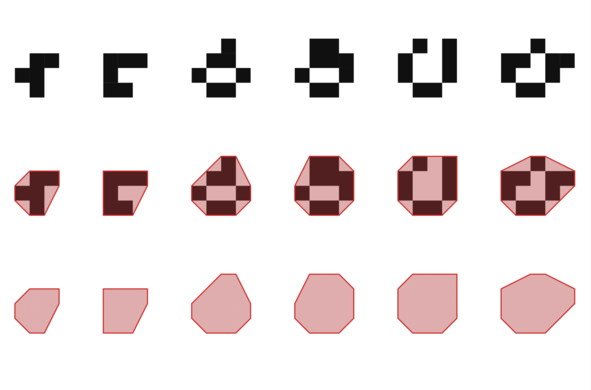
Idle aesthetic math thought just now: rendering Conway's Life automata as convex hulls of cell clusters instead of as the cell clusters themselves.

For example, the four frames of a glider.
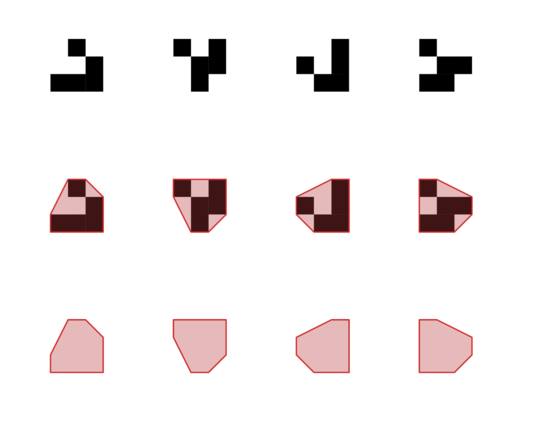
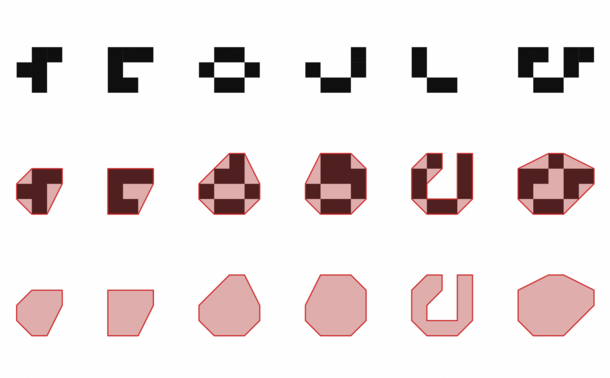
Here's the same treatment for the first six steps of the famously unruly r pentomino
There's other variations that might be more visually interesting (or at least more varied: what if instead of doing a strict convex hull you did a sort of shrinkwrap maneuver (there is probably a good bit of math jargon for this but I have no idea) such that pieces like the fifth step of the r-pentomino looked like this instead?
(Though i'm being very loose and sketchy and don't feel like I've defined a remotely consistent ruleset in my head for that last variations; why would the fifth step "U" piece shrink into the cavity like that but the second step piece wouldn't? For that matter, why wouldn't ALL the diagonal sink into tight corners? At which point instead of having any diagonals at all it'd just have flood-filled versions of the original pieces with steps 3, 4, and 6 no longer having empty cavities in the middle)
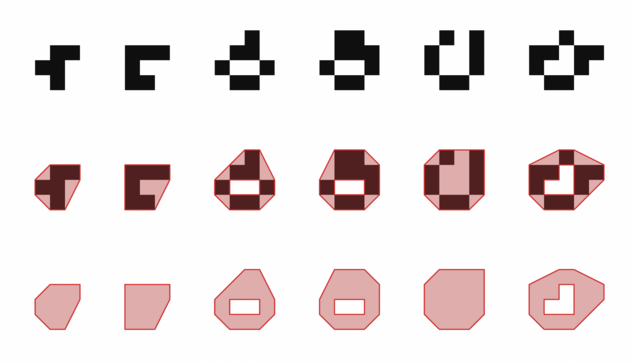
Another possible variation: convex hull but then also carve out any fully-encolosed cavities within that outer hull, like so. Though that's a little aesthetically jarring: why are we taking diagonal approaches to the exterior but returning to sharp blocky interiors?
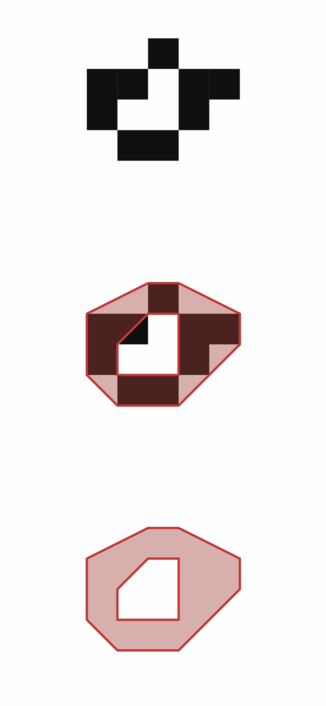
Perhaps more consistent: for those interior cavities, take the convex hull of the perimeter of the cavity itself too. This doesn't change steps 3 and 4 of the r, but for 6 we get this new diagonal that feels more in the spirit of the thing.
Anyway, I like the idea and I'm not in a spot this morning to do take the most useful next step in exploring this, which would be to add these ideas as a rendering step for an existing Life implementation. If anybody else plays around with it, let me know, I'd love to see how it plays out (and what new geometry/topology wrinkles pop up) when applied to larger and more complicated configurations.
@joshmillard To make it even less blocky, you could treat each live cell as a single point on the grid rather than a square pixel...
@mbrubeck On a tangent from that, it'd be funny to see a Life implementation that grouped contiguous clusters by like spring simulations and let them go blobby while on their subset of the grid, and only rectifying toward proper grid alignment when a cell got close to a cell of an unrelated cluster.
@joshmillard could you make it concave?
@joshmillard if convex works alternating concave / convex curves for each curve could give some squiggly results.
@joshmillard this reminds me of when I ran NES games in an emulator that tried to upscale the graphics. https://johanneskopf.de/publications/pixelart/supplementary/multi_comparison.html
Depixelizing Pixel Art