
📢 ClimateBench is out! 📢

I’m really pleased to announce that ClimateBench has now been published in JAMES: https://agupubs.onlinelibrary.wiley.com/doi/10.1029/2021MS002954

This team-effort describes the first #ML benchmark for emulating #climate models. But what does that mean…? A 🧵...
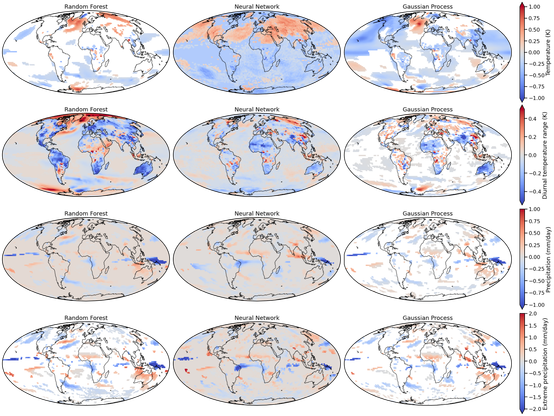
tl;dr: We used machine learning regression models trained on CMIP6 data to predict maps of temperature and (extreme) precipitation at the end of the century under unseen scenarios with excellent accuracy!
I think most people assume that we use complex climate models to try and predict the future warming under all the various different possible future emission scenarios, but this isn’t quite true...
Full complexity climate models are really expensive to run, so are usually only run for a handful of scenarios, including a low end (best case) and a high end (worst case) of emissions, and these simulations are used to fit simple energy balance models such as #FAIR
These are physically very robust (arguably more so than the full models) but only predict global mean temperature. In ClimateBench we ask: can we emulate the full spatial response of the models, and not just for temperature??
It turns out you can using a variety of machine learning techniques, and pretty well! There are the differences between the emulators and the full model but they’re mostly small

I think I broke the thread :-(

It carries on here: https://mastodon.online/@duncanwp/109308827893221490

Duncan Watson-Parris (@[email protected])

A key aspect with this approach is that we’re also able to take into account the spatial distribution of aerosol emissions, which can make a crucial difference c.f. https://www.nature.com/articles/s41558-022-01415-4

Mastodon