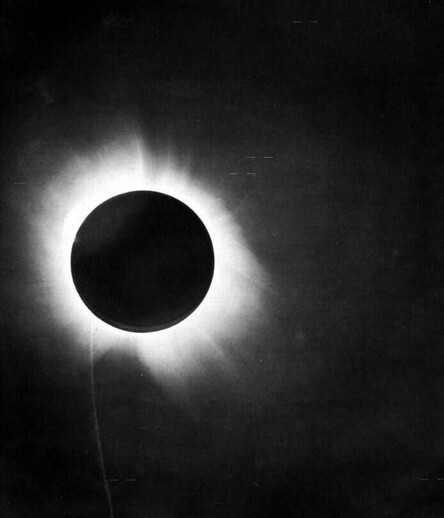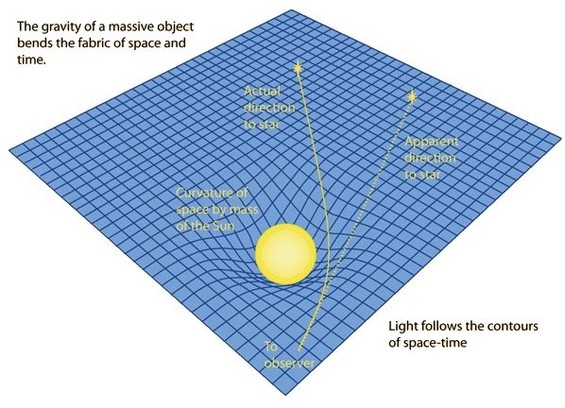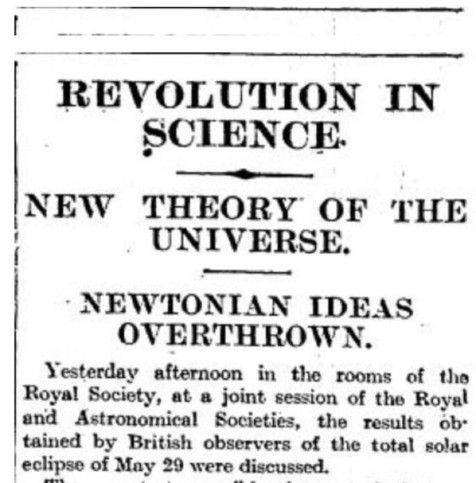
Most of the meeting's attendees, led by Eddington and Sir Frank Dyson (the Astronomer Royal), viewed these measurements as a striking confirmation of general relativity. A stubborn few, including Oliver Lodge, clung to old theories despite the new evidence.
In closing remarks at the end of the meeting, JJ Thomson said: "This is the most important result obtained in connection with the theory of gravitation since Newton's day... This result [is] one of the highest achievements of human thought."
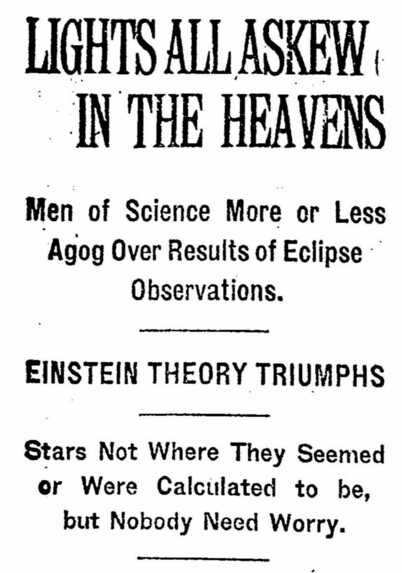
In the days following the meeting, headlines began to appear in newspapers around the world. "Lights All Askew in the Heavens," read the New York Times. "Stars Not Where They Seemed or Were Calculated to be, but Nobody Need Worry."
(Apologies for the very of-its-day gendered language in the subhed.)
Einstein embarked on a well-deserved victory tour. Scientists in almost every country celebrated the success of his radical theory.
The one exception was Germany. Most scientists there were excited by relativity and supported Einstein's work. But a few, like Lenard, were envious of Einstein. Seeing his ideas as a threat to the status of experimental physics, they exploited anti-semitism and Nationalism to sow distrust of his work.
(Lenard, of course, went on to become a high-ranking Nazi.)
There is a very funny story that Chandrasekhar told, about an encounter between Eddington and the physicist Ludwik Silberstein at a party after the meeting.
Silberstein said "Professor Eddington, you must be one of three persons in the world who understands general relativity."
This made Eddington very quiet.
"There’s no need to be modest," offered Silberstein.
“On the contrary,” said Eddington, “I am trying to think who the third person is."